

Why do we find it challenging to focus on a task sometimes?
You’re trying to finish reading an email thread so you can send a reply and be done for the day. Just one last task, and yet your mind drifts elsewhere—dinner plans, weekend errands, the clothes in the dryer, plane tickets, your in-laws, mango lassi… what is the deal with the incessant thinking in our awareness?
The mind serves up thoughts constantly as a coping mechanism. It’s solving the problem we set it to, which is, “How can I be happier compared to how I feel right now?”
Our brains have evolved to solve problems of survival and keep us alive. As the brain responds to stimuli, it is constantly gathering information about how to outrun predators and adapt to environmental changes. All of that information gets filtered through our conscious mind anytime we find the present task less than 100% enthralling and bliss-inducing (which is 99% of the time).
It’s always searching for ways to feel happier than it does right now. This pattern of overthinking is natural—our brains evolved to solve problems and ensure survival. In modern life, however, these thoughts are less about outrunning predators and more about juggling daily stressors.
But when this pattern becomes overwhelming, managing overthinking becomes essential for mental clarity and well-being.
So what can we do about incessant thinking?
First, realize that overthinking isn’t inherently “bad.” It doesn’t mean you’re not conscious or that you lack mindfulness. The body responds to inputs and stressors with thoughts.
But here’s the thing about a mind that thinks incessantly: it is not a contented mind. A truly happy and contented mind would have no need to source thoughts and reactions when they were not relevant for the need of the time.
Don’t be so hard on your mind…
We’ve all been conditioned —both by biology and modern life—to have busy, overactive minds. Add the subconscious quest for happiness, and it’s no surprise that managing overthinking feels like a constant battle.
Instead of fighting your thoughts, what if you could train your mind to naturally settle into a state of peace and clarity?
A discontented mind reflects the presence of stress.
It doesn’t mean you’re not capable of being happy. Our bodies accumulate stress each time we have a change in expectations or an overwhelming experience for our nervous system.
To be human is to experience stress when life doesn’t go as planned. But the good news? You don’t have to stay trapped in the cycle of incessant thinking.
Here are 2 ways to deal with incessant thinking:
- Try to Stop Thinking (The Hard Way). Force the mind to cancel each thought, or try to not think. If you find this challenging, you’re in good company. This is the hard way. Why? Because what we resist, persists. As soon as you say, ‘don’t think about elephants’… you’re thinking about elephants. When you command the mind to stop thinking, you’re thinking about not thinking, and how frustrating it is to be bad at not thinking.
- Give the mind what it wants: happiness. This does not refer to positive thinking. It refers to actually satisfying the mental process of searching for happiness. When we take the mind to total relaxation through meditation, it experiences happiness and bliss in a relaxed state. The mind isn’t trying to annoy you—it’s searching for happiness and fulfillment. The most effective way to manage overthinking isn’t through suppression, but by guiding the mind to a naturally blissful state. This is where Vedic meditation comes in. Instead of battling thoughts, this practice effortlessly leads the mind to deep rest and inner contentment. Through the repetition of a mantra, the mind settles into a state of unbounded awareness, where stress dissolves and incessant thinking fades away.
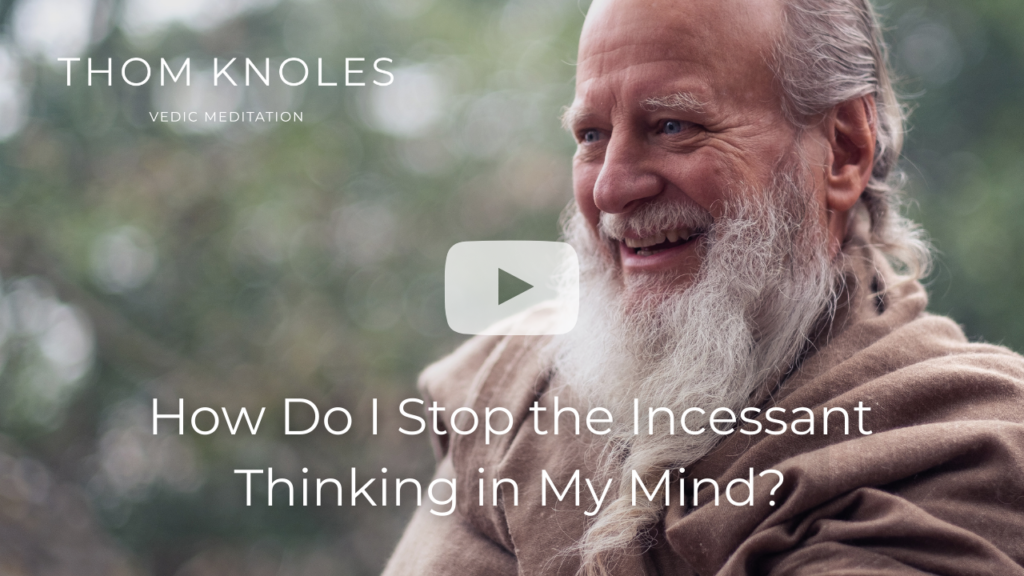
In this video, Thom talks about these 2 methods to deal with incessant thinking
Thom covers:
- Why ‘not thinking’ doesn’t work.
- How a Vedic meditation mantra naturally quiets the mind
- How experiencing deep rest in Vedic Meditation trains the mind to be happy, instead of searching for happiness.
Here is the paradigm shift:
- A contented mind will stay on any subject for as long as you want, with no concentration required.
- A busy, discontented mind cannot be forced to stop searching for what it wants through thinking. This kind of mind can never be silenced.
Instead of struggling against your thoughts, learn how to effortlessly manage overthinking through Vedic meditation. Let go of the pressure to “fix” your mind and allow it to settle naturally. Discover how Vedic meditation can help you break free from the cycle of incessant thinking. Start your journey today.
Jai Guru Deva
