
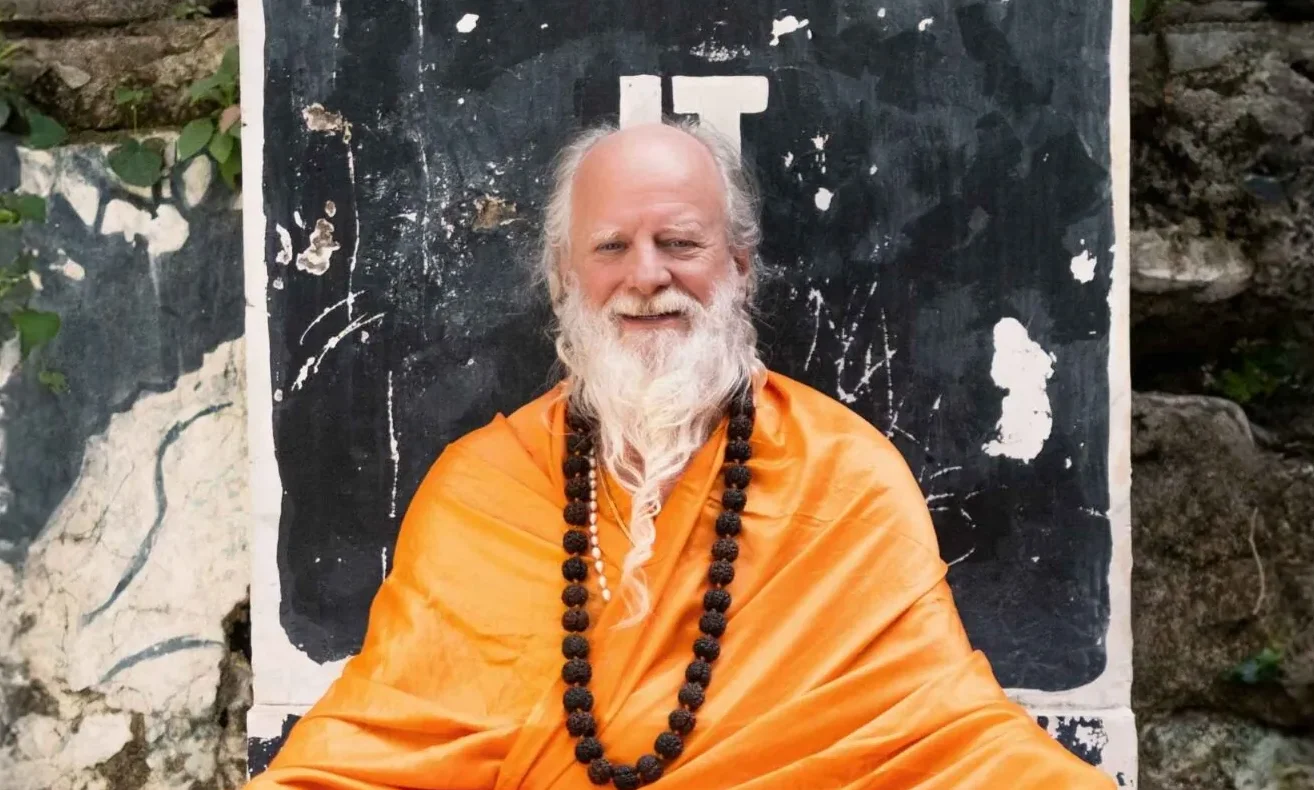
“We have to stop looking before we leap. If you can’t arrange a soft landing, just crash right into the rocks. But are you going to be okay? You’re going to be better, actually.”
Thom Knoles
Decisions can be difficult to make even at the best of times, but during times of upheaval, even more so. In this episode, Thom explains why Nature doesn’t make concessions, and that the same rules apply, whether we’re under pressure or not.
Thom describes why disruption is not necessarily a mistake in the evolutionary process, and why our search for guarantees can keep us stuck in the ever-repeating known. Drawing on the Vedic worldview, he reframes uncertainty, adaptation, and right action in a way that feels both grounded and liberating.
Listen or watch for an inspiring perspective on change, decision-making, and how to move when life stops feeling predictable.
You can also watch this episode on YouTube here: https://youtu.be/uY-HFywIDls
Episode Highlights
01.
Q – How do I make decisive change?
(00:45)
02.
A – Leap Before You Look
(01:17)
03.
Disruption Speeds Up Evolution
(04:17)
04.
When a Rashi Arrives
(07:23)
05.
Knowledge Comes From Jumping
(08:28)
06.
Meditation Without a Script
(10:48)
07.
The Unknown Is Safe
(12:23)
08.
Be Adaptive, Then Wait
(16:09)
Jai Guru Deva
Transcript
How Can We Make Decisions During Challenging Times?
[00:45] Q – How do I make decisive change?
I’m currently experiencing another rashi in my life, a wave of acute evolutionary change and disruption. I can sense within that wave opportunities and windows of time and intelligence, but I’m having trouble tuning into those opportunities and making decisions spontaneously. How do I surrender that and just tune into making right decisive change.
[01:17] A – Leap Before You Look
We have to stop looking before we leap. And, you know, “look before you leap,” old saying of how to continue having a life that’s no good. We have to leap before we look.
What stops us from spontaneous right action is our internal sense, our need to have guarantees. “Will I be guaranteed of being safe if I move this way?” Nature doesn’t work that way.
When we look at the evolutionary process, I’ve been talking a lot lately to astrobiologists about a concept, the universe as a living thing. My favorite, by the way, if you want to look her up, is Sara Walker, S-A-R-A, no H, Walker, just like it sounds. She’s got lots of YouTube videos, and she lives in my state, in Arizona, and is professor of astrobiology at Arizona State University.
So the way Sara puts it, I think is really good. There is a fundamental requirement of matter… matter also works on a principle of natural selection. How interesting? It’s not merely a biological thing. You can demonstrate in lab science, the material world of atoms, if you want to think of it as atoms, if you want it to go quantum mechanically, the material world of wave functions, actually has a requirement of assembling itself. And she calls it Assembly Theory.
[04:17] Disruption Speeds Up Evolution
The Universe is assembling itself. So let’s talk about that in another word that we’re used to, which is evolution. It’s moving from less sophisticated forms and structures and becoming more complex forms and structures in aid of what? It wants to make the jump into a nervous system, into living things.
A nervous system might be, you know, a biofilm to start with, meaning cellular matter. But there’s some point at which atoms and molecules are no longer merely atoms and molecules, they’ve assembled enough complexity that they move into being living things. So abiogenesis is the name of that phenomenon, from non-bio to bio.
And when you look at how The Universe is doing its natural selection, it has a requirement for forward movement, if we want to give it a direction, into greater complexity. And in order for it to really, for any form or any system, if you take a snapshot of a particular region, a human being could be a region or a biosphere like the Earth could be a region of this evolutionary process occurring, if the process has a regulated, steady state of evolving, going through its own change without disruption, it’s not evolving fast enough to meet the standard of the whole.
What happens is the whole will organize disruption. What does disruption do? When you disrupt the steady state, adaptive forms and functions begin to appear, and the evolution will usually take a different direction. It’ll go in a different direction, but it will begin producing forms and functions that cause evolution to happen more quickly. But it’s not going to evolve in a straight line, it’s going to go off at an angle somewhere.
So think of 60, 70, million years ago. I don’t have the exact number in my head, so forgive that, don’t hold me to that, when the giant meteorite impacted the Yucatan Peninsula and wiped out, on Earth, something like 90% of all existing species, except our ancestors.
You know, the big stomping dinosaurs that you see in Jurassic Park movie were the rulers of the domain at the time, and there was a steady forward state of evolution in the reptilian world. Our ancestors, little furry critters, we’re not to a hundred percent sure what they looked like, but we’re pretty sure they had four legs, were zooming around underneath the feet of the Tyrannosaurus Rex’s and the Brontosauri and whatnot, watching out for those Velociraptors, and life was pretty hard for our ancestors.
And then, kaboom, and almost all the giant reptiles, anyway, the ones that couldn’t fly, were wiped out, and our ancestors suddenly took off at an angle, and move forward 60, 70, 80, million years, and we’ve got iPhones, and we’re texting revenge Instagrams to each other and things.
[07:23] When a Rashi Arrives
So our idea about what is it that’s going to comprise evolution, having some kind of a thought about, “I know where I want my evolution to go. I can feel a big change coming,” that’s that Sanskrit word, rashi, that you used. For other people to know, rashi means a big surge of evolution is coming. “There’s a disruption event occurring. How can I ensure that everything and everyone’s going to be all right?”
You cannot. You can’t ensure that. What you have to do is leap, and while you are past the point of no return, you look on the way down and see to what extent you can arrange a soft landing. If you can’t arrange a soft landing, just crash right into the rocks. But are you going to be okay? You’re going to be better, actually.
[08:28] Knowledge Comes From Jumping
So leaping before you look is the Vedic concept here. People will say to me, “Well, that event, that would take a lot of trust,” and I’m not a fan of trust, by the way. I’m not a fan of trusting, I’m not a fan of hope, and I’m not a fan of faith. I’m a fan of knowledge, and there’s only one way to get knowledge, and that is jump.
So then you are, like you have throughout your life, you did all this jumping. You jumped into an embryo, and you jumped out through the birth canal, and you jumped and jumped and jumped, and here you are. The thing that’s holding us back is, “I want the guarantees,” and you’re not going to have the guarantee. The longer you hold on to the guarantees, the faster the evolutionary force of Nature is going to remove your guarantees.
Or it might do the bait and switch, like, “Okay, guarantees are over here. Come on,” and then you arrive, and all the guarantees vanish. There’s a bait and switch thing that goes on sometimes too.
And so it is good to be, it’s not being careless, but carefree, forward movement, and that’s an important thing to have in our awareness. We want to make ourselves… this is again one of the ways in which the Vedic worldview is just absolutely a disruptive force in all usual, what’s considered usual conventional wisdom, is the letting go of the need to know.
[10:48] Meditation Without a Script
Letting go of the need to know. That’s where maximum speed of evolution is. Just like in our meditation, we don’t sit in meditation and have a plan for how the meditation session is going to go. “Will I go really deep? Will I go really shallow? Will I this? Will I that? How can I make sure that I’m having the right experience?” Our idea of what the right experience might be is probably not what evolution has planned for us in that sitting.
Let’s take that outside of meditation and apply it to daily life. Daily life is actually an evolutionary force, and what Nature seems to really rankle under is formulaic thinking. “I’ve got the formula. I wake up at this time. I do that, I do that, I do that, I do that, I do that. And if I keep doing that, then there’s going to be this, and then there’ll be a house, and then there’ll be children, and then there’ll be grandchildren, and then everybody’s got university degrees, and they’re all employed, and they’re all going to look after me when I’m ancient and old, and I even know where I’m going to be buried, right there. And then it’s all over with.” No, it’s not. That was a failure, so you’re going to come back.
[12:23] The Unknown Is Safe
What Nature tends to rankle over is the ever-repeating known. It rankles over that. What Nature really appears, and Nature means your nature, Nature is someone’s nature, it’s your nature, what Nature really, where Nature’s flowing fast, is when there is enthusiastic embrace of the unknown.
And here’s an interesting play, unknown is safe. Known is dangerous. Why is known dangerous? Stagnation is dangerous. Constant repetition of formulaic behavior is dangerous because it attracts disruptive influences. I don’t need to be disrupted. I am myself the disruptor. I just move forward and people always say to me, “Thom so much has been achieved with Vedic Meditation. What’s the plan? Where’s it all going?”
And I just say, “I don’t have a clue about the next 30 seconds. Anything could happen anytime. I don’t have a plan.” “You know, it could go here, it could go there and… what’s your vision?” I say, “My vision is, I’m looking at you right now, and I’m feeling it’s a little little bit hopeless.”
Let’s get out of this, you know, like… we’ll see, let’s see together. Let’s see together. Let’s together see where it’s all going. It’s going. That’s one thing we know. It’s going. Where it’s going? Doesn’t matter where it’s going. It’s going. So we can plan the plan, but then you know what happens.
There’s a very high up executive of a bank who retired and then became a teacher of Vedic Meditation, Neil. One day Neil was sitting in my audience, having just retired as a very senior person at the Commonwealth Bank of Australia, and I said to Neil, “You know when various outfits come to you, as a bank, and they apply for a loan, $200 million or whatever, for a big development in the city or whatever, do they have to submit a business plan?” He said, “100% all have to submit a business plan.”
And I said, “All right. So then you’re the lending authority, and if they look like they’ve done their homework, you’ll lend the money. What percentage of them follow the business plan?” He goes, “Exactly zero. 100% are required to carry out a business plan and show it to us, and exactly zero follow the business plan. And we know that in advance. We just want to see if they can do their homework. What kind of a thinker are we dealing with here?”
And that, to me, really says it all. If even a staid organization like a bank expects the people they lend the money to not to follow the business plan which is being submitted on the basis of which the money is being lent, really, that’s kind of the way the whole Universe is going.
[16:09] Be Adaptive, Then Wait
You can have a plan, you can have intentions. You can lean into your preferences, but be prepared to be adaptive, because anything can happen, and Universe, very often, will bait us into a certain set of behaviors in order for the ever-repeating known to get disrupted, to reveal to us that, “You have to go from here to there.” And you’re standing over there thinking, “I got charmed to go here. What’s this about?” De-excite and wait for the next prompt, because the next prompt will come. You’ll know.
So in answer to your question about how, how can I know and all that, let go of the need to know. Allow this unfolding to unfold, and if it seems a little breathless and scary, you’re in the right place. You know that you’re letting go of the ever-repeating known.
