
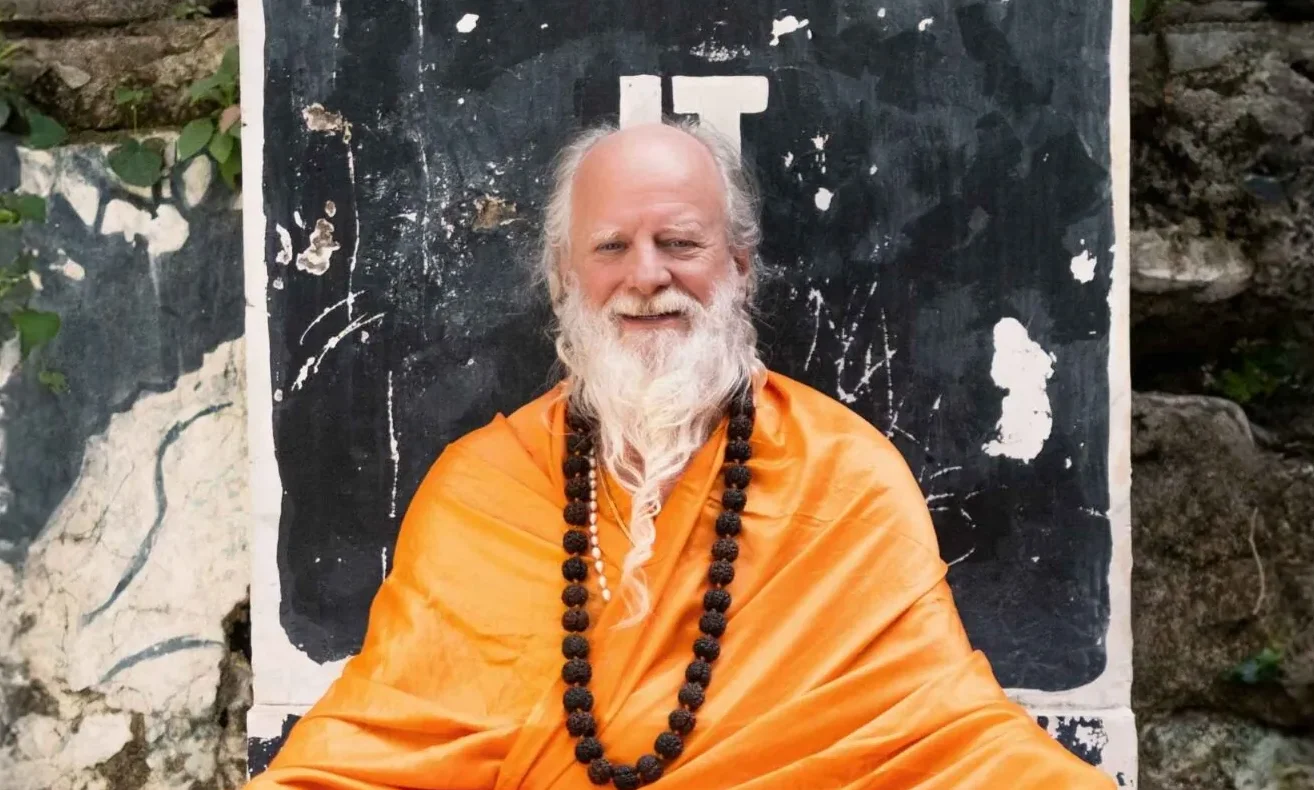
“Enlightenment acquires individuality. Individuals do not attain to or achieve enlightenment.”
Thom Knoles
What if spiritual progress becomes clearest when you stop trying to measure it? In this episode of The Vedic Worldview, Thom explores why enlightenment is not an individual achievement but a gradual expansion of Universal Consciousness through the individual.
He describes the signs of growing consciousness, from moments of inner silence to greater adaptability, rapid recovery, and a quieter relationship with stress. Listen or watch to learn why Vedic Meditation changes the pace of evolution and how real progress often becomes most obvious in daily life.
Episode Highlights
01.
Relax and Enjoy the River
(00:45)
02.
The First Taste of Transcendence
(06:34)
03.
Eyes Open, Silence Remains
(07:51)
04.
Adaptation Is a Hallmark
(10:45)
05.
Enlightenment Does Not Boost Ego
(13:05)
06.
Uncontrollable and Unpredictable
(15:35)
07.
Rapid Recovery and Relevance
(18:37)
08.
Q – Can non-meditators measure progress too?
(19:39)
09.
A – Why Meditation Changes the Timeline
(20:10)
10.
The Direct Route to Transcending
(23:18)
11.
Q – Can attachment block enlightenment?
(27:04)
12.
A – Stop Striving, Keep Practicing
(27:27)
Jai Guru Deva
Transcript
What Are the Signs of Expanding Consciousness?
[00:45] Relax and Enjoy the River
Welcome to the Vedic Worldview, my podcast. I’m Thom Knoles.
I’m often asked by meditators who are very achievement oriented, “How do I know how far I’ve gone with this practice? I’ve been practicing Vedic Meditation for three days, and I really want to know, how long is it going to take for me to gain full enlightenment, and how do I know what the signs are of progress to? What are the milestones? How can I tell where I am?”
And my first reaction to all of this is just to say, smilingly, just to say, relax and enjoy, Nature knows best how to organize. And the idea that your arrival into enlightenment is an individual achievement and an individual accomplishment, the kind of thing that you’re used to in your individual life, is a complete phony idea.
What’s happening on a daily basis is that your own big Self, that’s Universal Consciousness, it is your own big Self, it’s not an it, is, in grades, taking over your individuality. This is happening in grades, little tiny grades at a time.
Your individuality is no longer the dominant feature that is running the show, and so then what is happening is a graded process of Universe’s Consciousness taking over its own property, which is your individual status and structure and body. Universal Consciousness is in the process of taking it over.
Not eliminating the individuality. No. Individuality is being augmented by predominant Universality. So this is the way to understand this process of graded enlightenment. It is individuality being the means through which Universality finds expression, and the idea that “my individuality” is in charge of this process makes me laugh, because I know that it has absolutely almost no impact whatsoever.
There are varying degrees to which our individuality might resist the process, the inexorable process of enlightenment. When you’re going downstream in a broad river, you could turn upstream. If you were just floating in the river and enjoying the view as it came by, all the winds and the turns and everything of the river, which all rivers do. Almost every river at some phase of its riparian movement goes through S bends, you know, meaning it may be headed south overall, because that’s where the ocean is, but it goes north for a while, it goes east for a while, it goes west for a while, it goes northeast for a while, and gradually, gradually, but the overall direction is south.
So while all that’s going on, you could be in that river of consciousness, and you could attempt to go faster than the river. Let’s say the river is going at 20 miles an hour current downstream. You could try to add your puny human thing to it, an absolute top fast swimmer might swim two or three miles an hour, so you could swim with the current and arrive at the ocean maybe 15 minutes early.
Or you could do the other thing, which was going to create misery and fatigue in your life, turn upstream and begin swimming one or two miles an hour upstream the hardest you can possibly swim, and you’re still going downstream. You’re still evolving, you’re moving backwards while swimming up river. So going down river while swimming up river is what I see a lot of people doing. They’re doing their absolute best to resist the process of enlightenment.
Meditating, practicing Vedic Meditation, is a strategic method. We practice it twice every day, and if practicing it twice every day, you still engage in things, behaviors, or attitudes which are enlightenment-denial attitudes, you’re not actually getting any traction in your denial of your enlightenment.
You’re still moving downstream because you’re in that river that is exorably moving in that direction towards oceanic consciousness, and so try as you may, you can’t defeat the force of evolution. All you can do is make yourself tired, make yourself exhausted, make yourself depressed that you’re not making any progress upriver, struggling to hang on to your individuality being in charge of everything.
[06:34] The First Taste of Transcendence
So, what are the signs? One of the first signs is something that happens in meditation, usually in the first six months, and that is, I get to a place in my meditation where mantra is gone, and usually there could be a moment where mantra is gone and thought is gone, and I’m experiencing a deep inner silence. But I don’t know about that until I come out and realize, in contrast, that was a moment of no mantra and no thought, and so I had this moment of transcendence.
Then a new experience begins to occur. I feel as vast and as unbounded, even if I’m thinking, so I’m having thoughts in my meditation, feeling as deep as ever I felt, and yet I’m thinking while feeling vast and unbounded. This is a new experience. We call it Ritambhara Pragyan. Ritam, R-I-T-A-M, is the short name for it. We won’t bother with the whole rest of the name. Ritam, and Ritam means virtual unboundedness, and yet some perception or some thinking.
[07:51] Eyes Open, Silence Remains
The next stage is that meditation time is over, and I’ve noted that, and so I’ve let go of the process of meditating, and I have a little while of sitting in quietness before I get up and engage in the world, and then it’s time for me to open my eyes, and when I open my eyes, I still feel even with eyes open as deep as ever I felt in my deepest meditation. Now my eyes are open, I might be looking downcast or even looking around the room, but I feel that vastness, that deep inner silence, as strongly as I had felt it once, only in the deepest meditation. “Oh, that’s remarkable.”
But what happens if you do this [scratches nose]? You have to scratch your nose or something. It’s gone. The process of moving the hand is enough to overshadow it.
So you keep meditating morning and evening, and morning and evening, and you end up experiencing a kind of vastness, which can persist even if you begin moving. You start walking toward the door to head off to your day, and it’s like the unboundedness is coming with you. When the unboundedness is coming with you, while you’re moving, and then that gradually fades off, and fades off, and fades off, and you lose conscious experience of that.
So you keep practicing morning and evening, morning and evening, and you begin to notice that the unboundedness persists now for more hours, and you begin to have the experience of, “I feel quite unbounded, even when I’m talking, when I’m speaking.” Then you normalize it, and when you normalize it, you don’t know you’re experiencing that anymore.
What is that? Vast unboundedness, along with thinking, action, memories, behavior of individuality. “It feels like I’m just the same me here, I’m just a regular person,” and because you’ve lost contrast, there’s no peak experiences anymore, the baseline has now risen to the level of the peak, and so you don’t feel a peak experience going on anymore.
With no contrast, you can’t tell how different you are to how you were before this, and so then how do you know? Well, you have the experiences of others. You have the experience of being in the unboundedness and others being sharply in boundaries. What does that mean?
[10:45] Adaptation Is a Hallmark
Let’s just take an experience that many of us may have when we are, let’s say, in an airport and waiting for the same aircraft, and there’s a delay in the flight, and you might find yourself hearing that news and be filled with adaptation energy, where, although it doesn’t particularly suit you, you feel quite okay. You’re wondering what the next adventure is going to be.
You know, “That’s interesting. Maybe I’ll spend the night in Dallas. Haven’t had a night in Dallas before, so interesting.” But you look at everyone around you and they’re panicking. Panicking because they’re having to spend a night in a city that they had no plan to spend the night in.
So when you find yourself more adaptive, more open, more easygoing than anybody else around you, and you begin to notice, “I’m different to everybody around me. I’m different even to those who haven’t meditated as much as me, haven’t practiced for as long a period of time as me. I may not feel particularly enlightened or anything, I just feel like it’s just me. But I notice the people around me are really pretty stressed compared with me, you know, they’re going through a lot.
“They live their lives by their watches and by their TikTok and by their weather reports and by their schedules and everything, and I do all that too, but none of those things is capable of making me feel stressed. For me to get stressed would take an unusually large perceptual or expectation change, some kind of massive expectation change. And even if I do get stressed, I could get stressed, and seconds later, maybe minutes later, I’ve recovered. I’m back in experiencing feeling the normal me again.”
[13:05] Enlightenment Does Not Boost Ego
These are the hallmarks of enlightenment sneaking up on you. When you’re enlightened… I get people all the time who say to me, “Oh, it’s going to be so cool when I’m enlightened. I’ll be in Cosmic Consciousness. I sell widgets, and I’m the best widget sales person on the sales force. Imagine how many widgets I’ll be able to sell when I’ve got the badge of Cosmic Consciousness on me. I’ll be able to really get into people’s minds, and…”
This I that’s doing the talking, “I’ll be able to do this, I’ll be able to do that,” this I isn’t going to be there anymore when that enlightenment occurs. It’s not going to be “I” get enlightened. What happens is this I gradually becomes just the tiniest little, like a speck on the face of a massive dam.
You know those dams, those hydroelectric scheme dams, how big those walls are? Imagine a little speck on the face of that, some tiny little speck on the face of this massive wall of consciousness. That’s what the individuality is, and the idea that that’s the I that got enlightened, and that’s the I that’s going to use the Cosmos to make stuff happen, to sell widgets, it’s a completely funny idea.
You are going to become this [widens arms], and this is going to be operating that [pinches fingers together to indicate speck]. That individual intellect, that individual conceptualization, the individual desiring mechanism, the individual capability, all of that is going to be owned by Universe, and your predominant sense of what you are is going to be universal.
For the sake of relatability, you’ll still talk inside of the boundaries, because people are talking to the speck. When another speck speaks to the speck that your individuality is, your Universality gets your speck to talk to them in speck speech, speck consciousness, and so on.
So speck relates to speck now. So relatability is still there from speck to speck, but inside you, if you are asked the question, what am I? What is this experiencing mechanism? It would be in a vast, almost amorphous Universality. That’s enlightenment.
[15:35] Uncontrollable and Unpredictable
So, enlightenment has a body, enlightenment has an intellect, enlightenment has an individuality, but enlightenment is not defined by the body. It’s not defined by the individual intellect, is not defined by the individualistic desiring mechanism, and one of the things that this makes you is two things: uncontrollable and unpredictable.
When other specks try to control your speck, they’re actually dealing with The Universe, and if Universe decides to be conforming through its speck to the specks that are others, then they seem to have some capacity of, you know, “I induced compliance in that person.” If Universality doesn’t completely agree that its speck should be conforming or complying, then it simply won’t.
And so controllability, if you find yourself getting less and less controllable, you’re getting more and more enlightened. If you find yourself getting less and less predictable, you’re getting more and more enlightened. So people begin to say, “I noticed that you ate beans, and I never knew you ate beans before.” You just say, “Uh, huh. This is me transcending the predictability that you have assigned to me. I’m not a speck anymore.”
So our consciousness growing is going to grow in all kinds of ways that are outside of convention. You’re going to become less and less of a conventional person. If you were hoping that by getting enlightened you’d become more and more conventional, forget about it. You’re going to become more and more unconventional. And unconventional doesn’t mean that you’ll be a disruption or whatever it is.
[18:37] Rapid Recovery and Relevance
So basically what we have to do, and all of this thing of, you know, “Where am I on the scale? I want a graph and I want experiences and a graph…” you’ll be moving continuously in the direction of unboundedness, which means that your inner sense of Self, your inner sense of Beingness is something other than what other people see when they look at your body.
Other people look at your body and they think they understand what you are, they listen to the words that come out of your mouth, and they think they understand what that is, and it turns out that none of that actually fully describes you or fully defines you.
Rapid recovery from overloads of experience: one of the hallmarks, rapid recovery. Or non-reactivity, you don’t get stressed in the first place, that’s another hallmark of this. And your capacity for behaving with relevance. You can behave relevantly. Relevant behavior is one of the hallmarks of greater states of enlightenment, less and less irrelevant behavior.
So, there’s some things for us to look at, but we need to let go of our achievement orientation. Individuality cannot achieve enlightenment. Enlightenment will acquire individuality, that’s the truth of it. Enlightenment acquires individuality. Individuals do not attain to or achieve enlightenment.
[19:39] Q – Can non-meditators measure progress too?
For those who do not yet practice Vedic Meditation, would the signs that you spoke about still be relevant for them in terms of reviewing and reflecting on whatever it is that they’re doing in their life is working for them? And what would you recommend to them in terms of, if they’re not beginning to feel that depth of vastness in their life, when would it be a good sign that they might want to consider Vedic Meditation?
[20:10] A – Why Meditation Changes the Timeline
For those who are not yet practicing Vedic Meditation, fall back on whatever your grandparents taught you. Do a lot of praying, you’re going to need every minute of it. Read philosophical books, you’re going to need everything you can possibly read. Listen to the wisest people you can listen to, you’re going to need every word of wisdom.
Because you’re throwing yourself into the relative world of constant and ever-changing reality, you’re not going to gain enlightenment anytime in this body life. And so it now becomes incumbent upon you and urgent for you to go on my website and be in touch with my team and discover the closest qualified teacher of Vedic Meditation and get on with learning this technique, which is… it’s the nonstop jet flight to enlightenment.
There are lots of slow ways of getting enlightened. There must be many tiring ways. For example, if I wanted to walk from Los Angeles to New York, it’d be possible, but, you know, by the time I get to New York, I’d be dead. You know, 15 pairs of shoes later, and maybe a year, three years, four years, or something like that.
Or I could go on a donkey cart from Los Angeles to New York, and it’s possible, I think, probably things like that have been done. Or I could ride on horseback, or I could go on a tractor, or I could go in a car. Now we’re getting closer to it, and you know, it might take five days in a car, or I could take a nonstop jet flight.
How much of our time do we want to assign to very tiring ways of gaining enlightenment? There are multiple extremely tiring ways of gaining enlightenment that eat up years, months and years of body life.
Enlightenment can only occur in the body that you have. You can get another body and gain enlightenment in that one, but why waste that much body life? Why not gain enlightenment now?
So, for those who are holding their finger on the pulse of how enlightened am I, and at what speed am I gaining enlightenment, without Vedic Meditation, I would say that you are like a snail moving from Los Angeles to New York.
[23:18] The Direct Route to Transcending
And so what are the signs of it? Of more enlightenment? There’ll hardly be any. Getting tired, trying to control your behavior, trying to make your individuality do all the things that individuality thinks it can do in order to lead a more productive life, and all of it failing.
Those are the prospects of an attempt to gain enlightenment without Vedic Meditation. With Vedic Meditation, we go straight into the transcendental field of Unified Field Consciousness, and the process of gaining enlightenment is describable by the fourth day of instruction in the technique.
By the fourth day of instruction in the technique, we can already point to experiences that indicate that the process of enlightenment has already begun. Without Vedic Meditation, whatever you found charming to you that might be charming, you know, Leninism, Marxism, religion, Catholicism, Judaism, go through all of it, see what it is that charms you.
Don’t have very many high hopes. Try to do your best. Be obedient to the instructions from wiser people than you, but I don’t give it much hope.
Compared with you turn on your iPhone or your computer, and right there at your fingertips, you could learn the method that’s going to get you enlightened with blinding speed by comparison.
So it’s almost futility. It’s kind of like a snail asking, “How will I know if I’m making progress from LA to New York, while I’m a snail on the ground? You know, what will be the signs that I’m getting to New York?”
And my answer is going to be, well, you know, you’ll go from Santa Monica to Western LA, but you’re still not in New York. Then you’re going to go from Western LA to Downtown LA, but you’re still not in New York. Get back in touch with me in five years. Now you’re in Pasadena, and you’re still not in New York.
These, these are the increments we can talk in if someone doesn’t practice Vedic Meditation. Microscopic increments. Life does tend to get better lifetime after lifetime, but without Vedic Meditation we’d need to be talking in lifetimes of increments.
Compared with Vedic Meditation we’re talking years. We’re talking years.
So it’s a serious subject. I take it very seriously, and I see all of those in the world who are just struggling to have a better life with futility, because they don’t know how to transcend, don’t know how to step beyond thought.
It’s such a ridiculously simple thing to learn. It’s almost like, “How can I, without doing any training at all, become an Olympic athlete? I want to become an Olympic athlete. I’m sitting in a chair playing video games. What are the signs of me becoming an Olympic athlete while I sit in a chair and play video games?” Well, there aren’t any.
People who don’t meditate ask me, “What are the signs of enlightenment? How will I know when I’m becoming more enlightened but I don’t meditate?” It’s very hard to find any signs, very hard, except to say over thousands of lifetimes there’s been evolution towards enlightenment. So, look forward to more thousands of them.
[27:04] Q – Can attachment block enlightenment?
So, as meditators are evolving, it seems this dedication to expansion of consciousness is a good thing, you know, Advanced Techniques and knowledge, and correcting the intellect, and sitting at the feet, but then there seems to be this trap where attachment to enlightenment can get them stuck. Could you speak to that?
[27:27] A – Stop Striving, Keep Practicing
It’s attachment to what they think enlightenment is. I, meaning the small individual self, am going to be enlightened? That I never gets enlightened. What happens is enlightenment is your deep innermost universal Self gradually acquiring greater and greater percentages of that individuality, gradually gaining access to and operating every aspect of your individuality.
So the idea that, “I’m going to get enlightened,” it’s a little bit like being a Boy Scout or a Girl Scout, and getting little badges of rank. You know, “I’m going to be an Eagle Scout, I’ll be, it’ll still be me, the me is going to get enlightened.”
That me that thinks it’s going to get enlightened is actually an obstacle to the enlightenment. We just need to practice our meditation twice every day, and listen to the knowledge, listen to the wisdom, but take away the individual striving. Individual striving for enlightenment is not… it’s ineffective. It’s swimming upriver in a river that’s moving downstream anyway.
That “I…” people often say to me, “But you know, I’ve been meditating five years, and I this, and I that, and my this, and my that, and all that.” And I just say to them, “Who is this I and this my that’s talking? Who is that?
“That’s me,” and I go, “That’s the me that’s got to go.”
