
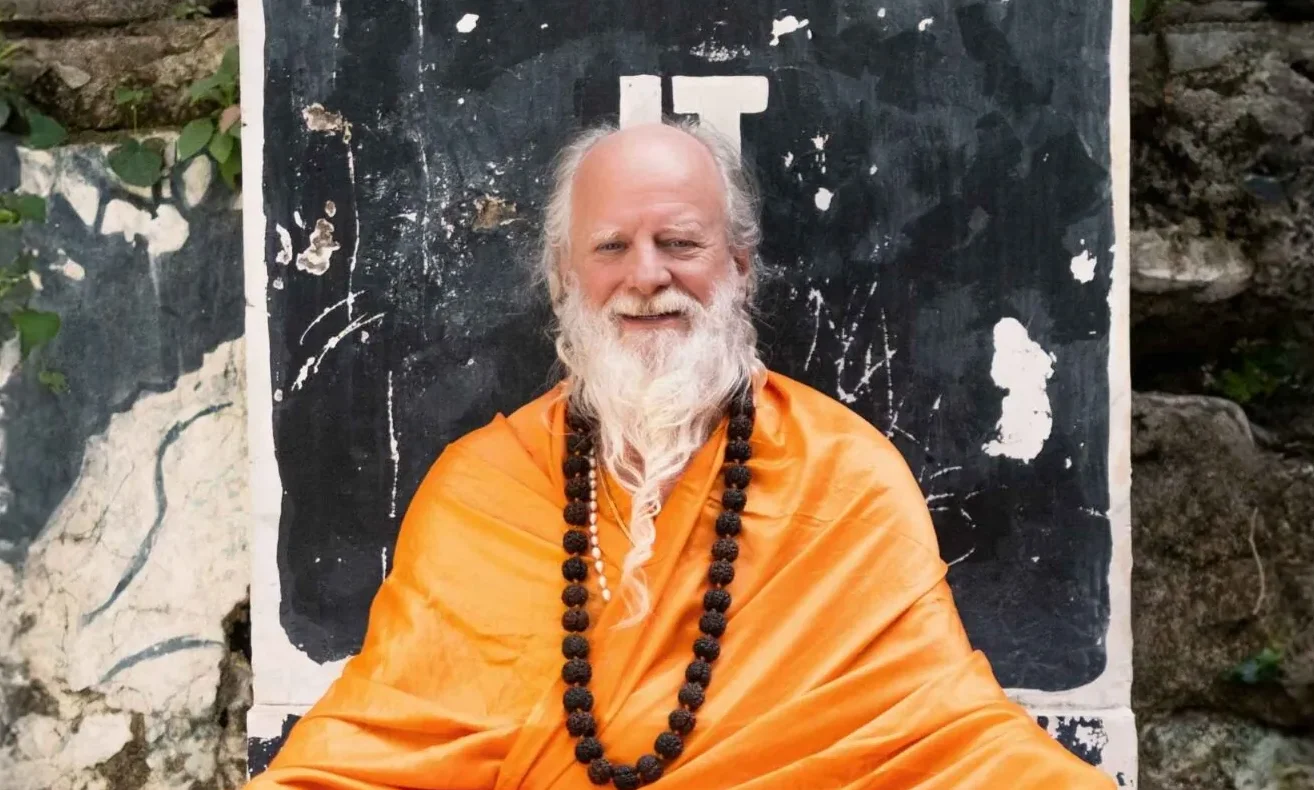
“If we’re not seeking forgiveness, don’t apologize.”
Thom Knoles
Have we met before? Is it possible to be over apologetic? And if Cosmic Consciousness is so special, then what’s the function of God Consciousness and Unity Consciousness?
In this Ask Thom Anything episode, Thom responds to guest questions on when an apology is appropriate, how Cosmic Consciousness differs from God Consciousness and Unity Consciousness, and whether past-life connections continue into this life.
He explores responsibility without sorrow, the refinement of perception through higher states of consciousness, and the braided nature of lifetimes.
Listen or watch to understand the grounded Vedic perspective on relationship, enlightenment, and continuity across lives.
You can also watch these episodes on YouTube here:
How Should We Apologize?
Do Past Lives Reconnect in this Life?
What Comes After Cosmic Consciousness?
Episode Highlights
01.
Q – How should we apologize?
(00:45)
02.
A – Only Apologize if You’re Sorry
(01:08)
03.
Responsibility vs Sorrow
(02:15)
04.
Q – How does Cosmic Consciousness Compare with God and Unity Consciousnesses?
(04:55)
05.
A – Understanding What Is Relevant
(05:08)
06.
Senses Refine Beyond Cosmic Consciousness
(07:13)
07.
From Almost Self to Self
(09:01)
08.
Love Is Recognition of Self
(10:48)
09.
Q – Do past lives reconnect in this life?
(13:50)
10.
A – Lifetimes Follow Braided Threads
(14:05)
Jai Guru Deva
Transcript
Ask Thom Anything: Apology, Higher Consciousness, and Past Lives
[00:00] Q – How should we apologize?
Could you talk about the Vedic worldview on apologizing? You’ve discussed forgiving versus forgetting in the past, but what are your thoughts on the actual act of apologizing? How do we apologize in an evolutionary way, and what is the purpose of apologizing if we aren’t seeking forgiveness?
[00:23] A – Only Apologize if You’re Sorry
Well, if we’re not seeking forgiveness, don’t apologize. Very important, you know. If you interacted with somebody in a way that perhaps didn’t suit them, but you’re not sorry about it, because perhaps that was what they needed, then I wouldn’t be going apologetic.
The worst possible thing, an employer who has spotted an inefficient employee doing things, and who has said to the employee, “We’re going to let you go, but I’m sorry…” then they know this is a mistake, to say “I’m sorry.” “We’re going to do you a favor and let you go.” That’s a better thing to say: “We’re going to help you find a place that’s more suited to your personality, and this isn’t it.”
And so, constantly saying “I’m sorry” is a bit of a social pathology these days. “Oh, I’m sorry, but… I’m sorry, but… I’m constantly sorry.” You know, you keep saying you’re sorry all the time, you’re a sorry person, and you don’t want to be a sorry person. You want to be magnificent person who gives everyone opportunities.
[01:30] Responsibility vs Sorrow
So, if indeed you have cut across someone else’s interests in a way that is non-evolutionary for them, or you foresaw their progress, and you think that it needs to be redressed, I’d suggest to you that you approach them and say, “Look, just to clear the air, I would like to take responsibility if what I said or what I’ve done has made your life more difficult. I’d like to take responsibility. You’ll let me know.” And if they say, “No, nothing like that happened,” just say, “Fantastic, we’re on good terms. Let’s move on to the next thing,” like that.
But constantly being willing to be the perpetrator of that, somehow I seem to be constantly the perpetrator of little hiccups and little problems and little, “I’m sorry, I’m sorry, I’m sorry, I’m sorry,” we should count how many times we say that in a day. Take an inventory of it.
If you find that habitually you’re saying “I’m sorry,” or not just “I’m sorry,” but, “Sorry, sorry, sorry, I have to take this call. Sorry I have to do this. Sorry I have to do that,” what’s the thing that’s being radiated? I’m a really sorry person. All I do is make mistakes every few seconds, and I’m constantly apologizing for them.
If you have to excuse your existence on a regular basis, if you have to justify your existence on a regular basis through sorrow, then you’re living a life of sorrow. Get rid of those words. You’re not sorry. If you make a little mistake, you just say, “Sit over here. Oh, I changed my mind. Sit over here. Perhaps that’s better.” You might seek information, “Is that better?” But don’t say sorry.
And if, in fact, you have committed some kind of a gaff, then say to someone, “Look, I’d like to clear the air. I’ll happily take responsibility. You’ll let me know if I offended you.” And if they say, “No, you didn’t offend me,” then don’t say sorry for asking, just relax.
We need to be a lot more relaxed, and a relaxed person moves around with a kind of silent magnificence. Aspire to that.
[04:10] Q – How does Cosmic Consciousness Compare with God and Unity Consciousnesses?
So, you mentioned previously that in Cosmic Consciousness we understand everything. What does that mean for GC and UC, God Consciousness and Unity Consciousness?
[04:23] A – Understanding What Is Relevant
So in Cosmic Consciousness we understand everything that is relevant to understand. Not everything, but just whatever is relevant. And the degree to which we employ the tool of a little bit of ignorance, a little bit of surprise, is greater in CC.
So, there’s this function called leisha avidya. Leisha avidya means the faint remains of ignorance, where you are allowing yourself to intentionally not know absolutely everything, and in Cosmic Consciousness, the experience is, “I am The Absolute. I’m the big Self, and all of this relativity, including this body, even the intellect, the mind, the feelings, they’re all non-self.”
It’s a very odd state. It’s a transitional state that we don’t recommend anyone spend too much time in. It’s the first step of enlightenment, but there is a sense of knowing that there has to be more to what I’m perceiving through my senses than what’s meeting my senses. And in Cosmic Consciousness we still have the waking state sensory perceptual capability. It’s only when, through regular daily life in Cosmic Consciousness… and also there are techniques.
You don’t practice meditation to transcend because you can’t transcend in Cosmic Consciousness. You are inside experiencing yourself as that unbounded state, so you can’t go to a state that you have utterly become. But what can happen is that the technique that you practice, which involves the use of specialized God Consciousness mantras, will continuously refine your perception. The perceptual ability will get refined.
[06:28] Senses Refine Beyond Cosmic Consciousness
There’s another thing that happens, which is the body begins to produce the finest product of digestion, which is a celestial biochemical known as soma, S-O-M-A. And soma, when it’s produced, causes the senses to become hyper acute in the perceptual capability.
So, now what’s happening is leisha avidya, the faint remains of ignorance, is getting a little thinner, and instead of you regarding the world as non-self that’s just ever changing, you regard the world, meaning relativity, as very close to the unboundedness that I am.
“Ever since Cosmic Consciousness, my innermost sense of what I am has been unboundedness. The body can’t describe what I am. The history of the body can’t define or describe what I sense myself to be. Only The Absolute can describe what it is I find myself to be. It’s the… I’m The Absolute, and all of this is non-absolute.”
Now, in God Consciousness, with super-acute sensory perception, I’m beginning to see that the relative world is actually made up of the finest products that are first coming out of The Absolute, and although not Absolute, the celestial layers that I’m perceiving are almost Absolute. “I am Absolute. This is almost Absolute.”
[08:16] From Almost Self to Self
So now leisha avidya, the faint remains of ignorance, gets a little thinner, and a deeper reality dawns. I’m surrounded by Divine Intelligence. Everywhere I look, everything I perceive, every taste, touch, smell, sight, sound, every conception, every perception, every feeling, everything is with reference to this Divine Intelligence that I find myself surrounded by. It’s the diametrically opposed state than Cosmic Consciousness is.
Cosmic Consciousness: “I am the Self, all of this is non-self.” In God Consciousness: “I am the Self, all of this is the almost Self.” Almost. Very attractive. So leisha avidya got even thinner. Now Unity Consciousness: in Unity Consciousness, the senses of perception become so acute that they can actually see, in every object, every form, and every phenomenon, can actually experience The Absolute in that thing. Beyond the celestial and into The Absolute.
“I am The Absolute. This is The Absolute.” Where does leisha avidya play a role here? The faint remains of ignorance is in the time delay. So I look at the cup, and for a second it’s the cup sitting at the end of his hand, and then I experience it as extended Self. Absolute sees Absolute, and there’s a time delay. The time delay may be one second before I recognize this as myself.
[10:03] Love Is Recognition of Self
But leisha avidya plays another role here. I look at the cup, it’s myself, and then I look at my hand, the physical hand, and for a moment it’s non-self, but then it becomes Self. What happened to the cup? Let me look back. I look back at the cup. The cup, for a second, is non-self, and then I see Self in it. But what happened to the hand? By implication, it became non-self again. So, this shifting around of the non-self happens in Unity Consciousness.
There’s a moment of perceiving an object as an object, and then totally finding that object to be an extension of you. And what is that experience? That’s what we, in our usual romantic parlance, we refer to as love. In Unity Consciousness, every one second or so, you’re falling in love with whatever it is that you’re experiencing, because love actually is recognition of Self in the so-called other.
But you’re on this kind of program of perceptual elimination of other. “Let me see if there’s anything other. What about that wall over there? Oh no, it’s Self too. It was for a second non-self. Then let me look at the sky. The sky… oh, but it’s also Self.” Everything ends up turning into Self, step after step.
And so this delay mechanism is now becoming the playground of leisha avidya. Leisha avidya no longer is there as a permanent thing. In CC, leisha avidya is quite thick compared with the leisha avidya of Unity Consciousness. In Cosmic Consciousness, “I am the Self and nothing else is.” In God Consciousness, “I am the Self, and everything is almost Self.” In Unity Consciousness, “I am the Self, and let me have a look. Oh, non-self, but now it’s Self. Oh, non-self, but now it’s Self. Oh, non-self, but now it’s Self.”
And so there’s this little time delay that goes on, and there’s also peripheral awareness. Peripheral awareness fascinates you because you want to know what happened to that which you were looking at. The mountain over there, three minutes ago, and it was Self, and now you’re not looking at it, it evidently is non-self again. So you look back over there and it’s non-self, and then it turns into Self. But what happened to all this stuff over here?
And so the world starts to become a very fascinating playground, and this is baseline Unity Consciousness. There are more advanced stages of Unity Consciousness, more advanced, but we’ll, we’ll stick with the baseline Unity Consciousness.
[13:05] Q – Do past lives reconnect in this life?
Do you believe you’ve met anyone in this life that you’ve known in a past life? And do past lives tend to navigate back to a thread in this life?
[13:20] A – Lifetimes Follow Braided Threads
Yes, and yes, I’ve met many people in this life that had some crossover with this consciousness in a different body, both of us in different bodies in previous lifetimes, many. And yes, there are braided plots, and so these lifetimes and jivas, or consciousnesses, that move from body to body as they are becoming more and more liberated progressively, the plots are all braided.
It doesn’t mean that a new thread isn’t added in. Of course, new threads get added in all the time. And ultimately all of the jivas, all of the consciousnesses that are extant in The Universe are braided into one mega braided plot, because actually they’re all one thing. They’re actually just streams of the same one. But until that revelation, where all the rivers go into the same one ocean, there’s a lot of crossover, a lot of confluences.
The idea that you’ve met somebody absolutely new who had nothing to do with you before, and yet you feel a kind of affinity, that’s usually the sign that… And it may be somebody with whom you have no more unfinished business, and so you might just have a crossover with them that’s relatively short in time, but you feel that you recognize them, or you feel as though there’s some affinity.
