
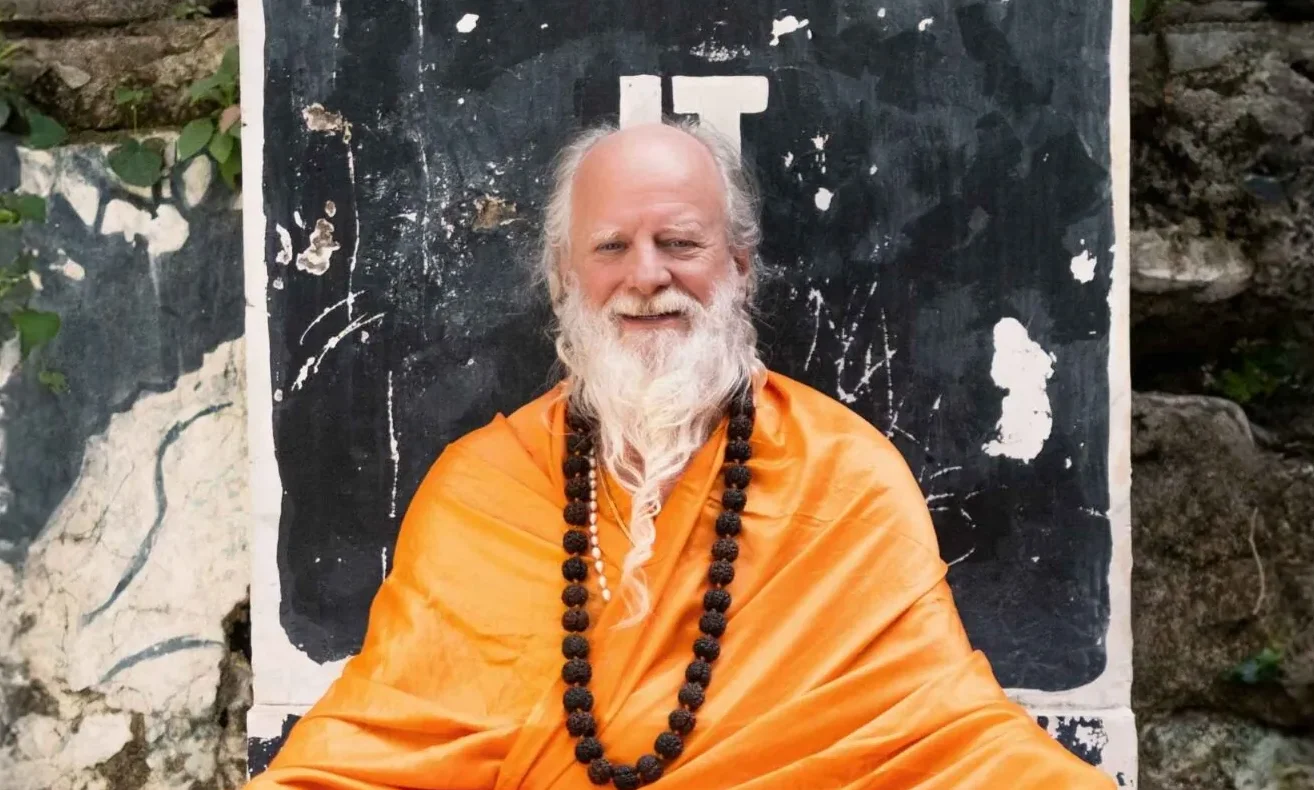
“The most serious thing in life is to stop having illusions about what you are.”
Thom Knoles
What if safety is not found in the familiar, but in our willingness to move into the unknown?
In this episode, Thom explores why the ever-repeating known leads to stagnation, while greater context, transcendence, and Vedic Meditation awaken more of our human potential.
From brain power and stress to evolution, ancestry, and consciously designed change, he offers a grounded Vedic perspective on what it really means to become an extraordinary human being.
Listen to or watch this episode for a practical and expansive reframe on change, relevance, and the courage to evolve.
You can also watch this episode on YouTube here: https://youtu.be/l1tuckqbwZg
Episode Highlights
01.
Beyond the Body Story
(00:45)
02.
The Guru Gives Context
(03:59)
03.
Consciousness Shapes Experience
(07:36)
04.
Scarcity Is a Brain-Power Problem
(10:27)
05.
A Renaissance Brain Awakens
(13:54)
06.
Stress Eats Brain Power
(16:57)
07.
The Ever-Repeating Known
(20:30)
08.
Design Change or Deteriorate
(24:38)
09.
Your Ancestors Were Adventurers
(28:17)
10.
The Cognitive Revolution
(31:28)
11.
There Is No Going Back
(33:52)
12.
The Human Spirit Explores
(36:44)
13.
Meditation Launches Into the Unknown
(38:01)
14.
Thank You for Making Me Worthy
(40:40)
Jai Guru Deva
Transcript
How to Be an Extraordinary Human Being Pt 1
[00:45] Beyond the Body Story
The most serious thing in life is to stop having illusions about what you are.
You’re not just a little body event, you know, that you got born and you got this body and it went around here and there and stuff happened and the mind was hitchhiking on it and the mind was the recipient of all the experiences of wherever the body went.
That kind of idea is not scientific. It’s just not scientific because in science we’re able to demonstrate that there is one indivisible whole consciousness out of which everything emerges, including you. It can’t be that there’s one indivisible wholeness out of which everything emerges except you. All right, unless you are a supreme egotist, the only exception in the entire universe to being an individual status and structure emerging from the Unified Field. If you’re the one exception, then congratulations, that’s amazing. You must be more powerful than the Supreme Being.
So we have to get on with accepting this intellectually and then we have to take steps toward realization.
Realization just means to have the capacity to awaken and take possession of your true inner nature. True inner nature is unboundedness. And so, to whatever extent that’s already true, and it comes in percentages, right, you learn to meditate and you’re 99% an ignoramus and 1%, you’ve got a few things figured out.
And then six months goes by and now you’re just 95% an ignoramus and you have 5% of things figured out. Then a year, two years, you’re up at 60% ignorant and 40%, you’ve really got a sense of what you are.
Eight years meditating, nine years meditating, it’s really, now you’re beginning to really get there. And the getting there, there are signs of getting there and the signs have to do with you being able to see through the immediate content.
[03:59] The Guru Gives Context
See, here’s what a guru is always supposed to do. You come to me with content, “You know, I just can’t believe it. The price of tahini went up since the Iran war. Those damn warmongers, you know. I used to get my best tahini from Turkey and now, you know, at the rate I’m going…” that’s content. And, “I’m gonna be living life in misery,” and then my role is to give it context.
Context means we build and awaken an awareness of time, the fullness of time around that content. What is the contextualization of the content? So to contextualize content, this is the capacity of the illuminated mind.
The idea that content itself within very narrow time constraints tells you the whole story about what you are and what you’re going to be experiencing, that is ignorance, meaning, and it’s not a pejorative term, it’s literal, you are ignoring the fullness of time.
Time is full. You know, we live in a universe that’s around 13.8 billion years old. In the fullness of time, what is the truth of what you are, what you’re going to be experiencing and what’s happening? We have to be contextualized with time.
And so this is what parents are doing for children all the time, every minute of the day. They fall down and skin their knee and you’re like, “It’s going to be all right. By this afternoon, you’re not going to feel that anymore,” and like, “Yeah, but it really hurts.” “Yes, but soon it’s going to be better. Soon it’s going to be better.” This is the parental thing.
I know that it’s in the narrow context of time right now and you’re angry with Sally because she pushed you off your bicycle and all that, but she thought she was just having fun and playing a game with you. You’re contextualizing. And if you can continue to contextualize, then the tears dry and the little dirt that’s on the face, you wipe that away. And then would you like a really colored Band-Aid with little bunnies on it? Or would you like little hearts? Or what kind of Band-Aid would you like? And, you know, all of that stuff. This is contextualization.
[07:36] Consciousness Shapes Experience
So take that to a much larger scale. You’re all gurus. You are a guru to the extent that you can contextualize content. And contextualization always has to do with a more expansive space-time view. More expansive space, more expansive time. Larger space and larger time is the answer.
And so then next step is to awaken to there’s no such thing as anything except the state of consciousness you’re in. We think that we know where we are and what’s going on and what’s happened. And if it hasn’t occurred to you yet, there are as many opinions about that as there are human beings.
“What’s going on right now? What’s happening right now?” Every state of consciousness has a different answer to that. Since that’s true, you can’t go around changing people’s state of consciousness because you can’t stop people from being in the consciousness state in which they find themselves. You can, however, change your own consciousness state. And it’s going to involve more transcendence, more transcendence.
Every time you go beyond space-time, your personal sense of context grows. So you hear these statements about Cosmic Consciousness. Cosmic Consciousness means all-inclusive awareness, the capacity to find context for absolutely everything. You can see everything in context.
And it doesn’t mean there’s nothing to be done. There’s always something to be done. But mostly, the doing has to do with getting a bigger picture of how whatever’s in front of you fits in to the largest possible picture and living in that bigger picture.
And then what happens when you start moving in that direction is the suffering gradient begins to drop, a certain amount of suffering. How much suffering is going on? In Cosmic Consciousness, there’s no true suffering. I mean, if somebody was to pinch your toe, you’d probably laughingly say, “I can tell that you have a limited capacity to keep doing that. Because I have context and it’s hurting, but it’ll be over soon.” You can’t stay in that body doing that for as long as you think you can.
[10:27] Scarcity Is a Brain-Power Problem
So the capacity to minimize the amount of suffering that’s going on in a given moment comes from this having virtually infinite context, infinite context for whatever it is that’s happening. The idea that there’s a limited amount of everything, limited amount of everything, is just absolutely not correct. As long as you have infinite creative intelligence, there’s an infinite amount of everything. There’s not a limit on anything.
I’ll use Phoenix, Arizona as an example. It’s one of my favorites, an arid city that looks doomed. And it looks doomed because it’s running out of water and it’s the fastest growing metropolitan area in the United States, just down to the south here. Probably some of most of you came through Phoenix on the way here. And it’s almightily hot in summertime.
And the great thing about Phoenix is that, like every other town in Arizona, come around the first week of July, five cubic kilometers of water fall out of the sky and land on the city. That’s a lot of water. Five cubic kilometers every week lands on that city.
The city doesn’t rely on that. It relies on water that is brought across the desert in open canals 200 miles from the Colorado River. And one third of that water evaporates on the way to Phoenix. And then the water is used for watering golf courses. And next comes the residential use.
When the five cubic kilometers of water fall from the heavens, like a gift from the gods in July, August, and September, what happens is it lands on the desert yards, on the golf courses and everywhere, and just drains away into the desert. Nobody catches anything.
And so in fact, Phoenix receives a huge amount of water, but everybody ignores it because there’s that river 200 miles away with a canal that cost something like $10 billion to build to bring the evaporating water to the golf courses. So Phoenix is doomed, right? This is not a water problem. This is a brain-power problem.
It has to do with a failure of the brain. All problems are brain-power problems. The moment anybody says to me, “We have a problem,” I think, no, you’ve got a weak brain. Let’s contextualize this. It’s not a problem. It’s an incapacity to see beyond the immediate.
“What assumptions are you challenging?” And sometimes people will say to me, “What?” And I’ll say, “There are assumptions that you make. Let’s hear those assumptions and let’s start challenging those assumptions.”
[13:54] A Renaissance Brain Awakens
I work for companies. Some of you don’t realize this, but major corporations hire me to work with them on strategy, tactics and everything to do with the company, from personnel to methodology, to delivery of goods and services, to marketing and so on and so forth. I have no qualifications for that. I learned how to teach mantras, but in the process, I did a lot of meditating, lots and lots and lots of meditating, lots of rounding, lots and lots and lots of rounding. And it turns out that I did more meditating than is required to teach people mantras.
Teaching people mantras, it requires a certain amount of brain power. What happened over the years was that my capacity to advise went past the demand level of teaching meditation. I still teach meditation, as you know, but people began coming to me saying, “Would you be able to advise me on this?” And I say, “Sure.” “What about this?” “Sure.” “What about this?” “Sure.” “What about this?” “Yeah, sure. Let’s do that.”
And so then what is it that qualifies me to be a business consultant or a government consultant, which I am also? It has nothing to do with what I trained in. I trained in Vedic knowledge.
I have at least five psychiatrists who are active, very famous psychiatrists who come to me to get trained in therapeutic method. I’ve never trained in psychiatric therapeutic method, but I trained them in it.
So you have a Renaissance brain. You have the capacity to be the greatest artist, the greatest musician, the greatest business mind, the greatest everything. If only you wake it up.
[16:57] Stress Eats Brain Power
The brain has, the brain that’s inside the cranium, the cranial brain has about 100 billion neurons in it. These are brain cells. And I studied under an Australian Nobel Prize winning neurologist in 1974 by the name of Sir John Eccles. He was in New York City, retired, had left Australia years before that.
And Sir John was the one who used the phraseology with me that on average, people are using about 2% of their brain’s available computing power. And I said, “What’s happening with the other 98%?” He said, “The brain’s active, but it’s active retaining past impressions.” We refer to that in our language as stress. Holding on to stress, holding on to past impressions is eating up about 98% of the brain’s organizing power.
The brain’s active, the entire brain’s active, but what is it active doing? Redundancy, the repetition of the known. “Oh, I got in trouble once for knocking a butter knife off the table. That was when I was five. And now I better really watch my manners because if I knock a butter knife off the table again, I’m going to be in as much trouble as I got in when I was five.”
You wouldn’t believe how much brain power that eats up. Now you’re 45 and you’re desperately afraid that you’re going to knock a butter knife off the table or some other kind of gaffe. And so you’re tense and worried. In fact, nobody even cares except you. Nobody cares.
But, you know, you’re tense, you’re worried, you’re watching out, you’re being careful how you step, you’re being careful how you move, you’re being careful what you say. You’re trying to be clever and everything, but in the backdrop is don’t hit that butter knife. It may not be there as a conscious thought, but something akin to that is driving the extreme care with which you’re carrying out things. This is just an example I’m using.
And we carry forward this and our brain has to use millions, maybe hundreds of millions of neurons to maintain that level of care that’s going on. And it’s causing you to miss other things. There are other things that do need attention, which aren’t getting attention because of this irrelevant reactivity.
How much irrelevant reactivity do we bring to daily life? As non-meditators, not you, you’re meditators, as non-meditators, about 98% of our reactivity, 98% of our responsiveness, according to the Nobel Prize winning neurologist, is the repetition of irrelevant care. Irrelevant carefulness that’s not actually needed in a given situation, leaving about 2% of the brain’s available computing power to compute what is needed.
[20:30] The Ever-Repeating Known
So that would be like having a mighty desktop computer that could run an entire corporation or government and using it to check your emails. And that’s all you do with it, just you check your emails and that’s it. And this thing could do almost anything.
So we’re most of us, without meditation, we’re kind of the equivalent of checking emails with this giant computing phenomenon, massive brain that we have.
And so as meditators, we need to begin thinking how we can find greater outlet and more expression for what our potentials are, rather than the ever repeating known. The ever repeating known is the enemy. It causes stagnation. It’s a kind of a, it smacks of stagnation when the known just keeps on repeating and repeating and repeating.
And what happens in stagnancy? Destruction operators, scavengers, and all of that begin to appear on the scene. The things that scavenge whatever it is that’s not growing start to appear. And we attract to ourselves those scavenging forces in Nature, which they sound terrible when we put it this way, but in fact, they’re just there to keep everything clean and neat.
And if you’re the ever repeating known, you’re not clean and neat. And so there are things coming, that you’re attracting, that will eat up the time that you have remaining, whatever time you have remaining, because it’s repetitious.
So we need to start thinking in terms of embracing change enthusiastically, embracing change enthusiastically. The fascinating thing is that the unknown is the safe place. The known is not the safe place. We have this backwards.
“If I do what’s known, if I do what’s known, if I do what’s known, I’m safe. I’ll stay inside the known.” The fact is that that’s not how we awakened our potential from the time we were children to being adults. We got out into the unknown, but we tend to, once we’re adults, we tend to think, well, I know what I know now. If I just keep repeating what I know, because I had to earn a lot.
I was a little afraid when I was pushing the envelope and getting beyond the point of no return, getting beyond the known. That was when, in fact, all the best things came to you, but now I have knowledge. I’m just going to stick in the known. Repetition, repetition, repetition, pattern, pattern, pattern.
Let’s create a pattern out of it. Let’s keep on juicing it. You juice the lime using a certain juicing method, and then you think, I’ll just keep juicing this lime, because it worked. Look how much juice I got in the cup. Let’s keep doing that thing to the lime, and the lime runs out of juice. You can’t just keep juicing it. You have to do something else.
[24:38] Design Change or Deteriorate
So we have to start thinking, all of us in our lives, how can we branch out and explore something that challenges us, that causes us to have to behave in ways that we didn’t have figured out already? If you’ve already got it figured out, that’s dangerous.
If you are willing to engage in experiences where you don’t know what’s going to happen next, that’s safe. The unknown is safe, because the unknown stimulates Creative Intelligence, and the ever repeating known attracts destruction. So don’t try to protect yourself from change. Change is, in fact, inexorable.
You’re going to change one way or the other, and there are two ways. Either you can change by designing it and leaning into the change, and then that box, as Commonwealth people say, is ticked. Americans say checked. You check that box that you design change, and change happened, fantastic.
If you don’t design the change, you’re going to be changing anyway. That kind of change we call deterioration. Change will come in one of these two ways. Change will either arrive undesigned by you, not designed by you. Change will arrive anyway, and you’ll have to use up your adaptation energies, your health, your time, your resources, and so on, meeting the undesigned change.
But if you design change and you yourself push yourself beyond the point of no return in new areas, then what happens is it satisfies Nature’s demand for change and you’ve designed it. And so you are free of attracting to yourself undesigned change. So this is a really fascinating way of looking at everything.
And if it makes you feel a little breathless and slightly like, “Oh my God,” good, very good, because since paleontological times, when we were, what are, Paleolithic times, since Paleolithic times is the proper word for it, Stone Age, our ancestors evolved into what we’ve become today by virtue of embracing change. Massive, massive climatic change.
[28:17] Your Ancestors Were Adventurers
10,000 years ago, in most places in the Northern Hemisphere was the end of the last glacial era, about 10,000 years ago. And you know, different in different places, but roughly the same all over the Northern Hemisphere. Southern Hemisphere had a bit of it to the Glacial Age, but not as big as the Northern Hemisphere.
And our, that glacial period, which ended about 10,000 years ago, had lasted 10 millennia, 10,000 years. And our ancestors, whose, we still have some records of their experiences, mostly in their cave art. There’s anthropological record, archaeological record.
The population arguably bottlenecked by the end of that glacial period, down to somewhere between 12,000 people and maybe as many as 50,000 people on the face of the Earth. So the totality of the human population was somewhere between 12,000. And there are a lot of proponents who say it was only 12. That’s all the different tribes taken together. The disparate tribes from Africa, all the way up into Europe and everywhere that humans had walked to that point.
And these people, two of them were your ancestors. They didn’t merely survive 10,000 years of glaciation. They thrived in it. And we can tell that they thrived because of their artwork. They were thriving people.
And so what made them thrive? Evidently, they were always curious, “What’s over there? What’s over that next mountain range? What’s over that?” And some of them were saying, “I don’t know, better be safe, stay back. Could be, you know, saber-toothed tigers. Could be, you know, things we haven’t dealt with yet.”
And there were some adventurous ones of them that said, “No, there’s a group of us going over, anybody wanna come?” And, you know, that’s how we ended up covering the face of the Earth with humans.
So here we are. We are the descendants of two of those people. That means you are made of stern stuff. The next time you consider yourself to be a pansy weakling, remember your ancestors. Your ancestors were not. They were rigorous, vigorous people. And you have their genes in you right now. You have their DNA in you right now. You need to live up to that.
We need to be ready to live up to rigorous and vigorous examination of how much of our potential we’re using.
[31:28] The Cognitive Revolution
The greatest thing that happened was about 100,000, 120,000 years ago, which is referred to as the cognitive revolution. What happened, we’re not really 100% sure, but there was an explosion of brain power.
The frontal cortex took about 1,000 reproductive generations to build itself, and that’s short in geologic time. The brain suddenly exploded, and we know this because we can see the skulls. We can see the skull of an ancestor 150,000 years ago and the skulls of their descendants who lived, say, 120,000 years ago. And we see the bone structure accommodating a larger brain.
And based on the fundamental truth that all forms are adaptations to function, a larger cranium, which had to get birthed by women, ever larger crania, bigger heads, which was a challenge for human women. Why was that challenge acceptable? Well, because the brain was getting bigger. And a larger brain began to appear.
This is the cognitive revolution. It was during that time that humans began to discover that instead of taking a stick and throwing it or walking with it, you could bend the stick and tie a string at this end and make it taut over to that end and tie it there. And then you could twang, twang. And then music came out of it. Tom likes that.
And you could put another stick on there and pull it back. And suddenly you had a stick that could travel at 300 feet per second. And, you know, you could run maybe seven miles an hour, but you have a stick that can go 300 feet per second.
Well, what if you put a little pointy thing on the end of that? And if it tends to go off somewhere you don’t like, what about if you put some feathers on the end so that it spins and goes in a kind of straight line? The discovery of archery happened after the cognitive revolution. And it revolutionized human’s capacity to nourish themselves.
Round about the same time, how to control fire. When you could control fire, rather than simply being a victim of it, you could cause it to be. Then you could take the things that you shot with your two little sticks and you could extract greater nourishment from them by cooking, by heating it.
Cognitive revolution. Now, we are constantly pushing the cusp of the cognitive revolutions on Earth. And we need to continue going, need to continue moving forward with that. There’s never any true safety in going back in time.
[33:52] There Is No Going Back
If only we could go back in time, culturally go back in time. There are entire political movements that want something to happen again. This, this, and that again. Again is never a possibility in evolutionary terms. There’s no such thing as again. It’s next, what’s next.
Embracing the unknown and moving forward means challenging the assumptions that are being made in the present, which are based on the assumptions that you had from the past. So we cannot move back.
People are always saying to me, “Oh, we’ve got to hold back this AI thing. Got to hold it back. Stop it from happening. Because truck drivers won’t have jobs. Maybe lawyers won’t have jobs. Gosh, wouldn’t that be a great thing? And, you know, this won’t happen. That won’t happen. We’ve got to go back to a time when we didn’t know this.”
There’s no going back. You can’t unknow what you know. It’s just absolutely, there is no going back. We have to harness whatever good can come from whatever is coming. Harness it. Harness it. Rather than saying, let’s go back and put our blinkers and blinds on and pretend it never happened and get back to a time, and maybe later on we can dump it on some future generation if we just pretend it doesn’t exist.
So we have to continue to have the courage of our ancestors and move forward. And, of course, everybody’s always going to say, “Oh, but there’ll be mistakes.” What, there were no mistakes when you were hunting? There were no mistakes when you were learning how to get into another big bundle of sticks called a boat and go across oceans? Were there no mistakes?
People might’ve said back then, “I don’t know about this going across the ocean thing. Johnny tried it on the lake and he sunk and he’s gone now. And you’re looking at what, the Pacific? You’re going to go across that?” And the Polynesians said, “You bet we are.”
[36:44] The Human Spirit Explores
And they figured out how to travel thousands of miles across open sea with no sextant, using their fingers to figure out the stars and what direction they were going in. They loved traveling at night because that was their navigation method. And they figured out where all the islands of the Pacific Basin were.
That didn’t happen because somebody said, “Let’s go back to a time when we didn’t know about sticks floating.” It happened because a few people said, “Hey, a bunch of us are going to get on these bound together sticks and we’re heading that way.” “Why, what’s out there?” “Don’t know. And we’ll know that we’re doing it properly when we vanish over the horizon and we can’t see the place we came from anymore.” That’s the human spirit.
And so this is built into us. We have this, but we tend to, in modern times, we got a little comfortable and we like to make ourselves sort of cozy.
Let’s just repeat the known. “I saw the streaming video, it was so good, I’m going to watch it again. It’s going to take me another 300 hours of my waking conscious experience instead of learning French or something. I’m going to watch my favorite streaming video again for 300 hours while I eat my whatever, Ayurvedic donuts or something.”
[38:01] Meditation Launches Into the Unknown
The whole thing I’m talking about is your meditation is like archery. You’re drawing your attention back on this weekend into the deep inner unboundedness. And now it needs to launch forward and go into embrace of the unknown. And we need to decide, have that orientation. That’s me.
Even if you do it in little ways, like I’ve never tasted this before. I’ll have a taste and see. I’ve never experienced that before. I’ll experience that and see. I’ve never, whatever it is that you haven’t ventured into, start venturing. That’s what keeps you relevant.
When you are relevant, you have like a big capital R stamped on you. Nature allows you to continue evolving. When you are irrelevant to the process of evolution, then you’re a drag on the process of evolution and you have that stamped on you. Irrelevant. And what happens? Scavengers come. And you get scavenged.
So we have to keep ourselves fresh and relevant by challenging assumptions, remembering the greatness of our ancestry. Whatever you think about your parents, you might think, “Oh, my parents are jerks. He doesn’t know what he’s talking about.” I hear that a lot because I meet a thousand people a year and a lot of people tell me how jerky their parents are.
But I’m talking as a general rule, the ancestry you have going back to the Stone Age, Paleolithic times, it’s pretty magnificent. Otherwise, you wouldn’t be here. Your ancestry survived all the depredations of things trying to kill them for 10,000 years. Things were trying to kill everybody in your family up till now. And somehow they lived to reproductive age and made you. So there’s some greatness there. We need to really embrace that, awaken it, and we can feel gratitude and all that, but we don’t wanna sort of live inside of a, “I’m so grateful I’m unworthy, I’m so grateful I’m unworthy.”
[40:40] Thank You for Making Me Worthy
We’re very worthy. And I remember once saying to Maharishi, “I feel like when I talk to my ancestors, I want to say in my consciousness, I want to say, make me worthy.” And he said, “No, no, no, wrong message.” And I said, “What, what should I say?” He said, “Thank you for making me worthy.” Thank you for making me worthy, comma, I accept.
Wow, that’s different, right? Make me worthy means I’m not worthy, and I aspire to become so. Thank you for making me worthy, I accept. That’s a completely different mentality. He was a genius. He was a genius with this kind of thing.
So there’s some thoughts for you from me talking off the top of my head. And here’s the weirdest thing. I don’t think those thoughts, unless I have somebody in front of me like you. You might wonder, what’s the cause of this? I might be the source of it, but you’re the cause.
If I don’t have a group of people in front of me, I have the most, you know, everyday thoughts, like I see a caterpillar, and I think an hour could go by. “Oh, that was an hour,” you know.
What causes me to talk like this is you people. You make me do this, it’s you. So congratulations. You got a nice little hour-long pep talk about how to be an extraordinary person. Extraordinary human.
