
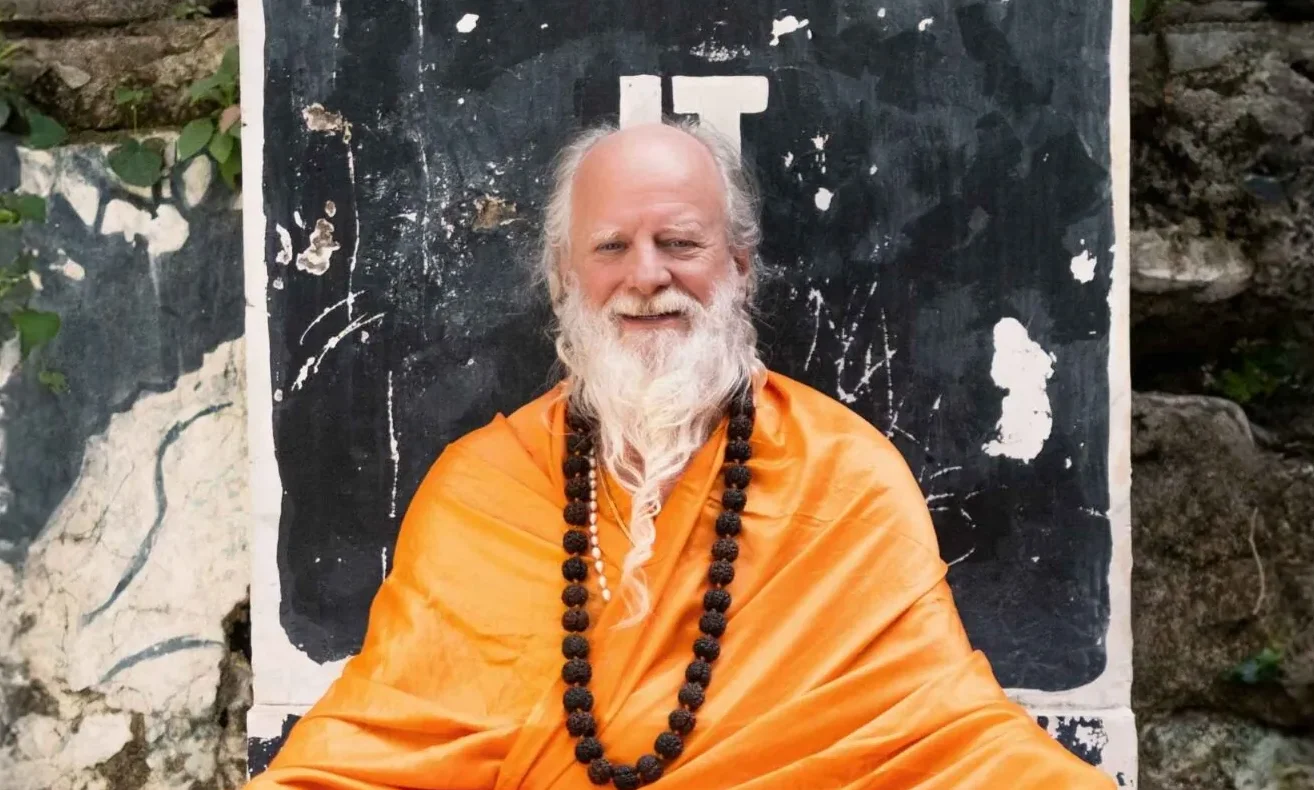
“There’s always something that’s too big to be made toxic. We want to be that consciousness, too big to be made toxic.”
Thom Knoles
We’re often told that we live in a world full of toxic behaviour, but is it the world that’s toxic or is it our view of it that gives it a toxic flavor?
In this episode, Thom explores the true source of toxicity: the stress we carry that makes us sensitive to the inputs from the outside world.
As always Thom has a solution that allows us to remove those stresses and develop the resilience we need to be less disturbed by the forms and phenomena we come into contact with on a day-to-day basis.
Listen to or watch this episode for a grounded Vedic perspective on toxicity, stress reactivity, and the invincible integrity of the inner Self.
You can also watch this episode on YouTube here: https://youtu.be/Z5jy9j5VigE
Episode Highlights
01.
What Makes Something Toxic?
(00:45)
02.
Beyond Stoicism, Toward Vastness
(04:31)
03.
Maharishi Meets an Imposter
(06:15)
04.
Toxicity Comes From Reactivity
(08:58)
05.
Granite, Clay, and Foam Rubber
(10:32)
06.
Infinite Stability Meets Adaptability
(14:40)
07.
Premature Associations Become Reactions
(16:12)
08.
Rest Beyond What Sleep Provides
(19:43)
09.
Inner Integrity Is Invincible
(21:33)
Jai Guru Deva
Transcript
The True Source of Toxicity
[00:45] What Makes Something Toxic?
It’s important to identify what’s poisonous. That’s what toxic means: poisonous. If you are hyper allergenic, by that I mean, if almost anything that you come into contact with is like poison to you, then, you know, you have to take care.
Or, watch out: somebody said something nice to you, but they lifted one eyebrow slightly. That was a toxic expression, facial expression they gave me. Or, you took in some information that didn’t sit well with you because your inner personality has been made extremely vulnerable by it becoming field dependent.
Field dependence is a psychological term that means you don’t have a… You have an external locus of control. You don’t feel as though you’re in charge of what you’re experiencing. The world is in charge of what you’re experiencing.
When the world is in charge of what I’m experiencing, then the number of things that can make my little self inside feel challenged is just a plethora of things. I think, in general, the word toxic is itself toxic. There was a beautiful treatise written during the time of Queen Elizabeth I of England by her mentor Roger Ascham, A-S-C-H-A-M, Ascham, called Toxophilus, Toxophilus.
And Toxophilus was a treatise on archery. The Toxophili were the arrows, and, you know, arrows in those times, the arrowheads could be treated with various kinds of poisons. And this is where the word toxic came from: from an arrow point that had been laden with poison.
Toxic, it comes from Toxophilus. And so then, what is it that’s actually poison? One person’s poison could be another person’s nectar.
[04:31] Beyond Stoicism, Toward Vastness
If we are going to live our lives being vulnerable, being very, very vulnerable. By being vulnerable, I don’t mean, people often will say, “You know, it’s good to be vulnerable.” I agree that it’s good not to be defensive, because being defensive is actually a kind of demonstration of weakness.
But if we’re going to live a life of vulnerability, where I have to rely on the best intentions of others to lead my life in a smooth and frictionless way, but if others or other things cause me to feel discomfort, then that’s toxic. A toxic this, a toxic that, a toxic that, so on and so on. We need to be more resilient.
And resiliency is not based on stoicism. It’s not based on having a, forming a granite-like interior that is unmoved by the world. That’s not the answer either.
The answer is to be like the Unified Field itself: source of all, course of all, goal of all. Everything comes out of it.
Everything moves through it. Everything returns to it. That’s vastness.
Bigness is the answer. If you can become big, then you can become resilient. If you can become big, then you can become resilient.
We talk about big oceans. Even big oceans are being polluted by big industrial or big domestic polluters that are falling into the ocean. The vast ocean still can be polluted. What about the vastness of space? We don’t hear anybody talking about interstellar pollution or intergalactic pollution.
There’s always something that’s too big to be made toxic. We want to be that consciousness, too big to be made toxic. And so then, when giving a lecture once, I watched my teacher Maharishi, the Royal Albert Hall in London, filled with 10,000 people.
[06:15] Maharishi Meets an Imposter
And during question time, somebody got up, pointed their finger at him from the microphone place where it was question time, and said, “You are an imposter.” And Maharishi just looked at the man and began: you could see his shoulders beginning to shake because he wanted to laugh more than it was socially relevant to laugh. But he looked at him very sweetly and he said, “Yes.”
He said, “I accept. I accept your description of me.” And the man said, “You accept? What do you mean?” He said, “I appear to just be, and I’m giving you the impression, I’m just a person sitting up here.”
“I’m just a person who learned with a teacher.” And he said, “The truth is, we know that we are much more than that.” So I agree. “I’m an imposter.” And then he laughed and laughed and laughed and laughed like that. And he said to the man, “And your suggestion is? Let me hear your suggestion?”
[08:58] Toxicity Comes From Reactivity
“Now that I’ve agreed to your claim of me being an imposter, what is the suggestion? How can we make things better?” Now you see, somebody who’s a weaker consciousness state, extremely vulnerable or susceptible to what the outside is telling you to experience, somebody who is not Maharishi consciousness might come away from there and say, “That was a toxic questioner.” What was Maharishi’s point of view? You couldn’t have paid money to get such a fabulous interaction, because the whole audience got to watch while Maharishi interacted with this man with the most amazing aplomb. And the number of people that signed up to learn to meditate that night was unprecedented.
Thousands and thousands of people wanted to be instructed because they wanted to be like him, the man who could be called an imposter and be completely relaxed about it and answer it with just perfect aplomb, never got ruffled, just didn’t seem to care, and in fact was extremely generous and giving of spirit. And so what is it that’s actually toxic? What’s toxic is the capacity to be toxified. If you have the capacity to be toxified, we can’t find anything that’s not toxic.
Absolutely everything is toxic. If it’s something, if we’re thinking of toxicity as being something that’s capable of throwing you off the mission in life, which is 24-hour bliss, and something’s capable of throwing me off that mission, then anything… I look at my watch and, “Oh my god, I only have so many more minutes.”
Is my watch toxic? Is time toxic? Is the 20 minutes toxic? Well, evidently they are. If I’m thinking to myself, “Oh no, uh-oh, time.” So what do we do? Eliminate watches, eliminate that, eliminate things.
If you start eliminating everything that you think is going to have an impact on your terribly delicate consciousness, then you’re going to be, you’ll have a world of activity to do because you’re not going to be able to find anything that’s not in some way toxic to your delicate status. What we need to do is to become more robust. Robust and resilient.
See what resiliency means? You have a ball made out of a sphere, made out of stone, granite. Then you have another sphere. It’s made out of modeling clay.
[10:32] Granite, Clay, and Foam Rubber
For the Commonwealth listeners, it’s plasticine. Americans don’t use that word. Modeling clay.
And then you have another ball, same size, made out of rubber. A rubber ball. Maybe foam rubber, even to give it a little bit more accentuation.
The granite ball is stoic. It’s rigid. It seems to have stability until you know where the line is in it, where you can take your mason’s spike, and you can put the spike in just such a way, and one tap, and the ball splits in half.
And so that rigidity, in fact, is very vulnerable. Now we have the modeling clay. And so you can take your modeling clay ball and you can squeeze your fingers into it, and it’s malleable.
Malleability means it’s moldable. It can be molded. But when you do this to the ball, and if you do this to the ball, though it’s able to be molded, it can’t spring back.
It’ll stay in that shape until you carefully mold it back to where it was. So here we have rigidity, granite. Here we have malleability, which is, you know, easily formed but stays formed the way you form it.
Now we have the foam rubber ball. It has a degree of rigidity. We’re going to call it stability, but it’s adaptable.
You can squeeze it. You can flatten it. But the moment you remove the distorting pressure, it bounces back to being spherical.
You can take the foam rubber ball and throw it on the expressway, and trucks can run over it, and cars can run over it and everything. Flat, round, flat, round, flat, round, flat, round. This ability to spring back is what we call, in scientific use of the word, resiliency.
It is resilient. It is very malleable. It has a degree of integrity of structure to which it will return instantaneously, but it’s, you can’t defeat it.
You can’t defeat it. What is it that’s toxic for the foam rubber ball? In other words, what can distort it and make it stay distorted? Nothing. This is the thing to which we aspire.
That capacity of resiliency. We have infinite stability and infinite adaptability, all in one form, all in one function. And that is, in fact, the potential of the human mind and body setup.
That rather than avoiding the 18-wheeler, or breaking down the moment some little thing taps you, or going flat but staying flat forever, we don’t want merely rigidity. We don’t want merely malleability. We want resiliency, resilience.
And so then, how to get that? Remove the stresses from your body. You have to remove the stresses from your body. All the accumulated stress which is making you have to choose.
“Either I’ll be rigid and unmoved by this granite ball,” that’s the granite ball speaking, “or I’ll be super adaptive and just not get in anybody’s way and be passive.” That’s the plasticine, or the modeling clay ball speaking. “I’ll adapt to whatever demand anybody makes.”
[14:40] Infinite Stability Meets Adaptability
“Doesn’t matter to me. If they want me to go flat, I’ll go flat.” But then we have the foam rubber ball.
The capacity of infinite stability and infinite adaptability all together can’t be defeated. And so then, we have in a way to awaken that talent in us. And it is embedded in the human psychophysiology.
It is a greatness that’s embedded in the human psychophysiology. But it is made, it is defeated by layer after layer after layer of accumulated stress. Years and years and years of accumulating the overloads of experience and then not ever releasing it.
Now we have our finger on it. What is it that’s actually toxic? It’s not the world around you. It’s the stresses that you’re holding on to.
You don’t realize you’re holding on to them. You’re not intentionally holding on to them. But your physiology as a defense mechanism has stored memories in the cells of every overload of experience that you’ve had and has built, has inbuilt reactivity to those stresses based on the history of them.
[16:12] Premature Associations Become Reactions
All the things that were around at the time, the colors, the look, the sound, the smell, the taste, whatever it happened to be that was around at the time, making a premature commitment cognitively to, “Well, there was a red thing that was around when I had an overload of experience once. Now, if I experience red, red’s toxic to me because it makes me reactive.” It’s not the red that’s making you reactive.
It’s the way in which your psychophysiology, irrelevantly, are holding on prematurely to the danger meaning of red. Red didn’t do anything to you. It just happened to be around at the time.
And so then, how do we release our premature cognitive commitments? How do we get rid of the inappropriate production of the true toxin, which is our body continuing to reinforce old impressions that no longer have relevance because the world’s changed since that time? How do we have that freshness? We have to do this through a process of spontaneous release that occurs when we provide the unprecedented restfulness to our body that we do provide to it when we practice Vedic Meditation.
The mind settling down to the absolute least excited state, zero excitation, and then body following into levels of rest that are unprecedented. Unprecedented restfulness will allow the Creative Intelligence in the body to zoom forth and to restore, awaken the self-repair mechanisms that will eliminate the irrelevant chemistry that is that chemistry that’s holding on to impressions from the past.
It doesn’t mean you’ll forget about the thing. Maybe a dog barked at you when you were three and you got a real fright and you got a stress about that and you were sucking on a lime flavored lollipop at the time. And so now you can’t stand lime anymore because if any lime ever appears anywhere, it’s going to trigger your reaction that you had when you were three.
Is the lime toxic? The answer is no, it’s not. It just happened to be there. It’s premature.
It’s a premature commitment. So the chemicals in your body that store the memory in the cells that have to do with, in this particular analogy that I’m using, this made-up example of the association of lime with the freak-out danger of a barking dog on the other side of a fence. Is it relevant for you to be reacting that way to lime for the rest of your life? No, it’s not.
It’s not relevant. So how do we get rid of that? Our body knows how to do it, but we don’t give our body ample levels of restfulness. And by that I don’t mean go away to a five-star hotel and go to sleep for a week.
[19:43] Rest Beyond What Sleep Provides
When you sleep, your body cannot attain to the levels of restfulness that are required for total release of stress. It’s only during Vedic Meditation that the unprecedented levels of restfulness can be attained to. Nothing like that can happen during sleep.
Sleep will release a bit of superficial fatigue and some superficial tension. But to get down to the deepest stress, to release it, we have to have levels of rest that are absolute. And this is exactly what’s provided by Vedic Meditation.
So stress, layer by layer by layer, is eliminated psychophysiologically, neurochemically, from the human physiology. And with each release, a step of greater resiliency occurs. With each release, a step of greater resiliency occurs, until a time is reached where our ability to take in, and it’s not that a meditator doesn’t get stressed, just like the foam rubber ball may get stressed when a car tire runs over it, but it can’t stay stressed. When the distorting pressure is removed, it pops back to its spherical shape. We’re not saying that Vedic meditators are not capable of getting stressed.
What we are saying is they’re not capable of staying stressed. They don’t stay stressed because they have the ability to eliminate stress faster than it can accumulate. And so the net position is not a stressed position.
[21:33] Inner Integrity Is Invincible
The net position is that of structural integrity. So then we have a solution to this. How do we make less… The proper question would be, “How do we make life less toxic?” The answer is, stop blaming toxicity on the world around you.
Toxicity is over-reactivity. Toxicity is irrelevant stress reactivity. That’s what’s toxic.
Irrelevant stress reactivity. And so then, when you have that infinite adaptability, and you have that infinite stability inside you, let the world do what the world’s doing. The world does what the world does, and the integrity of my inner Self is invincible.
This is how we attain to personal invincibility. It’s not through rigidity. It’s through resiliency.
