
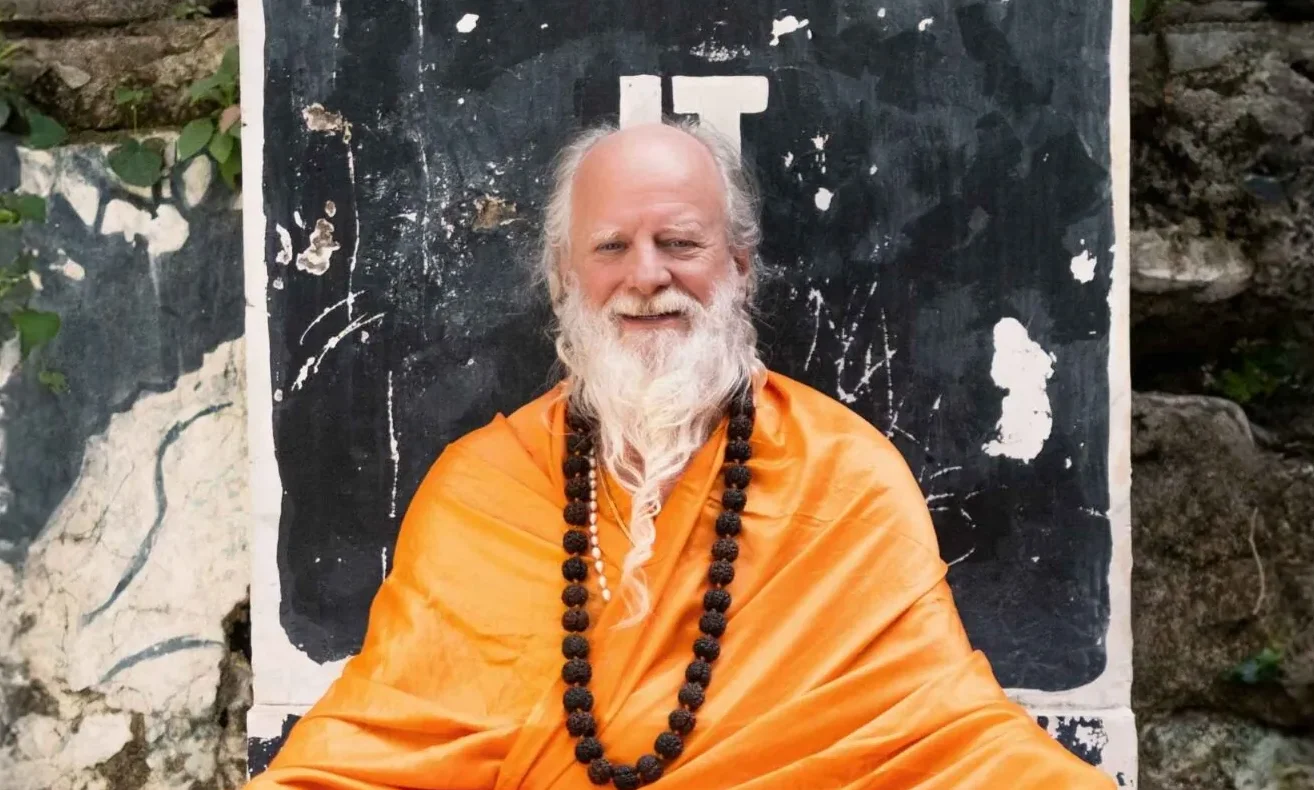
“You cannot impose order on an excited system.”
Thom Knoles
In spiritual circles it’s very trendy to speak of “raising frequency” or accessing “higher vibrations,” but what if higher vibration isn’t mystical at all, but a precise description of physics at work?
In this episode, Thom explores how order, coherence, and peace naturally emerge when we reduce excitation, rather than seek to raise it.
Drawing on the laws of thermodynamics, Thom demystifies the subject and explains the fundamentals of sustainable change.
You can also watch this episode on YouTube here: https://youtu.be/8KUIB4Plifk
Episode Highlights
01.
Q – What Is “Higher Vibration”?
(00:45)
02.
A – Excitation and Thermodynamics
(01:16)
03.
Why You Can’t Force Peace
(03:46)
04.
Superfluid Helium Seeks Unboundedness
(06:29)
05.
Superconductivity in Simple Terms
(08:45)
06.
Meditation and Society
(10:05)
07.
The Meissner Effect
(13:41)
Jai Guru Deva
Transcript
Good Vibrations
[00:45] Q – What Is “Higher Vibration”?
Guruji, when teachers talk about the need for humanity to go to a higher vibratory state, what is vibrating? Atoms in our body vibrate, chakras reportedly vibrate. Is vibration the best metaphor to use here? What is really being said? What vibrates at a higher or lower frequency and what tools help us shift those levels?
[01:16] A – Excitation and Thermodynamics
We like to here allude to the third law of thermodynamics. First of all, I better tell you what thermodynamics is. It’s the fundamental study in physics of the impact of higher or lower excitation.
Excitation always is measured in terms of vibration, wavelengths. And so if we take, for example, a beaker of very hot water and we look at it with a scanning electron microscope, what we will see is the molecules of water in an excited way, banging against each other. We call it a higher degree of randomicity, or entropy.
If we subject the beaker of water to a cooling process and start cooling it down, then spontaneously and built into the physics of the beaker of water is the capacity for the molecules to begin lining up into neat rows. And when the water does that, it becomes less excited, it spontaneously gets more orderly.
So the third law of thermodynamics states that if you decrease excitation of any system, temperature or thermodynamics is just one way of either increasing or decreasing excitation. Heat really is just one method. Anything that decreases excitation in a system will also increase order in that same system.
And so you could try to go into the hot water with your electron tweezers and try to rearrange all the molecules and get everybody, all the molecules, lined up into neat rows. But the problem is that with the excitation levels being what they are, due to temperature, the creation of order is always going to be messed up by the condition of the vibratory quality.
That is, the wavelengths that are going on at every level, from the level of the quantum wave function, to the level of the nuclei of the atoms, to the atoms in their excitation itself, and also to the overall excitation of molecules of water.
[03:46] Why You Can’t Force Peace
There’s no layer that is independently vibrating differently to the wholeness. Whenever we see excitation in a wholeness of any kind, we can find that same excitation all the way down to the quantum wave function, that is to say at the sub-nuclear level of whatever that matter is.
So when we look at society, if we try to go out and order the society by shouting at everybody to be peaceful, or protesting that everybody should start being peaceful, or we begin ordering people to be peaceful, maybe we even get guns and go out and threaten people to be peaceful, then we’re not actually decreasing excitation.
What we’re doing is increasing excitation. And it’s rather like the futility of going into the beaker with the tweezers and trying to line up the molecules of water while the temperature is still high.
All we really have to do is decrease the excitation. If we decrease the excitation spontaneously, orderly styles of behavior, orderly integrated styles of functioning, greater cohesiveness and greater coherence will begin to appear in the sociological system.
And so a decreasing of excitation as an average is the thing that’s going to cause orderliness, which is embedded and inherent in the system. That orderliness will emerge, and so order is emergent. You can’t cause order in an excited system. You can’t structure order in a state of excitation.
It’s inherent in every system, whether it’s a glass of water or human society, embedded in the excited state is the least excited state. If you can attain to it, embedded in that least excited state is high degree of orderliness.
And what does orderliness mean? It means integrated functioning, integrated functioning. So rather than disintegrated functioning, which becomes non-functional, if all the members of society are working to their own separate agendas completely in a highly excited state, you’re just going to have bedlam, chaos and mayhem.
And then if you attempt to cause order without de-exciting the sociological system, it’ll be futile. You can impose temporary patches of order through, say, fear based administration, or through people attempting to postpone their disorderly behaviors, but it never lasts.
[06:29] Superfluid Helium Seeks Unboundedness
So in order to have what people refer to in these colloquial terms as “higher vibration” or “lower vibration,” it doesn’t mean that much to me as a scientist. I look at the third law of thermodynamics, which is de-excitation. When you de-excite wave function, when you de-excite vibration, then inherent order appears.
It’s very important in this analysis to state that the ordering does not come from any external force. The ordering is inherent in the system. The order is embedded in it. What we have to do is de-excite and exploit the third law of thermodynamics in order for the order spontaneously to appear. Integrated function spontaneously will appear in any system, no exceptions, by de-exciting it.
Now we know from other elements of thermodynamics that, for example, if we take helium gas, which at room temperature, is a gas. You’ve seen it inside of party balloons, makes the balloon float around the room because it’s lighter than the atmosphere. Helium, a lighter-than-atmosphere, Earth atmosphere, gas at room temperatures is a gas.
When you de-excite the helium by cooling it, and you bring the helium down to near about Absolute Zero, which is very, very cold, then the gas suddenly turns into a fluid. It’s not a gas anymore, and it’s not a regular fluid either. It is a superfluid, a superfluid which is uncontainable.
The superfluid helium begins to spread out into a layer that is one atom thick, and you can’t contain it. If you were to put it, say, in a titanium screw top jar, superfluid helium would climb the walls of the jar, find its way around the threads and attempt to come out of the jar and spread itself one atom thick over every surface. It wants to go unbounded.
If the titanium jar was so tight that it wasn’t possible for the superfluid helium to get out of the threads, it would begin a process of percolating through the atomic structure of the titanium, and it would sweat its way out of the container. You cannot stop it from going unbounded, unboundedness.
[08:00] Superconductivity in Simple Terms
Superfluid helium has zero viscosity. So a thing is viscose, like, for example, honey, when you try to stir it in a cup, it resists stirring more than, say, water in a cup. So water has lower viscosity than honey. Air has less viscosity than water.
If you stir a spoon in a cup full of air, it has relatively little resistance. There is some but relatively little. But with superfluid helium, if you stir it, there’s absolutely zero resistance, zero viscosity, its capacity to go unbounded is absolute. Its tendency to go unbounded is absolute.
Now where does that orderliness, that quantum behavior of helium reside? when it’s a gas in a party balloon at your kid’s birthday party, helium doesn’t display any of these qualities. It is embedded in the helium itself, the capacity to go super orderly, to become a superfluid.
If we look at this, and there are many other examples of super phenomena, like, for example, superconductivity. Lead, which is normally a very poor conductor of electricity, you could take a lead bar, I don’t recommend you try this at home, but you could stick a lead bar with your bare hand, if it was long enough, into a high-voltage outlet, and you would get no tingle whatsoever, because lead doesn’t conduct electricity very well at room temperature.
But if you cool it to near about Absolute Zero, lead becomes a superconductor. It has the greatest conductivity of anything on Earth, with zero resistance to electrical current. Zero, absolutely zero resistance.
So we find orderly quantum mechanical behaviors are embedded in every system. All we have to do is reduce the excitation of the system. And so the reduction of excitation is the key. Reduction of excitation is that which causes the potential, it awakens the potential for integrated function.
[09:20] Vedic Meditation and Society
Now, what does this have to do with meditation and society? We have a society that is dominated by individuation and individual agendas. And basically, whoever can make the most noise, and who can ever frighten other people to stay away from them and let them make as much noise as they want to make, basically, whoever has the greatest amount of force can create a limited event horizon of enough order for long enough they can get something built or they can get something done.
But then left to its own devices, as society is, it will deteriorate very rapidly. The order will deteriorate, and it takes constant restructuring to maintain order in society, sociologically. Constant restructuring, constant commanding, constant attempts at and experiments at varying degrees of fear-based administration. You cause fear in somebody, and they’ll comply for a period of time so long as you’re watching. When you don’t watch, they go back to their other behavior again.
So whether it’s left politically or whether it’s right politically, the administration of fear-based approaches to getting compliance in people is never functional for very long. There is function, so long as there’s watchfulness of whomsoever is the controller, but the moment the controller takes their eyes away, it’s a return back to the previous state. And so fear-based administration just doesn’t work. It doesn’t work. It’s non-sustainable.
[13:01] The Meissner Effect
What is sustainable is adding pockets of meditators into the community. With the regular practice of Vedic Meditation, the minds of a sufficient number of people begin de exciting, and it creates, and you can look this up on your AI Google search, or any other search that you’re using, Anthropic or any of the others, and look up Meissner’s Effect.
The Meissner Effect is the spreader effect, where pockets of de-excitation can spread throughout a system and cause that system to become invincibly orderly. And there is a phase transition that occurs at a certain saturation point. If you can reach the saturation point required, you don’t have to get all elements of society meditating. You have to reach a critical mass.
And our reckoning is the critical mass is somewhere around the 1% mark. About one in 100 people meditating should be sufficient to cause a contagion of de-excitation, a contagion of order, enough that the whole system becomes measurably more orderly, more compliant, more optimized in its integrated functioning.
So bottom line, getting out of all the highfalutin language, more meditators in the community, more meditators, and then people practicing regularly, of course. Those already practicing could enhance the regularity of their practice. They could enhance the understanding that they have about what’s happening. That’s what partly these podcasts are about these episodes.
But adding increased number of meditators into, injecting that into a society is a surefire way of decreasing the overall excitation and awakening the embedded orderliness, awakening the embedded, integrated functioning.
Third law of thermodynamics. Fantastic.
