
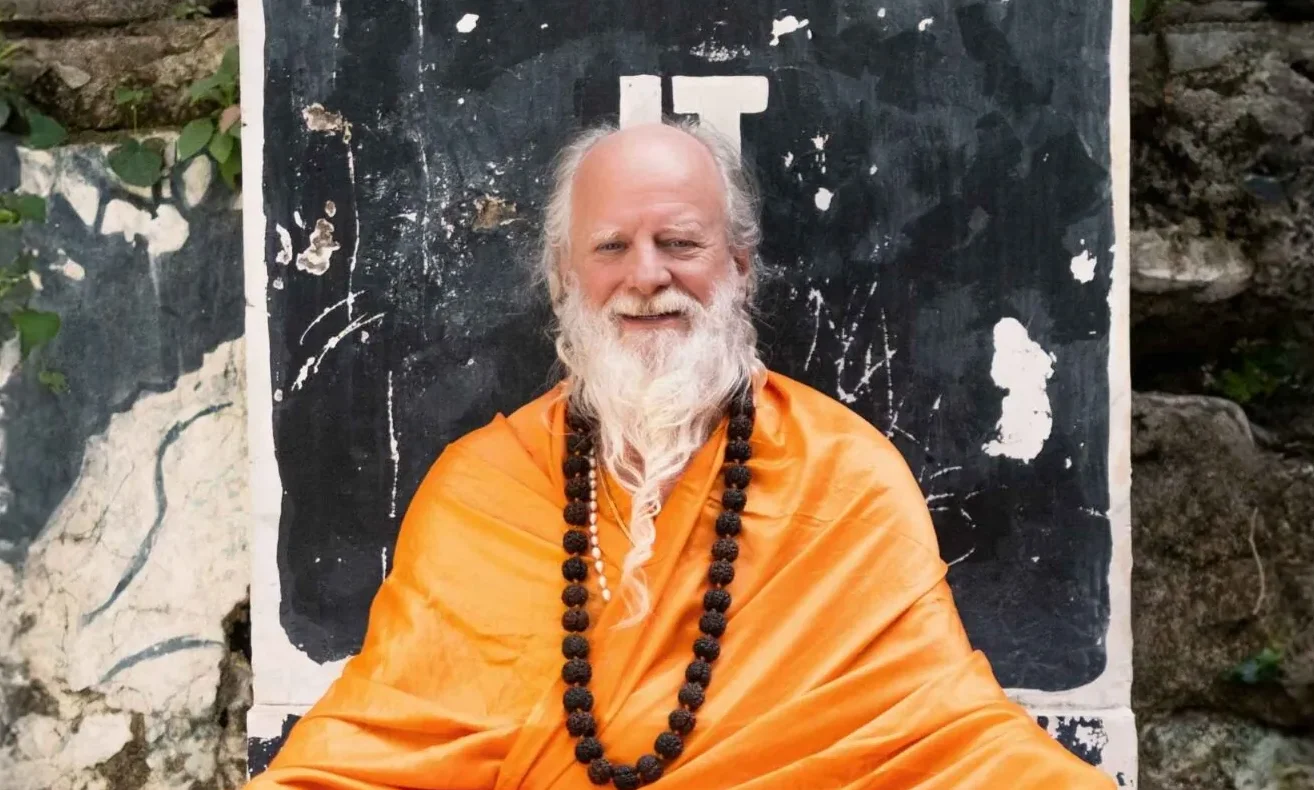
“All things are Consciousness. Consciousness is everything. There is nothing that is not conscious.”
Thom Knoles
What if consciousness is not something a body produces, but something that nothing can avoid?
In this episode, Thom explores whether an inorganic body could host consciousness, and what Vedic knowledge reveals about evolution, enlightenment, and the future of intelligence.
Thom challenges familiar assumptions about machines, suffering, war, and the role of transcendence in human progress. Listen in for a profound perspective on what it really means for Consciousness to evolve.
You can also watch this episode on YouTube here: https://youtu.be/Pki8I79CkQc
Episode Highlights
01.
Q – Can consciousness evolve in an inorganic body?
(00:45)
02.
A – Consciousness Exists Everywhere
(01:50)
03.
Satya Yuga And Repertoire
(05:09)
04.
Don’t Wait For The Cup
(09:16)
05.
War Cannot Create Peace
(11:05)
06.
The Lesson We Haven’t Learnt
(13:37)
07.
Thermonuclear Consequences Of Foggy Thinking
(15:50)
08.
Spread The Word About Transcendence
(19:02)
Jai Guru Deva
Transcript
Can Consciousness Evolve in an Inorganic Body?
[00:45] Q – Can consciousness evolve in an inorganic body?
Hi Thom. This is Nicholas from the Sunshine Coast. Could consciousness that matches or surpasses the degree that human bodies possess reside in an inorganic body? According to Terence McKenna, evolution can be described as a series of equilibrium states punctuated by violent fluctuations in between, and then a new equilibrium. Could our current age of acceleration and enlightenment within Kali Yuga be a punctuation catalyzing consciousness into super-flesh forms that might have a greater potential and more time to grow in wisdom and share with others before rejoining the pool of samsara? And if consciousness could reside in a self-repairing machine-type body with the option of turning off kinesthetic pain, would it aid or hinder the process of spiritual growth? Jai Guru Deva,
[01:50] A – Consciousness Exists Everywhere
Yes, is my answer. You ask me yes or no, and it’s yes. I’ll elaborate on the Yes.
It’s a very, very good question, and our decision to exclude consciousness from machine function is folly, because we cannot exclude consciousness from anything.
This cup has consciousness. It just doesn’t have a repertoire of consciousness that is anything like the consciousness of the house dust mite that’s likely climbing on the tabletop next to it. And so we determine the degree to which consciousness has been attained by a very simple one word, repertoire.
Repertoire. What is the range of things to which the consciousness can respond, and with what degree of success can the consciousness interact with the demand for evolution?
In the case of the cup, don’t rely on that cup to bring world peace. Don’t rely on that cup to solve the problems that are created by climate change. It doesn’t have that within its repertoire. Don’t go to the cup hoping that it’s going to give you the answer to which stock to buy on the stock market tomorrow. The cup doesn’t have that within its repertoire.
But does the cup have consciousness? Quantum mechanics says absolutely it has consciousness. Why? There’s nothing but consciousness. What is the criterion? This is a question posed to physicists, upon which the top physicists of the world all agree on the answer. What is the criterion, what is the level of sophistication of an array of molecules and atoms, what is the degree of sophistication that the thing has to have in order to be conscious? What is the threshold of complexity that then causes a thing to qualify as being conscious?
And the answer given by the top physicists of the world, some of whom I know, is one answer, existence. If a thing exists, the thing is conscious. Why? All things are Consciousness. Consciousness is everything. There is nothing that is not conscious.
So when we talk about the potential for machine consciousness to be consciousness that has a degree of capability to turn off various kinds of sensations that cause suffering, and so on and so forth… beautiful hypotheses. Let’s see. Let’s see what the repertoire is.
[05:09] Satya Yuga And Repertoire
But everything, including a speck of dust, according to the Vedic, when we talk about Sat[ya] Yuga, this is a particular time, Sat[ya] Yuga is properly Satya Yuga, S-A-T-Y-A, but it’s referred to as Sat[ya] because the final vowel sounds are often dropped in Sanskrit. So Sat[ya], Sat[ya] Yuga. Satya means truth, a period of time in which the majority of people are living in Unity Consciousness. This is Satya Yuga.
In Satya Yuga, rocks are as enlightened as the most enlightened people are today. Satya Yuga. A rock lying on the ground has vast repertoire of consciousness.
In Kali Yuga, only certain very carefully arranged molecular biological structures, so far, are able to be defined as knowing Totality while living individuality. That’s what enlightenment is, knowing oneself to be Totality, while nonetheless living individuality. This is enlightenment.
This is our definition of enlightenment. Anything that can do that demonstrably is an enlightened being, whether it has a biological nervous system or not. And so, are things progressing in that direction? Well, following Kali Yuga, following the Age of Ignorance, comes Satya Yuga, and there’s no astrological determination about when Satya Yuga can occur.
It can occur any time that people have had enough suffering. They’ve had enough of suffering to let go of the ever-repeating known. You know, you go to fulfill a desire, you inadvertently violate laws of Nature, you make yourself suffer, and then you repeat that, and repeat that, and repeat that, and repeat that. Kali Yuga.
And so then, once everyone has had enough, and in this particular era, the era of information readily available to anyone who can do this with their fingers [mimics typing on a keyboard], and turn on a computer and do that with their fingers, it’s possible to learn about how systematically, daily, twice every day, to transcend, to step beyond all of this illusion that continuous chasing of desires is the thing that is going to bring you to fulfillment. To learn how to transcend, to experience the one indivisible wholeness as your baseline of Being.
When there’s been sufficient level of suffering, then there’ll be recourse to whatever it is that if there are enough exemplars of enlightenment on the earth, people who look as though they have transcended the need to continue the experiment, the failing experiment of gaining fulfillment through desires. When there has been enough, then there will be, potentially, a universal wave of interest in learning how to transcend.
And if there can be evolution, since evolution is as real as all of history, history of the universe is a history of evolution, shows that everything is heading in the direction of being a guru. A grain of sand on the beach over here is heading in the direction of being a guru. That cup is heading in the direction of being a guru.
[09:16] Don’t Wait For The Cup
But you don’t have to wait for the cup. Come to me. I can teach you Vedic Meditation. Or one of my colleagues, who number in the hundreds, who are qualified to teach Vedic Meditation, who are experts in it, can teach you Vedic Meditation. Don’t wait for the cup to evolve.
Don’t wait for artificial intelligence to become guru like. There are already gurus extant on the earth right now, who can give you a shortcut to gaining enlightenment.
So is it possible, what you describe, the vision that you describe? Does Terence McKenna have it right? I know Terrence, by the way. I think he’s a very, very good and broad thinker, as is his his brother, Dennis, whom I also know. I think they’re very good and broad thinkers, but they need to add Vedic Meditation into their calculations.
All of that is true. What they describe, the waves of eventual progress, you suffer for a while, and then you progress, and then you suffer for a while, and you progress, and you suffer for a while, and you progress. And what should be happening is a downgrading of the suffering events, episodic suffering, and an expansion of the non-suffering, until eventually we figure out how to stop making ourselves suffer.
Is that what’s going on? Yes, that’s what’s going on. Can we speed it up? Definitely. Let’s get on with it. Let’s speed it up right now.
So it’s just a question of, at what point, collectively, has humanity reached a saturation point of willingness to repeat the known and repeat the known and repeat the known?
[11:05] War Cannot Create Peace
Let’s look at, for example, the classic idea that if sufficient numbers of people are killed, that you’ll live life in peace. So the idea that there are people who behave in a way that doesn’t suit you, or the way in which you would like to be living your life, singing the songs that you like, wearing the clothes that you like, and there are other people who sing other songs to you, and wear other clothes to you, and behave differently to you. We call that differences in culture.
And they look as though they’re winning, and you don’t want them to win. Or they look as though they’re invading, and you don’t want them to invade. So all you have to do is kill them. And if you don’t, if you kill the correct ones, the leaders, and you kill in sufficient numbers, then you’ll arrive at a beatific state where everything will just be fine, and you won’t be annoyed by these distractions from your happiness.
We’ve been doing this for tens of thousands of years, both selective killing and mass killing. We call it war. “Let’s go back to war and destroy the right nervous systems that we can identify as being in particular buildings at particular times, and let’s destroy sufficient numbers of people who think that way.” And then what? “Oh, we’ll all be back in peace again.”
Well, you weren’t in peace in the first place, and you won’t get to peace by doing this. This is not the methodology, and that should be evident, because we’ve done lots and lots and lots of it. In the 20th century alone, more than 160 million people were killed in the name of gaining peace. And then we arrived in the 21st Century, and look where we are. Did we gain the peace? We didn’t.
So where is peace going to come from? You cannot kill your way to peacefulness. You can’t kill your way to fearlessness. “Oh, there are people scaring me. Oh, there are people scaring me. I’ve identified who they are. They’re a particular club and culture. They live in this place. They hide out in those spots. Whack them all out, and then I’ll be free of fear.” No, you won’t. You will not.
[13:37] The Lesson We Haven’t Learnt
This is the lesson of history. But in Kali Yuga, this particular era in which people largely live in material and ignorance and materialism, one of the characteristics of this era is foggy thinking.
You thought it would be thrilling to stick your fork into the electrical power outlet and get a little buzz, and it shocked you and burned your hand. And you think to yourself, “Well, I just didn’t do it enough, I’ll do it again. And I just didn’t do it enough, I’ll do it again. And now I need to find, go online and find some kind of cream that helps me with my burns so I can continue sticking the fork into the electrical power outlet to see if I’m ever going to get the lovely experience that I want to have.”
And although it keeps on burning you, and keeps on burning you, and you keep on putting on more and more protective gear, and you keep doing the same thing, and it just never works. And so, what’s the characteristic of Kali Yuga? People are thick. They’re dense. Repeat something over and over and over again in hopes of gaining fulfillment or fearlessness or gaining satisfaction, and it just doesn’t work.
And so we evidently haven’t learned this lesson, because all the nations of the world right now are gearing up for war, without exception, all gearing up for the big war. Everybody’s gearing up. “Let’s stick our fork back into the electrical power point and see if this time we’re ever going to get the buzz that we’re hoping for.” And yet, history has shown us again and again and again, you cannot kill your way to fearlessness. You can’t kill your way to happiness or kill your way to peace.
[15:50] Thermonuclear Consequences Of Foggy Thinking
And so now, with 20 nations that all know how to kill tens of millions of people with a press of a button. About 20 nations have thermonuclear weapons that can evaporate entire cities in one second. We can’t really afford to keep going down this track, and it’s a very interesting position we’ve put ourselves in, where we think that killing, selective killing, selective killing, and mass killing is going to be the way to arrive at peace.
And you know, all it takes is one particular event that causes one particular leader, whether that leader has ever been democratically elected or not, to commence the process of a thermonuclear exchange, and the whole of humanity will be wiped out.
And so, then we start over from being the last few remaining humans, or maybe the cockroaches. I went to a talk once, a TED Talk, where an entomologist who, partly tongue in cheek but also using fact, was able to demonstrate that if there was global thermonuclear elimination of human beings, which, by the way, could happen in the next five minutes, that one of the creatures that likely would survive, it would be the cockroach that we all hate so much.
They have… they accumulate sufficient lead and other minerals in their shells to be able to survive fallout and radiation, and they’re only about 3 million years behind humans in getting upright onto their hind legs, developing large brains, and getting iPhones. If you don’t like the idea of a world that’s run by cockroaches, then start meditating, and help to make meditation more popular, because there is nothing that ordains human beings as being the only species on Earth that ever becomes upright, neurocentric, and capable of fostering the laws of Nature in a way that is a peaceful life.
The cockroaches might evolve right into that job if we wipe ourselves out. I mean, after all, they’ve survived millennia of us squashing them, spraying them, whacking them, and things, and they’re still here in abundance. There’s nothing pointing to their imminent death or elimination just because humans get into thermonuclear war.
[19:02] Spread The Word About Transcendence
So if we like being humans and we like being the means whereby the laws of Nature can find full expression on the earth, we need to get on with spreading the word about transcendence.
Transcend. Step beyond this petty idea of, “I’ll be fulfilled when other people don’t exist,” or, “I’ll be fulfilled when I get stuff.” There’s no acquisitive approach to enlightenment, and there’s no approach to enlightenment that is made more relevant by killing. It just doesn’t work.
So there it is, my answer to your question, my dear, highly-intelligent member of the intelligentsia questioner, you posed a question which was a yes/no, and my answer is yes.
Jai Guru Deva.
