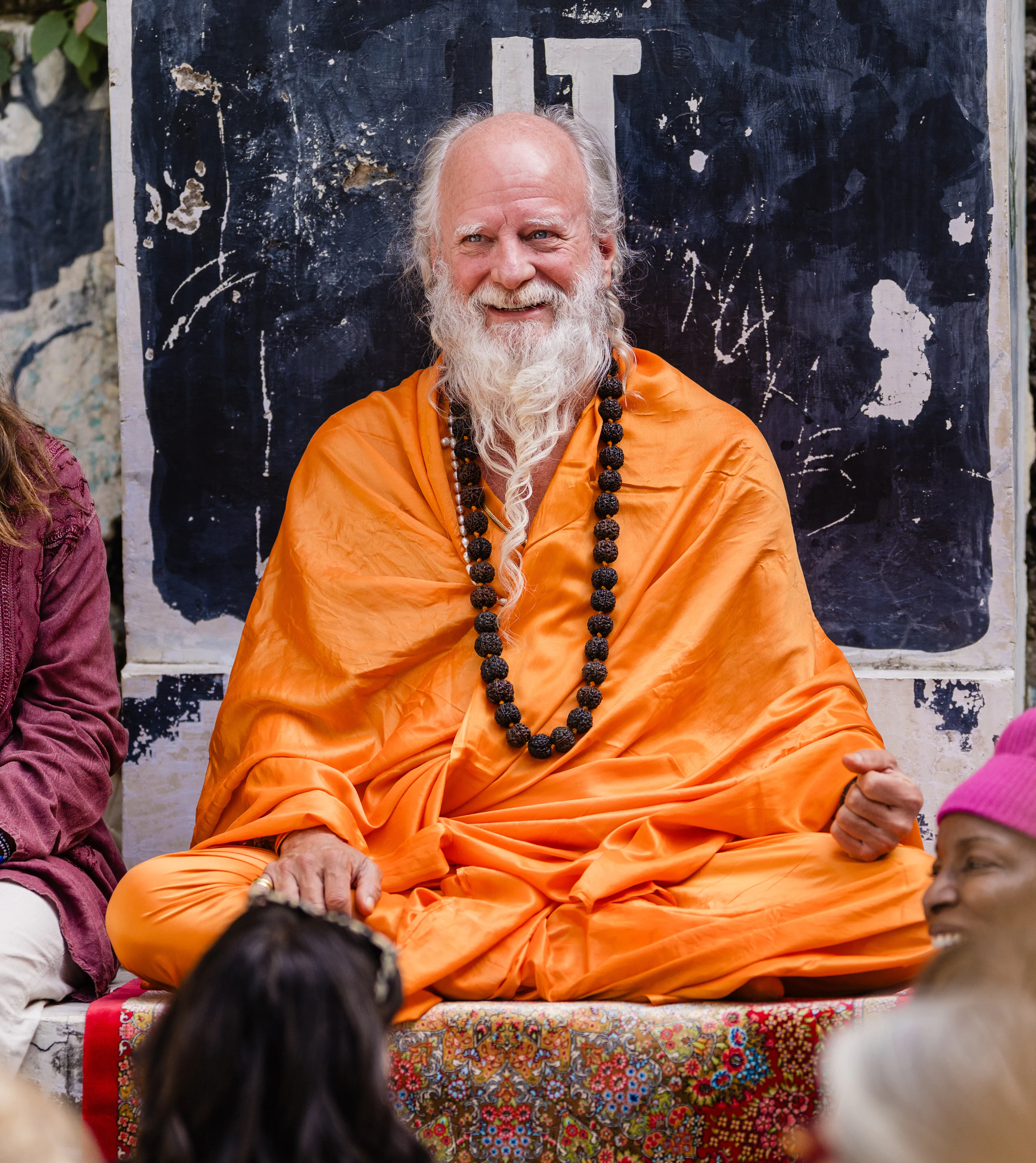
“Grace just means that somebody is living their life completely aligned with the need of the time.”
Thom Knoles
Grace and devotion are often seen as qualities we need to embody for our spiritual progress, but are they a cause or an effect? In this episode, Thom responds to a guest question about grace and devotion, clarifying the Vedic view of omnipresence, the role of devotion, and why Unity lies beyond the experience of self and Other.
It is a thoughtful exploration of evolutionary progress, deep inner consciousness, and the movement from friction to graceful living. Listen or watch for a clear and quietly radical reframing of two ideas that are often misunderstood.
You can also watch this episode on YouTube here: https://youtu.be/SgOrQJKF3rE
Episode Highlights
01.
Q – Could you talk about grace and devotion?
(00:45)
02.
A – Grace Means Relevant Living
(00:56)
03.
Grace Emerges From Within
(03:39)
04.
Devotion Begins With The Other
(05:34)
05.
Omnipresence Must Be Everything
(07:58)
06.
Science And The Unified Field
(11:41)
07.
Devotion Is A Transitional Phase
(13:22)
08.
Unity Lies Beyond Devotion
(14:45)
Jai Guru Deva
Transcript
Grace and Devotion on the Path to Unity Consciousness
[00:45] Q – Could you talk about grace and devotion?
[00:56] A – Grace Means Relevant Living
Grace and devotion are quite separate things, I think. Grace, to me, just means that somebody is living their life completely aligned with the need of the time.
That’s what spirituality is, really. You somehow, by whatever means, you’ve managed not to have irrelevant thoughts. Having irrelevant thoughts is not graceful. Having relevant thoughts is graceful. Not to have irrelevant actions. Having relevant actions is graceful.
And so someone who moves smoothly and frictionlessly has grace. That’s gracefulness. They have grace. And to me, this is what grace means, that you learn how to live without friction, and you don’t have a mind that’s constantly producing thoughts that are irrelevant, which, by the way, is caused by stress accumulation. Irrelevant thinking is caused by stress accumulation.
So to have a life of grace is not something bestowed upon you by something other, even if it’s a capital O, the Other. We have the idea in the western view, particularly those of us who have a theological or religious bent, that all grace comes from a being who lives in the heavens or lives everywhere.
And we say the being is omnipresent, but we usually don’t believe in the omnipresence. You know, we believe that the Omnipresent One has to be called upon. That if you call upon the Omnipresent One, then the Omnipresent One will respond if you’ve been good. And this defies the definition of the word omnipresence.
So omnipresence has to mean absolutely everywhere, including every cell of your own brain, right? It has to be absolutely everywhere.
So we have this belief that grace comes to us from on high, that there’s a being who can bestow grace on us, which is, you know, graceful living, graceful thinking, no irrelevant thoughts, living a life in tune with all the laws of Nature, meeting the need of the time and all of that.
[03:39] Grace Emerges From Within
The Vedic view is that grace is fully within the command of your own deep inner consciousness. Your own deep inner consciousness, that quiet place inside you, is the one, indivisible, whole, Unified Field of Consciousness, that same Unified Field out of which all of the particles are coming, all of the forces of Nature, everything.
That one, indivisible, whole, Unified Field is your own baseline, your own deep inner consciousness is that field. And grace comes from there. Grace emanates and emerges from your own deep inner consciousness.
But in order for that to play out in reality, we have to awaken that deep inner consciousness by regularly experiencing it. So long as it is something that is only temporarily conscious to us, here and there under certain very conditional circumstances, then we don’t have access to it.
So to get access to the grace, all we have really to do is to transcend thought, go beyond thought sufficient number of times, awaken that level, and then when that level is permanently awake, and we’re experiencing it all the time, even with eyes open, speaking, walking, moving, eating and all of that, then you are graceful. You’re graceful. You have grace.
[05:34] Devotion Begins With The Other
What was the other thing? Grace and something else. Oh, devotion. And devotion is a very interesting concept, too.
“I am devoted to something greater than me.” All right, that’s a good stage. It’s a good stage to give the small self relativity, my individuality. “I am devoted to God, or I am devoted to a being of some kind, but I can’t be devoted unless the thing to which I’m devoted is the non-me. That thing which is not me.
“It might be divine non-me, but whatever it is, it is greater than I am. And so the divine Other, the capital O Other, is the thing to which I become devoted.”
It’s a beautiful stage, but it has to be a stage, because, in the final analysis, if That, capital T, to which I am devoted is the ultimate, then it has the three O’s, the three oms: omnipresent, omniscient, omnipotent.
The first one is the one that does in our ability to stay devoted, omnipresent. If something is omnipresent, if it’s truly omnipresent, it’s not, it can’t be not you, otherwise it’s quasi present.
We have this word quasi, which means almost, almost everywhere, quasi present. You know, like present just about absolutely everywhere except in you.
If God is absolutely everywhere except in you, wow, you’re an extraordinary being. You’re the one exception in the entire universe.
Maybe God is absolutely present everywhere except in every human being. Well, that makes us a very unique species.
The point I’m making in being a little facetious about it is that for God to be omnipresent, God has to be you. If God is not you, God is not omnipresent. And so what is this God thing? You know, that which is absolutely everywhere must be everything. It’s not pervading.
[07:58] Omnipresence Must Be Everything
So, we could take that flower as an example. The yellow petals are made of colorless sap. There’s colorless sap inside the petals. There’s colorless sap in the green stem, there’s colorless sap in the flat leaf, there’s colorless sap in the thorn, in the fragrance.
But actually, the colorless sap makes itself into the yellow petal. The yellow petal, if broken down, will be found to be nothing but colorless sap. Same with the green stem, same with the green leaf, same with the thorn. It’s nothing but colorless sap at its base.
So where’s God? Well, where is God not? There’s not, God is not all pervasive. Pervasive means, like my kitchen sponge. There I have a kitchen sponge, and it doesn’t have water in it. It’s dry, so I hold it under the water tap, and now it’s filled with water.
And when I squeeze it just a little, I can see the water coming out of it. “Oh,” I can say, “my sponge is pervaded with water,” but there’s a sponge, the non-water, and the thing that pervades it. That’s not omnipresence.
Omnipresence would be the sponge is made of water, and it’s filled with water. It’s all 100% water. There’s no non-water. For something to permeate something else, for something to pervade something else, there has to be a thing that’s not it, and something which is it.
But this can’t be the omnipresent consciousness field. The omnipresent consciousness field must absolutely be everything, otherwise it’s not omnipresent. It’s quasi present.
So if we want to argue that God is quasi present, then we can have that argument, but that’s not God. That’s not what we know God to be.
And if God can be made to realize what it is you want, like, “Oh God, please be nice to my dog. It had a tumor discovered by the vet. And I’ve had this dog in my life for six months or six years or something, and please be kind to my dog. Make the tumor heal.”
I’m informing the omnipresent, omniscient being of what’s going on with my dog. You can imagine it from God’s point of view. “Thanks for telling me. I… I didn’t know about your dog or what you wanted or what was needed until you brought it to my desk.
“So now that you’ve mentioned it, and I’ve seen that you’ve been good, and you know, you donated to a charity, and you wanted to strike your wife, but you didn’t, and so on and so on and so on. Okay, dog will be healed.”
[11:41] Science And The Unified Field
Now, you know, this kind of childish way of looking at that reality of Totality Consciousness really is, it’s a fabric of the Age of Ignorance. This is a very, this is an age in which people don’t think very clearly. It’s famous for it. This is the age where clear thinking is not the hallmark of the age in which we find ourselves.
So we need to transcend that and think clearly. There is one indivisible whole thing. There is only one thing. Everything has to be it. Everything is it.
From the science point of view, and this is one of the places where science comes to the rescue, there is no such thing as non-Unified Field. Everything is Unified Field. It is one, it is indivisible, it is whole, but it is not formless. Even though it is seamless, it doesn’t have divisions or seams in it, but it does have forms in it.
It undulates. The one indivisible whole field undulates like waves. It has waves in it. You’re a wave. A wave of what? A wave of Unified Field. To what extent have you realized your Unified Field status?
On your way, if you’re a wave, like a curve, a swell sitting on a vast ocean, the swell may have the illusion, “I am an independent thing moving around on the surface of the ocean.” But if that swell can decrease its excitation and start flattening, flattening, flattening, the realization will come, “I am ocean. I am ocean.”
This is meditation. On our way to, “I am ocean,” there can be the realization, “Oh, there’s such a thing as ocean. Wave isn’t what this is all about.”
[13:22] Devotion Is A Transitional Phase
And this is the devotional phase, the ocean of devotion. One has a realization, “I come from, and I’m born of, and I’m emerging from a vast, unbounded field.”
I, who is the I that’s talking? It’s the individuality. Individuality is talking. What if the individuality just goes flop flat? It becomes that ocean. Wave doesn’t, the wave is not in any way connected to the ocean. Wave is ocean. It is ocean curving. Curved ocean is wave.
So when wave begins to recognize there’s something bigger, that’s devotion. When wave, if wave is going to continue its evolution, it has to become ocean. It has to become, it has to have that realization of becoming.
So devotion is a phase of our evolution, but it doesn’t bring about, devotion itself doesn’t bring about the ultimate realization, which we use the word in Vedic way of thinking about things, Unity.
[14:45] Unity Lies Beyond Devotion
Unity Consciousness is not a product of devotion. Devotion is a stage that you go through on your way to Unity Consciousness, Recognition of the one, indivisible wholeness, on the way to unifying with That, then there is devotion.
So devotion is a stage. It’s not a systematic technique that causes Unity to occur. You see the difference?
So devotion does play a role, but you can’t decide to get devoted. “I’m going to get devoted, and as a consequence of my devotion, I’m going to get Unity Consciousness.”
It doesn’t work that way. Your evolution, naturally, will take you through the devotional phase, and you’ll have to transcend it, because devotion requires the self and Other, and Other has to be greater than self, and that’s not a sustainable state.
There has to be Unity. There has to be oneness. There can’t be self and Other. Even if Other is the divine, then there’s still the little miserable me.
The Divine might be divine, but it’s not me. It’s not omnipresent. It’s the non-me. It’s the quasi present thing. The glorious quasi present thing, the non-self, it’s the non-self.
So for God to retain its non-self status, we have to retain a certain amount of ignorance. There has to be a certain amount of ignorance for devotion to occur. And ignorance is okay in this, in this progression, but devotion needs to be understood as a phase.
It’s a phase. It’s not the ultimate, or anything like that. The ultimate is Unity. Does it make sense?