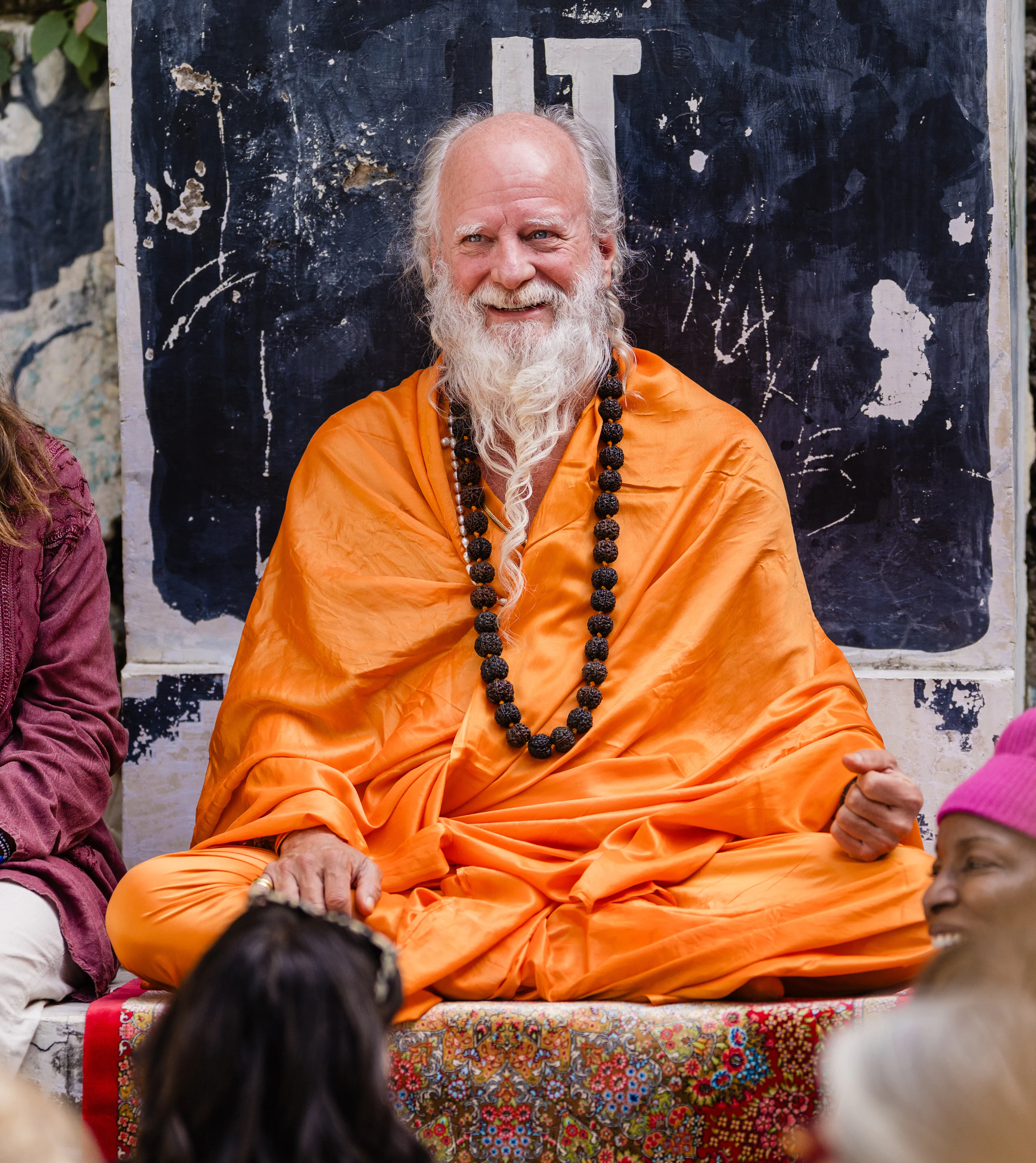
“Reincarnation is not necessary. It’s only for people who are resistant to enlightenment.”
Thom Knoles
Can we consciously design our next incarnation, or are we already doing it unwittingly?
In this episode, Thom explores the Vedic and Buddhist perspectives on rebirth, fulfillment, and the trap of unfulfilled desire. Along the way, Thom shares a remarkable story of enlightenment and a cautionary tale from the Mahabharata that reveals how easily we can mistake desire for destiny.
Listen as Thom explains how meditation allows us to live in “total and unambiguous relevance,” free from the need to chase fulfillment through endless cycles of becoming.
You can also watch this episode on YouTube: https://youtu.be/Y-nkLcRFwVQ
Episode Highlights
01.
Q – Can we engineer our incarnations in advance?
(00:45)
02.
A – Jataka: The Retrospective Approach
(00:51)
03.
Experience and Intellectual Understanding Go Together
(03:35)
04.
Fulfillment in Search of a Gelato
(06:35)
05.
Everythingness Cannot Reincarnate
(10:19)
06.
Living Life in Total and Unambiguous Relevance
(12:44)
07.
Q – Which path is better, revenge or enlightenment?
(14:56)
08.
A – It’s a Cautionary Tale
(15:44)
09.
Vedic Meditation: An End to Desperate Unhappiness
(18:37)
10.
Enlightenment: Fulfillment Seeking Need
(20:47)
Jai Guru Deva
Transcript
Can We Engineer Our Incarnations in Advance?
[00:45] Q – Can we engineer our incarnations in advance?
Can we engineer our incarnations in advance?
[00:51] A – Jataka: The Retrospective Approach
We should be looking to re-engineer all of our former incarnations in retrospect. Again I’m guided by an experience reported by the man who later in his life became known as the Buddha, Shakya Muni, the historic Buddha.
Upon gaining his nirvana, he is reported to have described an experience something akin to what we would call a hallway of mirrors. You know, sometimes you have a mirror in front of you and one behind you, in certain, kind of like a barbershop or a salon, or maybe even in your own bathroom, where you can see the back of your head.
And then if you look, you see a hallway of heads and mirrors going back infinitely, off into infinity, the hallway of mirrors. When Buddha gained his nirvana, he could see all of the individualities that his consciousness had embodied, going back all the way to a blade of grass. And it didn’t need to end there, but just for the context of a story, it ended there.
Blade of grass and then some insect, and then a more advanced insect, and then something in the amphibious kingdom, and then something in the mammal kingdom, and so on and on. And with a mere impulse of intentionality, a mere impulse of intention, he made all of them Buddha.
And so all of his past lives then became the enlightened version of that. Enlightened blade of grass, enlightened frog, enlightened bug, enlightened squirrel, enlightened deer, enlightened… And this thing is documented as J-A-T-A-K-A, jataka. Jataka, J-A-T-A-K-A, jataka.
Jataka has been, in India, turned into children’s bedtime tales. Little fables of the enlightened deer, the enlightened dog, the enlightened frog, the enlightened tree, and so on and so forth. But these are the descriptions of the enlightened past lives of the Buddha.
[03:35] Experience and Intellectual Understanding Go Together
Reincarnation is not necessary. It’s only for people who are resistant to enlightenment. When you insist upon having a bucket list, as people call it, you know, the list of unfulfilled desires before you kick the bucket. That’s what I’ve been told that means.
You know that you’re going to die one day, your body’s going to die, and as you’re lying on your death bed or lying in the gutter where you got thrown by the car or whatever it is, you’re having the thought, “If only… I feel myself dying. If only I had told Molly that I loved her. If only I had jumped out of an airplane with a parachute, but I was always too scared to. If only I had become a trillionaire. If only…”
Our if-only list, the list of unfulfilled desires, is the thing that is going to guarantee another incarnation. If what you are, what you are, if your inner identity of your consciousness, your inner identity of what you are, is a list of unfulfilled desires, then guaranteed you are going to end up in another body.
And can you structure your incarnations in advance? You’re already doing it right now, my friend, by having unfulfilled desires. It’s your unfulfilled desires that are the designer of what next you will become.
And so we don’t advocate having another incarnation. From the Vedic perspective, having another incarnation is a failure to really get it in this lifetime. How do you get it? What’s the “it” that you get?
To spontaneously experience the unbounded Unified Field of consciousness as your true inner identity. To merge with that in this lifetime, while you’re still alive and moving in a body, and to learn to accept that identity based on two things.
Direct experience, number one. Very important direct experience. Next thing is a proper, thorough-going intellectual understanding of what that experience implies. Two things. Experience and intellectual understanding go together, hand in hand, to create the enlightened state.
[06:35] Fulfillment in Search of a Gelato
And what is the enlightened state? “I’m not merely a bag of unfulfilled desires that incarnates lifetime after lifetime after lifetime, in this futile way of attempting to get rid of all the desires by fulfilling all of them.”
Because we know from our own life, you wanted a dolly. You got the little dolly, and then the dolly’s sitting in the corner. Now you wanted the bicycle, and you got the bicycle. Now the bicycle’s leaning against the fence, rusting with cobwebs all over it, and flat tires.
And then you wanted the relationship and you got the relationship, and then that got discarded. And then you wanted a car or whatever. Well, you got the car, and now that car’s gone and now you want this.
This thing of, is it possible ever to acquire everything that you could possibly conceive of acquiring and then run out of desires? Well, the evidence of life is, no, that’s not possible. If you want to gain fulfillment by fulfilling everything that you could think of, you will be coming back lifetime after lifetime after lifetime after lifetime in a futile search for fulfillment.
But if you learn Vedic Meditation and practice it regularly, you experience a baseline of consciousness in which, “I am the fulfillment. I am the consciousness that is the supreme inner contentedness. I am this consciousness. This is what I am. When I am this, I experience desires being a mechanism whereby my big consciousness, my nature, simply moves the body around.”
And so somebody who’s enlightened, who wants a gelato from the ice-cream store, is not going to gain fulfillment by getting a gelato. The body may rise, the body may move down there, and there are many reasons why that body’s moving.
Moving from here to there, touching the door, all kinds of evolutionary phenomena occur. Moving from the door to the elevator, all kinds of evolutionary phenomena occur. Seeing somebody in the elevator and glancing at them and them thinking, “I’m going to change my life and become like this person.”
Then something is happening on the way to the gelato. Walking out into the street and passing by people and all of them having an impact because they’re inside your event horizon. Then you’re having an impact.
You get to the gelato store and it’s closed, and you don’t care because having a gelato was only bait to get your body to get up and move. You weren’t going to get fulfilled by having a gelato, and you always knew it. Whether you had it or you didn’t have it wasn’t what mattered.
It was, a desire appeared to move the body around. Because the body is the encased Universe, Universe encased in a body, and that body is going to take the fulfillment on an excursion. The fulfillment is already fulfilled. It can’t get fulfilled by fulfilling a desire, and so the fulfillment gets moved around by the mechanism of desires appearing.
[10:19] Everythingness Cannot Reincarnate
And so then when we have established ourselves as being the fulfillment field itself, “I am the Universe living in a body,” then already your individual intellect has merged with Cosmic Intellect. Your individual mind has merged with Cosmic Mind. Individuality has merged with its Cosmic value, living in a breathing body.
This is enlightenment. In that state, it’s not possible to reincarnate. Why? Because when the body dies, the consciousness already is everywhere, and it has been everywhere for years. Being everywhere, it can’t leave a place and go to a new place and get embodied somewhere. The consciousness is the everythingness.
And the everythingness cannot reincarnate. It’s not localized anymore. Individuality is merged with its Cosmic value. The only thing left that makes it individual is a physical body. And when that body drops off, it’s like a drop evaporating out of the ocean.
What happens to the ocean if a drop evaporates? Nothing happens to the ocean. The ocean doesn’t reincarnate as a drop. The ocean just continues being ocean. Oceanic consciousness and the body, the old body drops off, nothing happens to that consciousness. It can’t reincarnate.
This is what we advocate. Be that. Don’t be the ever-incarnating unfulfilled bag of unfulfilled desires, to be incarnated yet again, yet again, yet again, constantly reincarnating.
Carne is Latin for meat, flesh. And incarnate means to go back into the meat, to go back into the flesh. So constantly to incarnate, reincarnate, we just don’t want the diapers and high school again, whatever it may be.
[12:44] Living Life in Total and Unambiguous Relevance
So rather than structuring your next incarnations, let me recommend to you that you structure now that permanent awareness of, “I am Universe having a human experience, living in the eternal present-moment awareness,” and being of the greatest possible use in the body that you now have, however long it’s going to last.
Maybe it’s only going to last another 15 minutes. Maybe it’s going to last another 15 years. Maybe you’re very young asking me this question, and you’re going to last another 50 years. Buddha had 50 years. He gained his nirvana at the age of 30, and then he dropped his body at the age of 80, so he had about 50 years of being able to teach how to experience transcendence to become Buddha-like yourself.
And, you know, we teach the same methodology as Buddha taught. Buddha was teaching transcendence actually. That’s what he was actually teaching. We teach that same mental technology. And so I advocate that we give up on the idea of structuring the next many miserable lives.
Is it possible for you to structure many more miserable lives where you don’t gain fulfillment? Oh, you’re doing it now. You’re already structuring many miserable lives to come.
Bring an end to all this misery. Learn Vedic Meditation. Practice it regularly. Transcend the need to continue not getting it. “One more life where I didn’t get it. One more life where I didn’t get it.” Let’s not think about our future that way. Let’s think about living life in total and unambiguous relevance now.
[14:56] Q – Which path is better, revenge or enlightenment?
So a follow-up question to that is, in The Mahabharata there’s the example of, I think the character’s name is Amba, who swears revenge on Bhishma for not marrying her, and she chooses to end her life and then reincarnate as a warrior so that she can take revenge on him basically, and bring about his death.
Which you could say was almost… we could argue that that was part of her dharma. And I’m not suggesting that any of us would ever find ourselves in that position, but is there something significant about that situation that would make it different, or would she have been better just to let the revenge go and work on her own enlightenment?
[15:44] A – It’s a Cautionary Tale
Amba would’ve been better off going to her stepfather, who was Vyasa, and asking him to be instructed in Vedic Meditation, so that she could transcend all this triviality and expand into the one indivisible whole consciousness field.
But she didn’t, and what happened was a war. She brought about the necessity for a war to be fought. In fact, the whole Mahabharata is in orbit around Amba and the mistaken intellect of Amba, and then the mistaken intellect of many others who were influenced by her.
Really the Mahabharata should have been called The Maha Amba because the whole story would’ve had no context were it not for Amba and her saṃskara, her rigid self-definition of wanting to bring revenge on a particular master of arms, Bhishma.
And so, it’s a cautionary tale in that regard. However, it is also a tale that tells us that in the end, everybody gains enlightenment. There are variants of the Mahabharata story and the exhaustive version of it, which is the 12-volume Mahabharata, where we find out what happens to the Amba consciousness as it progresses from yet another unfulfilled life, from one unfulfilled life to the next unfulfilled life, where a desire got fulfilled.
She certainly brought an end to the life of the person against whom she had vengeance, but that never satisfies anyone. It never brings an end to the idea that, “I’ll be fulfilled when…” When, whatever, fill in the blank.
“I will end up… I will arrive in a beatific state of no desires if only I can have that Ferrari. I’ll arrive in a beatific state of no further desires. I promise. I promise I won’t have any more desires. Just give me the guy or give me the girl,” whatever it is. “I promise I’ll never have any more desires, if only you give me a bicycle, Santa Claus.”
[18:37] Vedic Meditation: An End to Desperate Unhappiness
This idea that when I fulfill a desire, I’m going to arrive in a beatific state where there will be no more desires. And there are big thinkers and small thinkers, people who think, “Well when I have more dollars, liquid dollars available to me than any other human being on Earth, and I have power and prestige and I have great looks, and I’m surrounded by people who only ever say yes to me and I have all of it, then I’ll be in a beatific state with no more desires.”
We’ve never seen an example of it in the history of the world. People who’ve acquired property, people who’ve acquired power, people who’ve acquired the capability to bring about anything, and they’re not fulfilled people. They’re desperately unhappy people.
Desperate unhappiness is the product of attempting to arrive at fulfillment by merely fulfilling desires. Desperate unhappiness. And so there’s only one end to this desperate unhappiness, and that is to learn to identify, through meditation, to identify…
Not any old meditation, not like swimming-and-looking-at-the-black-line meditation or sitting-around-thinking-about-thinking meditation or concentrating-ferociously meditation or hypnotizing yourself, “I’m a queen, I’m a queen, I’m a queen,” meditation.
Meditation means Vedic Meditation. It means stepping beyond thought entirely and experiencing Being. That kind of meditation. This kind of meditation. You experience this, you experience unboundedness, oneness with that field, and then you experience what desires are actually in aid of.
[20:47] Enlightenment: Fulfillment Seeking Need
Desires don’t go away in enlightenment. They continue, but they no longer are the things that are going to bring you fulfillment. You are the fulfillment. They’re just going to bring you, the fulfillment, to things. They’re going to bring you in contact with people. Desires bring you in contact with the world that needs you.
In enlightenment, desires no longer are the mechanisms which you believe are going to bring you fulfillment if they’re fulfilled.
And so, when Krishna is asked by Arjuna, “Could you please explain to me, what are the characteristics of an enlightened person?”
Krishna gives many examples, but one of those which is the most interesting to me is, “Although beyond desires, he yet finds himself desiring.” Beyond desires, finds himself desiring. What does it mean?
“I’m the unbounded field of fulfillment, and I’m beyond any desires bringing anything of value to me, yet I find myself desiring. Desiring, even though I am utterly fulfilled, desire no longer is playing the role. This is the mistake of the intellect that gives it this role.”
Playing the role of, “I’ll be fulfilled when I’ll arrive at peace, when…” You will never arrive at peace, when…
No matter what it is that you are thinking is going to make you arrive at peace, when that thing comes, you won’t be at peace until you stop being an individual seeking fulfillment, and you become the fulfillment that lives inside of individuality. And then the usefulness of desire is to move the fulfillment around where it needs to be.
Fulfillment seeking need. That’s enlightenment. Neediness seeking fulfillment. That’s ignorance. “I am neediness seeking fulfillment.” That’s ignorance. “I am fulfillment seeking, where’s the need?” That’s enlightenment.
Amba eventually arrives at that, but she has a role to play in making the story happen, to give us all these examples of what works and what doesn’t work. And Mahabharata, the great epic of ancient India, is a fabulous cracking good tale of what works and what doesn’t work.