
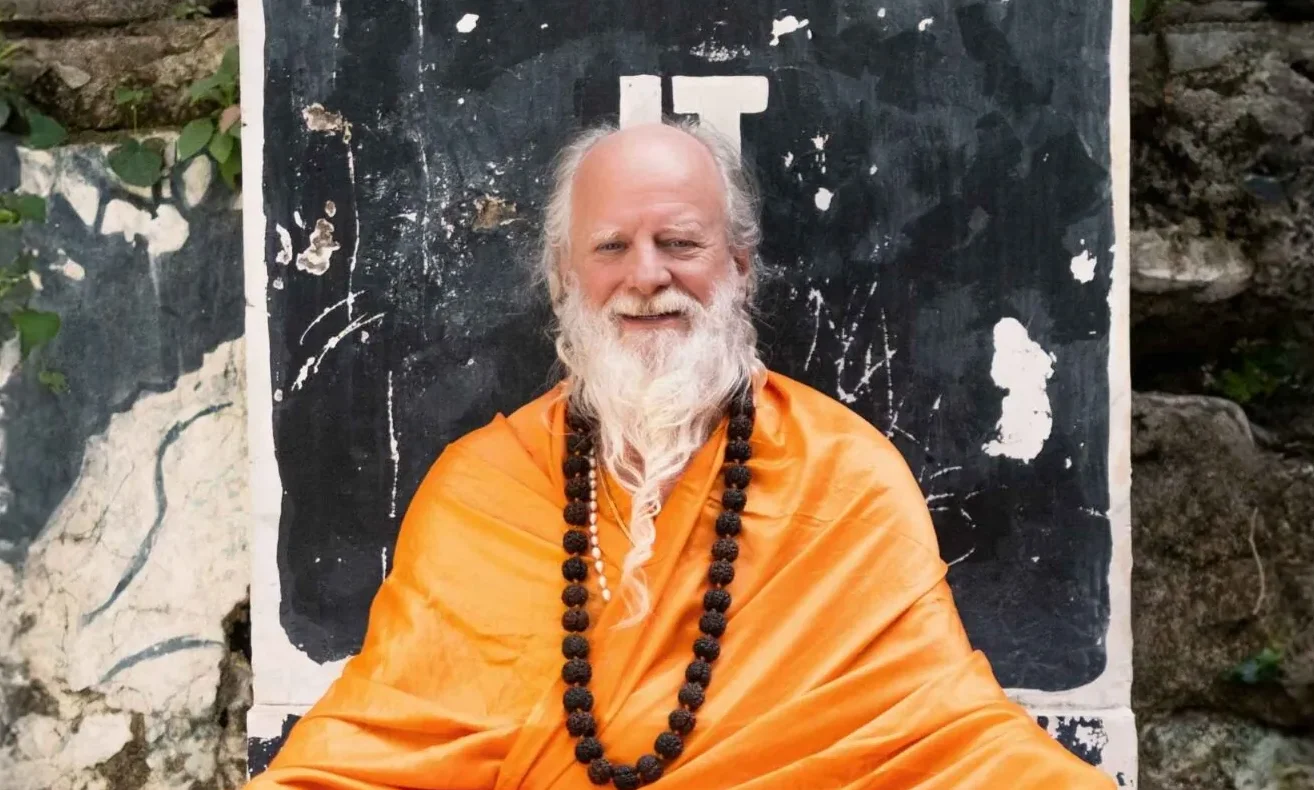
“The secret of life is being able, at will, to make yourself ignorant for short periods of time, so that you have some nice surprises.”
Thom Knoles
The ability to know what the future might hold can seem pretty compelling, but what if it has a downside?
In this episode, in answer to a question from a guest on a retreat, Thom explores why wisdom is not always an abundance of knowledge, but the ability to move between broad context and intimate human experience.
Through the lenses of dharma, avidya, and pattern recognition, Thom reveals how not knowing can be part of what makes life meaningful, relational, and full of discovery. Listen in to hear the Vedic perspective on why surprise in life is not a flaw, but part of its intelligence.
You can also watch this episode on YouTube here: https://youtu.be/JAutTLeafSI
Episode Highlights
01.
Q – Are patterns part of dharma?
(00:45)
02.
A – Zooming In and Out of Context
(01:28)
03.
Avidya and Not Knowing
(06:02)
04.
Mastering The Ignorance Dial
(09:07)
05.
Operating the Machinery of Life
(11:45)
06.
Elevational Theater
(14:48)
07.
Being Lovable Through Ignorance
(18:13)
Jai Guru Deva
Transcript
Pattern Recognition: The Hallmark of Wisdom
[00:45] Q – Are patterns part of dharma?
Yesterday you were talking about déjà vu and dreaming, and then towards the latter part about dharma and adharma, and it got me thinking about patterns emerging in our life that begin to feel like simulations, and dharma, our role in the evolution of things. And I was wondering if there’s any tie to the dharma and the pattern re-emerging, whether it’s the context of relationships, business dealings, or just situations, but they almost feel like simulations, here once again. So I just wanted to know your thoughts on any of that.
[01:28] A – Zooming In and Out of Context
Yeah, the secret of being wise is to have pattern recognition. Pattern recognition is the hallmark of being wise. Someone who’s not wise, who’s constantly like, “What? What? What?” They turn on the tap and water comes out, and go, “Oh, God. What? Whoa, I can’t take it,” but that’s been happening all the time. They just didn’t notice the pattern.
So, there are bigger patterns, bigger patterns, and everything is cyclical. Little cycles inside of bigger cycles, inside of bigger cycles, inside of bigger cycles. Absolutely everything is cyclical.
Anytime anyone goes, “All right, this is it. This is the end.” That’s not wisdom. No wise person ever said that. “Oh, this is the end. Oh, this is it. Okay. Well, now we’re done.” You know, cyclical and pattern recognition.
So to get pattern recognition, we have to have the ability to zoom in and zoom out contextually. To have that contextual capacity to go, “Okay, 10 years, all right. 100 years, all right, 1000 years. How far do I have to go? A billion?”
Because the whole universe is on cyclical patterns. Everything’s on cyclical patterns, from the atoms all the way to galaxies, it all behave the same way. Vortices, spirals spinning in orbit. From clusters of galaxies in orbit around a central black hole all the way to the nucleus of the atom and the electrons whirling around at a dizzying speed. It’s all the same thing.
Everything’s the same thing, but it seems sometimes that it’s not the same thing because our contextual boundaries get too narrow. Now, when you want enjoyment, you can’t stay out here all the time. You can’t stay in massive 1 billion year context, because then somebody will say, “Let’s go for a nice little boat ride in the lake.” And you go, “What does it matter? The universe is expanding and contracting.”
If you want enjoyment, you have to go localized. But when you go localized, there’s a certain cost, and the cost is a wearable cost. You wear that cost. Just like, you know, you fly in an airplane, it costs you money. Well, yeah, but you’re flying in an airplane. You’re not walking, so you wear the cost.
The cost of zooming in contextually is it looks like you don’t know what’s going to happen next. You lose massive context. So the secret of life is being able, at will, to make yourself ignorant for short periods of time, so that you have some nice surprises.
If you don’t know that they’re going to serve some kind of Mexican style paneer for lunch, judging by the reports that I got, it was probably a good thing that you didn’t know, otherwise, you might have decided to fast or something.
So somebody, some beautiful being, looks at you and says, “I think you’re wonderful.” And if your reaction is, “Universe is expanding and contracting in 12 billion year cycles,” it’s not very romantic. So we have to get ourselves, you know, we have to bring in the walls. Bring the walls in, narrow down, narrow down, narrow down, and then you have localized enjoyment. But if you have localized enjoyment, you don’t have all of this knowledge.
[06:02] Avidya and Not Knowing
And so in Sanskrit, we refer to this phenomenon as _avidya_. _Avidya_ is, _vidya_ means knowledge, V-I-D-Y-A, _vidya_. It’s where we get our English word, verify, validate. And also video obviously comes from _vidya_ in Sanskrit. Now, if you put an a in front of anything in Sanskrit, you’re negating whatever comes next. So _avidya_, not knowledge.
And it’s considered that wise people are not people who are just massively contextual all the time. Wise people are people who have absolute capacity. They’re in charge of context. They’re in charge of context. So you can zoom right down into the narrowest context and literally not know what’s outside that, in order to give yourself some nice surprises.
If you know everything, if there are no surprises, everything is really boring. It’s boring, but it’s also can give you relief. If you have broader knowledge, you get relief, but then you don’t get the play.
When you’re, think of sitting in a movie, and if the person who’s sitting next to you is one of those multi-dimensional types, like the screenwriter, the director, the producer and also one of the actors in the film, and they happen to be sitting right next to you, and they’re a know-it-all, and you’re watching the movie for the first time, and you’re getting a little bit like, “Oh, what’s going to happen? There’s a thing they don’t know. Oh, my God.”
And the person next year is going, “Don’t worry, don’t worry. It all turns out fine. Around the corner is another, you know, there’s a rescue coming from somebody who’s completely unexpected that you met in the start of the movie, and I wrote it that way.”
You just want that person to shut up, because now the movie is not unfolding for you. If you enjoy the unfolding of a story, you can’t skip ahead and read what’s going to happen so that you can go back and be okay with what you’re reading. That’s a terrible way to read a story. I don’t recommend it.
But in life, sometimes things happen and you get like that place in the movie where, “Oh no. Ohhh.” Then you have to be able to go out here and go, “Okay, I get it. I get it. I have greater knowledge now.” Once you have that, then the ability to move back into the boundaries again, that’s wisdom. That’s mastery, the capacity.
[09:07] Mastering The Ignorance Dial
This is… the most interesting concept in all of Vedic knowledge is not knowledge, it’s ignorance. The capacity to apply ignorance when you want it. The not knowing. Not the ability to be out here and [gestures widely with hands]. No, that’s relatively simple. You can see all the big patterns and see everything, but there are no surprises anymore. And when there’s no surprises, there’s no story.
If there is nothing but surprises, life is terrible. You’re surprised with everything. The wind changed, “Oh, the clouds came. Oh, I thought it was a sunny day. Now it’s going to rain. What the heck?” This constantly being surprised by every little change that’s going on is dreadful. But never being surprised at all is also dreadful.
So where do you find your contextual comfort? What we have to have is the capacity to move in and out at will. You wind the wheel and you say, “I think I’ll give myself some more ignorance now. I’m going to put myself in the I-don’t-know position,” because kind of fun not to know.
With AI and iPhones and everything, everybody’s like, “What was the name of that actor in that movie?” And everybody pulls their phones out. And sometimes I like to say, in a crowd like that, “Hey, let’s just not know. Let’s not know for a while. Let’s see. What would it be like not to know?”
See if your brain works, see if anybody can remember, or just live in suspense for a minute. It’s kind of fun living in suspense if you absolutely know everything all the time. And I get people saying this to me all the time who, relatively new meditators, will sit down with me and they’ll say, “Thom, where’s my life going?” And I’ll say, “You tell me a few things.” And they’ll go, “Why should I? Because, Thom, you know.”
[11:45] Operating the Machinery of Life
This is like the kid who wants to get the answer book from the teacher so that when the homework comes, they can just read the answer book and fill in the answers. You don’t learn algebra if all you do is look up the answers and insert them. You don’t know how to operate the machinery.
So in order to learn how to operate the machinery of life, you have to not know things and then find out those things. So finding out is a process where you’re moving from the suspense of not knowing, to the ease of mind of now knowing. That is sequential elaboration. That’s what allows a story to be a story. So, “I don’t know. Let’s see,” is a great thing. “I don’t know, let’s see. Let’s find out,” rather than, “Let’s get the answer book and write down the answers, and then we don’t have to operate the machinery of life.”
So this is a big lesson I’m teaching you. I hope you remember it, or if you don’t, that’s fine too, because it means that you’re operating the machinery. I’m kind of revealing a secret here, but the whole idea is being able to have mastery of the ignorance dial. “Can I make myself not know? Let’s wind the dial back, squeeze in the context.” And then, okay, if things are uncomfortable, let’s broaden the context. “Okay, now I’ve found a comfort zone, enough knowledge. It’s enough knowledge for story to play, but not so little knowledge that I have no concept of there being any thematic elevational theater.”
You see, everything, this is the spoiler, absolutely everything is elevational theater. You know this from comparing where you are now to your childhood. In your childhood, somebody lost your favorite doll, or, you know, your little dog died, or there was some little, relative to your adult life, some, what for a child was a big thing happened.
You, you put a little matchbox rattler on the spokes of your bicycle, and your brother took it off and threw it in the fire and burned it or something, and you were devastated. Something which, as an adult, you wouldn’t care about. Now, at that time, you were devastated, but here you are sitting in a chair on a lake, and evidently things turned out okay. In the fullness of time, everything evolved, and that thing was made little by virtue of how big everything got. Everything got much bigger.
[14:48] Elevational Theater
This is the theme, elevational theater. There’s a status quo. The status quo crumbles and drops, part of elevational theater. And then the status quo, a new status is built, and there’s an elevation, a climb, more knowledge, more context, more discoveries, more inventions, more improvisation, more creativity. And then a new status quo, a new plateau.
That plateau also will crumble, and then it will rise again to another thing, even higher, even better. And so I’m trying to do it in your direction. Go from right to left, status quo, fall from status quo, rise higher, new status quo, better than that one. Now this will fall, and this will rise, new status quo. There are three parts in every storyline. Status quo, fall from status quo, rise, new status quo. Fall, rise, new status quo. Fall, rise, but the average…
In geometry, we would call it a Fourier Curve. If you do a Fourier analysis of this jagged line, it’s climbing. It’s elevational. Things are progressively getting better and better.
So everything is going elevational. The question is, first of all, do you want to see it? I don’t recommend you always see it, because it’s a story. But if the story is really getting a little bit depressing, then you might want to see it, so you broaden the context, and then you see the elevational theater. But don’t stay out here all the time. You become a very boring person. Really boring.
If somebody says to you, “My name is Jorge and I’m the inventor of the successor to the iPhone,” and you go, “I know.” “How did you know? Nobody in the world knows it except me?” “Yeah, I know everything.”
“Well. It so happens that you and I share a great, great, great, great grandfather.” “I know.” You’re turning into a real this, I know. Know-it-all person. So boring. Not only is it boring, there’s no role for you in that person.
If somebody is 100% like, “I know, I know. I know. Yeah, let me tell you what it’s really about. It’s about the billion-year universe thing,” they don’t have any need that you can serve. If someone doesn’t have any need that you can serve, then there’s no place for you. You’re not needed. And if you’re not needed, then what’s, what’s the relevance of any interaction with this know-it-all person?
[18:13] Being Lovable Through Ignorance
So we have to have, interestingly, a sufficient amount of ignorance in order to be lovable, and we’d all like to be lovable, right? If you absolutely know everything, you lose your human relatability. There’s nothing that anybody can do for you. You’re too self sufficient, and that’s irrelevant. It’s irrelevant to be like that.
So this is just, you know, a warning, as you get more and more knowledgeable, not to turn into a know-it-all. It’s good from time to time to bring your contextual boundaries in and live in the I-don’t-know zone. Don’t know what’s going to happen, just the right balance of I don’t know, and I know. The right balance.
And where is that balance? It’s different in every situation. And then this comes back to your question about dharma. What is it that is dharmic to be? It’s not at all times and know-it-all that knows everything. Nor is it at all times an ignoramus who never knows anything. It’s it’s a fluctuating reality. It’s a fluctuation zone. It’s a flow and a flux.
So that’s the whole story. Elevational theater requires a plot that’s not known by everybody who’s reading it.
