
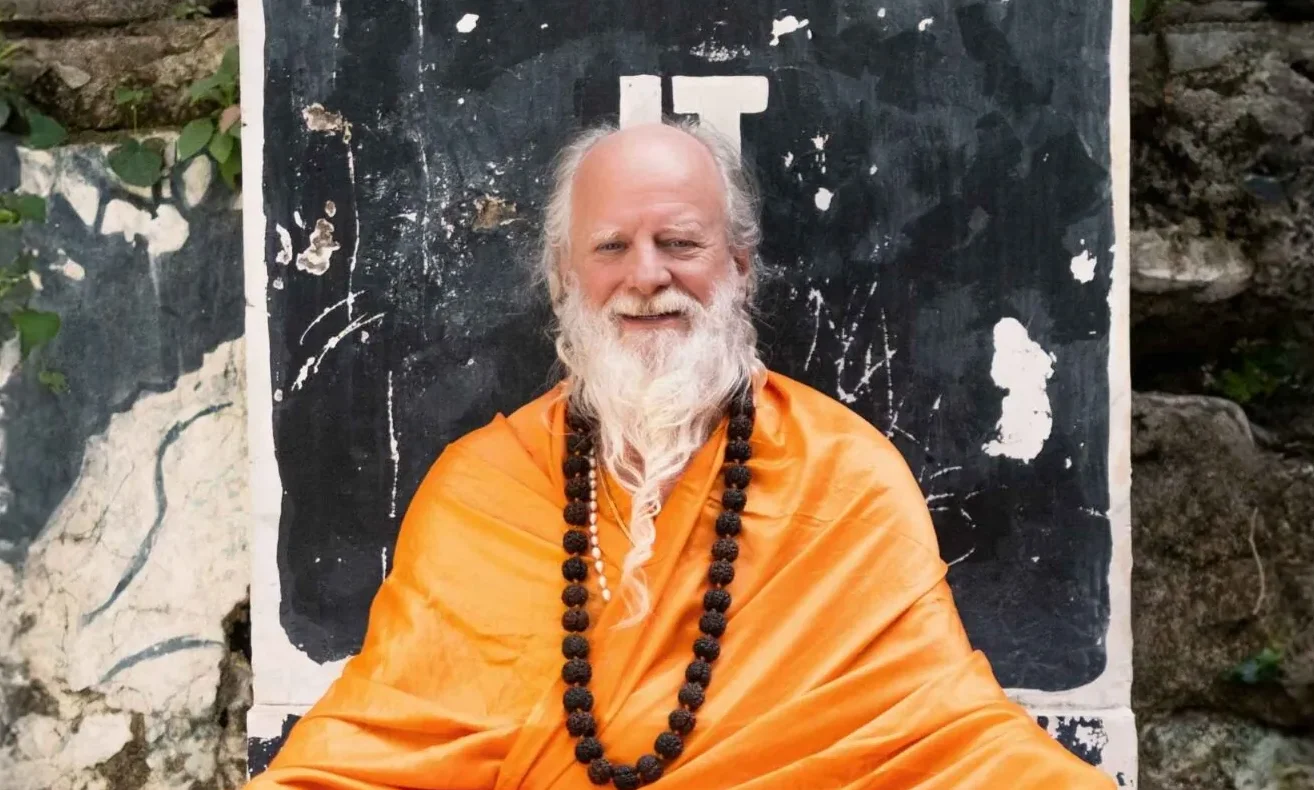
“Time is a concept to give definition to infinity.”
Thom Knoles
What if time is not an objective force, but a function of consciousness? In this Ask Thom Anything episode, Thom explores the Vedic view of time, the deeper meaning of evolution, whether God can feel individual pain, and how to think about artificial intelligence without fear or fantasy.
Along the way, he returns again and again to a central Vedic question: who is the “I” having the experience? Listen for a wide-ranging conversation on context, consciousness, and what it means to live from a larger sense of Self.
You can also watch these episodes on YouTube here:
https://youtu.be/FkHeG75R2aM
https://youtu.be/kr8E84VG_Zc
https://youtu.be/M_deSvTVZYQ
https://youtu.be/dd-3A3RX8d4
Episode Highlights
01.
Q – What is the Vedic view of time?
(00:45)
02.
A – Time Depends On Consciousness
(00:51)
03.
Dust Mites And Human Time
(02:52)
04.
The Universe’s Vast Idea Of Now
(04:54)
05.
Time Is Observer Dependent
(07:27)
06.
Q – Is evolution goal-based or Darwinian?
(09:39)
07.
A – Evolution Beyond Biology
(10:22)
08.
Life Emerges In Many Places
(12:13)
09.
Intention Reveals Consciousness
(13:53)
10.
Q – Does God feel human pain?
(16:06)
11.
A – Pain Depends On Context
(16:33)
12.
Cosmic Inclusivity Feels Everything
(19:39)
13.
Expand The Sense Of I
(21:35)
14.
Happiness Can Include Sadness
(22:47)
15.
Q – What is AI doing to us?
(25:10)
16.
A – AI Mirrors Humanity
(25:19)
17.
AI Resembles Horseless Carriages
(29:08)
18.
Humans Already Hold The Risk
(31:29)
19.
Everything Exists In Consciousness
(33:00)
20.
Stop Being Two Percenters
(35:48)
Jai Guru Deva
Transcript
Ask Me Anything: Time, Evolution, God, Pain, and Artificial Intelligence
[00:45] Q – What is the Vedic view of time?
[00:51] A – Time Depends On Consciousness
Time? Time is a concept to give definition to infinity. It’s a concept. All of time is already here.
So let’s think about the idea of now. Now [snaps fingers], that’s gone. Now [snaps fingers], that’s gone too. Now [snaps fingers], that’s gone. So what is now? I just named three nows, but they’re all in the past.
All right, so if my idea of now is maybe one second of time, now is not this morning. That’s why we say “these days,” because we don’t like to be constrained to one-second epochs. These days.
“I can’t believe these days,” you know, these days. Everybody talks about these days. How many days are in these days? Fifty days that we’re talking about? Is it a thousand days that we’re talking about?
[02:52] Dust Mites And Human Time
So inside this room right now, there are little, tiny pieces of dust. When the sun shines through here, you’ll see them, and floating on those pieces of dust, on every one of them, is at least fifty tiny little bugs. They’re called house dust mites.
A house dust mite is not the tiniest thing, but it’s really tiny. You can get fifty of them onto one little piece of dust, and you breathe them in. [Breathes in] There went… thousands of them just went in. Half of them died in that process.
I just slaughtered thousands and thousands of house dust mites. Some of them escaped, but now they’re coming back in. Watch. [Breathes in] Ahahahaha, you thought you got away. I’m just up here killing house dust mites.
Now, a house dust mite, you asked the Vedic world view on time. A house dust mite’s entire lifetime is 30 hours. They’re hatched from an egg. They quickly find a mate. They quickly get all their mating done, you know, have a date, make all kinds of commitments, get the family in, and then quickly get lots of eggs going, and then both the male and the female die. Within 30 hours, it’s all over.
Those house dust mites, when they look at the human level of now, one second, now, to them, is a huge percentage of their life. Our now is like an eternity to them. It could be, you know, one hour of a human life is 1/30 of the entire life of the dust mite. And one day, 10 days, 20 days, whatever, whatever, whatever, we are gods to them.
Not literally. They don’t sit around thinking of us, but if they could think about us, we’d be like gods to them. We are immortals. Compared with them, we’re immortal.
And so what is time? Well, time is exactly how fat is your now? What’s the now of a dust mite? It’s probably one ten-thousandth of a second. Now for a human, is about one second. Now [snapping fingers], over with, now, over with, now, over with. Now…
We go in these kind of one-second epochs for now. House dust mites, that’s a huge chunk of their life, our little now.
[04:54] The Universe’s Vast Idea Of Now
Okay, let’s go the opposite direction. There must be consciousness that’s bigger than the human. And even quantum astrophysics insists on this. There is a consciousness that is The Universe, consciousness.
And what is the now for a universe? We call it 12 billion years since the Big Bang. But 12 billion is just 12 billion times that our little planet went around a yellow star. That’s a year. We call that a year.
From the Cosmic perspective, that’s meaningless, such a tiny amount of time, one year. Boom out, boom back. 12 billion, 12 billion, 24 billion years now. Another one, boom out, boom back, boom out, squash back, boom out. These are the one seconds of The Universe.
The whole of everything that we know is in one of these and going back into that, and then the next one and going back into that. There is a consciousness state where now is 24 billion years. Right? And so if that’s true, if you could attain to that consciousness state, what would your idea of now be?
In a way, this is what we’ve been talking about today. Context. You have very narrowed context, because you want some surprises, because life’s boring without surprises. Or you’re tired of surprises, so you want to expand the context and expand the context and expand the context.
The human potential is to have Universal Consciousness, where now is this thing? Boom, boom. It means the totality of everything that did happen and can happen is there in one-second epochs doing this [expands and contracts arms and hands]. It’s all there.
But what’s relevant for you to be experiencing? You live in a human body, it only lasts some percentage of 100 years, and you want to have some localized experience while you’re in that human body, so you can’t stay out here all the time. That’s what we were talking about earlier.
[07:27] Time Is Observer Dependent
That’s the Vedic perspective on time. Time is not a thing. Time is a who. Who’s experiencing it? It’s not that time is an objective thing. Time is completely observer dependent.
Now this is not new. Anybody who studied the writings of Albert Einstein knows this. Albert Einstein figured all this out and got a Nobel Prize for it in his special theory of relativity in the very early 1900s. I can’t remember which year, maybe, ’02 or ’03, something like that, he won his Nobel Prize.
His first great discovery, the theory of special relativity. He talked about this. Time is not a what. It’s not a thing that’s objective. Time is subjective. Who’s experiencing it? It’s different depending on who’s experiencing it.
What is the state of consciousness that’s experiencing this thing called time? And you know, when you’re a little child, it’s like, “When are we going to get there? Are we there yet? Are we there yet? When are we going to get there?” riding in the car. You know, “When are we…” you know.
And the parents always say, “We’ll be there soon.” And the children go, “Aww, you always say that, and then it’s a long time.”
“Okay, well, how long has it been so far?” “It’s been hours.” “No, actually, it’s been three minutes.” “It’s been three minutes?” “Ah, it’s so much…”
So to the little child, three minutes is, if it’s three minutes that you have to wait till you get the ice cream, is just such a desperately long time.
So time is not a what, it’s a who. Who’s experiencing it? It’s all to do with the state of consciousness.
All right, Jack, and only because it’s your birthday still.
[09:39] Q – Is evolution goal-based or Darwinian?
Thanks. You speak a lot about evolution, and when I’ve read about it, we think about evolutionary theory, and as it was propounded by Darwin and later thinkers like Dawkins and Coyne, we see the premise being survival of the fittest.
When you speak about it in your podcast, you talk about evolution as teleological or goal based, and that’s certainly something which is disavowed in evolutionary theory, or certainly Darwinism. When you talk about evolution, are you talking about the same theory with a different, with a variation, or are you talking about something different?
[10:22] A – Evolution Beyond Biology
It’s something different. Biologists have kind of hijacked the idea of evolution and put boundaries on it. It’s only in in the field of bios. And so there can’t be the evolution of a rock or the evolution of the Earth. Evolution is purely living things.
And this is a very convenient way of avoiding a very ticklish subject. And every biologist, with a few notable exceptions, get really uncomfortable when you start going here.
We talked yesterday about biogenesis. What is the point at which non-biological matter becomes biological? Because it has to happen, right?
And even if you go, “Well, it’s all right. It came from Mars. A comet hit and brought it to the Earth.” “Okay? So it happened on Mars? What was the point on Mars when?” “Oh, but it came from somewhere.” “Stop changing the subject.”
The subject is, at what point do atoms that are the basis of molecules go from being non-living to living? At what point does that happen?
It makes biologists very uncomfortable, because evolution supposedly starts from the premise that biology exists, but there also has to be an acknowledgement that just before it existed, it didn’t exist. So what’s that line? Where is that line?
[12:13] Life Emerges In Many Places
Now you can go a little beyond that and get even more challenging, because the biologists who aren’t afraid of this question will say, “It can’t be that it was once upon a time in one place. It’s happening continuously, everywhere. Molecules everywhere, everywhere, are moving toward becoming life.”
And this is the understanding of a bio-friendly universe. It appears that there is a trend, and this is the only reason why we are looking for life in other places of the universe. When you ask the basic question, the fundamental question, why are humans so fascinated and obsessed with the possibility that there’s life somewhere outside the Earth? Ultimately, what does it matter?
And the fact is, what matters is we want to know, is the universe bio-friendly? In other words, is this little dot that we’re on that’s going around a little, tiny yellow Sun in one galaxy of a trillion galaxies, is this the unique place in the universe where this thing happened?
Or is it likely that there’s a trend, a trend of physical matter to move towards a nervous system, becoming a nervous system. And we rather suspect, whether we’re willing to admit it or not, that it’s the latter.
[13:53] Intention Reveals Consciousness
It appears that we’re convinced, just by our actions of looking out there, it appears that we’re convinced that the universe probably is bio-friendly, and if it is that indicates something else, which is intention. And how can a thing intend if it’s not conscious?
Now we’re really getting down to the juice of this thing. So where does evolution start? Evidently, we all agree, whether we’re biologists or not, we all agree that evolution starts with whatever it takes for bios to appear.
If little bits of sand need to move around in certain ways, certain temperatures need to be attained, to certain movement of various kinds of things like water and all of that. What is it that, what’s going to create the crucible for bios to appear?
And it looks as though we believe, because we’re looking out there for it, it looks as though we’re hopeful that this is occurring in more than one place in the universe. And if so, take the next jump. Why is the universe moving in that way, that crucibles of living things that can talk about themselves, like we’re doing right now, crucibles of living things are happening all over the place?
This seems to be, if there’s a trend, there must be, dare we say it, an intention. And if there’s an intention, there must be consciousness. And this is the frontier of science. This is the actual frontier of science.
So the limited Darwinistic evolution is not, this is not the actual boundary of the concept. The concept is everything that moves in the direction of bios, which is basically everything.
Does it make sense, Jack?
Great. Good.
[16:06] Q – Does God feel human pain?
I was asked recently, taking the concept of Vedanta and the concept that God is omnipresent, omniscient and omnipotent, does it mean then that whenever people feel pain, God also feels pain.
[16:33] A – Pain Depends On Context
Yeah. So we, first of all, pain isn’t pain. It’s a question of the extent to which individualization is there.
Somebody goes to a little child and says, “I’m going to massage your toe.” And the child’s like, “Oh, you know, watch out.”
Then you grow up to be an adult person, 30, 40, 50, 60, whatever you are, and someone says, “I’m going to massage your toe,” and you go, “I can’t wait. Could you please add more pressure to that?”
The thing that somebody calls pain in a consciousness state that’s isolated, a set of sensations that’s pain. What’s being called pain, that same set of sensations, if it’s contextualized into the big, is it felt by the one indivisible whole consciousness field?
Yes, it is being felt. To what extent is the consciousness localized? Localized consciousness? So when we look through… I have a daughter who’s an astronomer. We look through Mary’s telescope, and we see, she loves to do this, you know, zero in on a black spot between…
This is a massive telescope at an observatory, not a little kid’s telescope. Zero into a black space in between any two stars that you can see in the heavens. You do that, it looks black. There’s a star, there’s a star. She cranks up the magnification, suddenly, that black place turns into a whole bunch of galaxies.
All right. Now point the crosshairs of the telescope onto a point in between the galaxies, a black space in the galaxies. And you do that, she cranks up the magnification, and the black place opens up, and there are hundreds more galaxies.
[19:39] Cosmic Inclusivity Feels Everything
Find any black spot in space, amplify it. It’s more galaxies, and the most recent reckoning by NASA just recently doubled, recently, meaning in the last month. It was considered that about one trillion galaxies had been identified hanging in space, but they neglected to look in certain other black spots between galaxies, and now the reckoning has doubled, two trillion galaxies.
How long is it going to be before there are three? Space is the known edges of the expanding space. The edges are expanding faster than the speed of light, 186,000 miles per second, 300,000 kilometers per second.
And the mass, this number is going to change every minute, but as of the last week, 94 billion light years across. So 94 billion light years, wow, that’s a big distance. Is that thing feeling pain when somebody has a hangnail on their toe on Earth?
Well, you know, all inclusivity means it’s all inclusive. Sure it can feel not only a hang nail on the toe of a teenager who just stubbed her toe in Bondi, but that Cosmic Self can experience the disappointment that an amoeba has when it couldn’t reproduce by dividing in this second, so it’s looking forward to a new opportunity to reproduce by dividing. It can feel all that too.
Can it feel? Yes, it does feel, but we have to ask the question, who is the I? This is always the question that Vedanta brings to you. Who is this I? Is there an individuality that is going through experiences like joy or pain or expectation, delight, whatever? Yes, all that’s going on.
Who is the I? If the I is the universe, the 94 billion light years across, expanding at faster than the speed of light, with two trillion galaxies in it, yeah, it can experience the hangnails and the amoebic disappointments.
[21:35] Expand The Sense Of I
But that’s not all there is. When it’s not all there is then it’s contextualized. So now this gives us a clue to what to do about suffering. You know, “I’m suffering.” Who is the I?
You want to bring suffering into context where suffering is made less individualizing? Expand who the I is, and keep expanding who the I is.
Who is this I that’s experiencing this thing? “I thought the teacher was going to give me a B, but the teacher gave me a C, oh, my life’s over.” Who’s the I? Who’s the I?
So if we can keep expanding who the I is, then what we do is we contextualize the suffering. It doesn’t mean you don’t experience it, but you experience it in context, in its proper context.
[22:47] Happiness Can Include Sadness
I remember once a woman who said, in an introductory talk to Maharishi, it was a fabulous setting, “I hear you talking about bliss consciousness. I hear you talking about happiness. I hear you talking about Cosmic awareness, and I’d kind of love to learn to meditate, but I’m a little bit afraid of something.”
He said, “What’s that?” She said, “You see, if it’s a rainy day, in particular, I like to come home and play records.” That was the old fashioned way we listened to music.
“I like to come home and play records, and if it’s a cloudy day and a rainy day, I’ll put on a sad record. And I like to just sit in my room and look out at the raindrops and everything,” and she says, “and I put on the sad music and I cry, and I like to make myself sad and I cry.”
And she said, “I’m afraid that if I learn to meditate, I’m going to have the bliss, and I’m not going to be able to come home and get myself into that mood and listen to the music and cry.”
He says, “No, no, no, you’re misunderstanding.” He said, “You know, right now, what I hear you saying is you’re getting a particular kind of joy from crying, and the joy that you’ll have when you learn to meditate, you’re going to be able to make yourself cry so much better.”
“You’re, right now, you’re not crying to your fullest potential. Right now, your crying is only a small percentage of the potential that you have to cry. If only you could learn to meditate, you’d be using your full potential. You’ll be able to make yourself so sad, your happiness will grow dramatically from all this sadness. You’re going to be so happy with your sadness.”
He said, “Come and let me teach you to meditate tomorrow. I’m going to show you how to really get lots of happiness from your sadness, because what I hear is your sadness is making you happy.”
So these are all very interesting concepts to contemplate, aren’t they? What a master. What a master. And he had her laughing at the microphone. You know, she was just laughing, laughing like… she came and learned to meditate.
[25:10] Q – What is AI doing to human consciousness?
I’m very curious for your perspective on the evolving role of human consciousness in the age of artificial intelligence.
[25:19] A – AI Mirrors Humanity
Artificial intelligence has turned in the collective mind into this kind of bogeyman, which, I know three or four of the people who are at the absolute forefront and head of the creation of artificial intelligence.
It reminds me of a book I read once about Sydney. Bear with me.
The time was Federation, when Australia had just received permission from the Crown to call itself a separate nation, though still under the monarchy. Australia became a country of its own about 1900, around that time, right? Federation.
And during that time was the same time that horseless carriages were beginning to appear, a few Model T Fords and a few Packards and things like that. Funny cars that ran on alcohol and gasoline hadn’t yet been properly developed, and there were a few people around Sydney who had them.
And there was great consternation, because there were thousands and thousands of people who worked in the horse industry, and there were entire industries that cleaned up with straw, all of the urine and horse poo and everything that was all over Oxford Street and all up and down everywhere.
Bondi wasn’t here yet. It was all sand dunes in those days that hadn’t been developed yet. But places you know, Oxford Street, Jersey Road, all of that, covered with manure all day and all night. And hundreds and thousands of people who cleaned those things up, hundreds and thousands of people who looked after the horses, hundreds and thousands of people who worked in stables and who dealt in the field of transport.
You know you had to get around either on a horseback or be drawn by a horse round about the time of Federation. And these horseless carriages started coming in, and people were saying, “I’ll never get one of those. I’m into horses. Watch out, it’s going to take over. There will be thousands of people who lose their jobs. As soon as people can drive their own car, they’re not going to need horse and carriage anymore.
“As soon as people learn how to drive these cars around, what’s going to happen to all those people who shovel all the stuff off the roads and dump it into Sydney Harbor every night?” Apparently, from Rushcutters Bay to Mosman the floating straw and manure was three or four feet in height, and boats had to carve their way through that mess in the harbor.
And horses die every day, and the horses were just taken out round about where the Opera House is now, and thrown in. The dead horses were thrown into the harbor so the sharks would come and have a feast. And this is one of the reasons why, right up to the 1960s and ’70s, Sydney Harbor was shark city, because sharks have a memory. You know, come back and see if there’s any horses around here.
[29:08] AI Resembles Horseless Carriages
So when I hear about people going, “Oh no, AI,” I’m reminded of, “Oh no, horseless carriages. What’s it going to do? What’s it going to mean?”
AI, basically, is only a reflection of humanity as already it is. AI cannot innovate. AI cannot invent. AI cannot be creative. AI can combine and permute and show you what’s here already, and it can do it at great speed. You’ll be able to have combinations and permutations of the already known placed before you at great speed.
And the idea that it’s going to put people out of work is very similar to what happened at every phase transition of technology in the history of humanity so far. I’m sure that there’ll be lots of people out of work, but we have creativity, and there are going to be lots of other ways to make a quid and get your rent paid.
But if you’re in one of those jobs that looks as though AI can replace you, start looking now for something else to do, because it’s a little bit like, “Man, you know. I was a… I was the best, the best driver of horse and carriage in Sydney, and now look what’s happened. Nobody’s hailing me anymore. I have my handsome cab, and they’re just putting by in those Model T’s. You know, it ruined the world.”
You know you need to… we all need to learn to get with what’s happening. It’s not going to go away. This is what’s happening.
[31:29] Humans Already Hold The Risk
Is it going to take over the world and Arnold Schwarzenegger going to come back and be the Terminator and try to destroy us all? No, that’s not what’s going to be happening.
Right now, any one of 200 humans living on the Earth could go a little bit weird tonight and press a button and cause thermonuclear destruction. Humans can do that.
So for worry that AI is going to do it, aren’t we kind of postponing our worry onto a machine where a human could just have one extra wine too much tonight and sloppily decide that he’s angry at another country and instruct his generals to push the button?
This has been a reality since 1945, and the idea that we’re turning it all over to machines, my attitude is, I don’t see machines getting drunk and I see world leaders getting drunk. I don’t see machines having vendettas. I do see human beings having vendettas.
So if you’re worried about world destruction, put your worry where it should be, not on the machines that are coming, the very fault-laden 200 human beings who could destroy the world in the next half hour are alive and unwell. They’re not alive and well. They’re alive and unwell.
[33:00] Everything Exists In Consciousness
So let’s get on with putting our attention where it needs to be. AI, like everything else in the universe is made up of Unified Field. Everything is. There’s no exception. And grades of consciousness. Grades of consciousness.
So this cup has consciousness. It just doesn’t have a very large repertoire of behaviors. It’s not as conscious as a house dust mite. It’s not as conscious as a mouse. It’s not as conscious as a human.
And so we’re able to assess the degree of sentience by repertoire. How many things can a thing do? So then, when we look at AI, it is, we can’t say that it’s not conscious. There’s no black and white line between things that are conscious and things that aren’t.
Everything is conscious to an extent, to a certain extent. I’m sure some of you have a love affair with your car, or maybe you have a love/hate affair with your car. And you might have even given your car a name. And when you turn it on, you might say, “Come on, Betsy,” or whatever.
And it might have a kind of a feeling of a personality about it. It’s a machine, but, you know, it’s got a kind of personality about it, hasn’t it? I know surfers who name their surfboards and think of their surfboards as little living things.
And, well, this is a kind of truth. We have to learn to begin seeing the world as grades of self awareness. Grades of self awareness. Everything is consciousness. What’s its repertoire? What grades of self awareness does it have?
It’s not black and white. There’s nothing that’s not consciousness. Atoms are conscious. The sub-nuclear particles are conscious, and everything’s made of those things. So everything is conscious. It’s just a question of grades of it.
Will AI eventually get more conscious than it is? Well, yeah, of course it will. Is it ever going to replace the humans? Well, that’s up to the humans.
[35:48] Stop Being Two Percenters
I see a world that, according to one of my mentors, Sir John Eccles, an Australian neurologist who won the Nobel Prize in the 19 late ’60s in neurology.
I had the great good fortune of being mentored by him in his retirement when he lived in upstate New York, and he’s the one who convinced me that, due to accumulated stress, on average, and that was in the 1970s and I’m sure it’s the same now, on average, due to accumulated stress, people have access to only about 2% of their available brain’s computing power.
Not 2% topologically, of the brain. The whole brain is active, but 98% of the brain’s activity is in storing accumulated stress, images, impressions, reactivity and all kinds of things that aren’t actually here in the room. Memories of overload. Memories of overload, leaving about 2% on average.
And of course, there may be somebody who’s got five, somebody who has 1% or whatever, but on average, around 2% of the brain’s available computing power.
If we’re worried about AI overtaking us, we need to step out of that 2% thing and retrieve maximal, optimal brain functioning. And the only way of doing that is to peel away, to peel away the layers of accumulated stress. And the only way of doing that is to get systematic at exposing our nervous system to deep and profound rest, and the best way of doing that is to learn Vedic Meditation.
And so if we can make a machine that makes us irrelevant because we’re only using 2% of our brain, we deserve it. We need to stop being two percenters.
And you know, if you had 50% at least, you’re a half wit. So let’s at least get up to 50%.
