
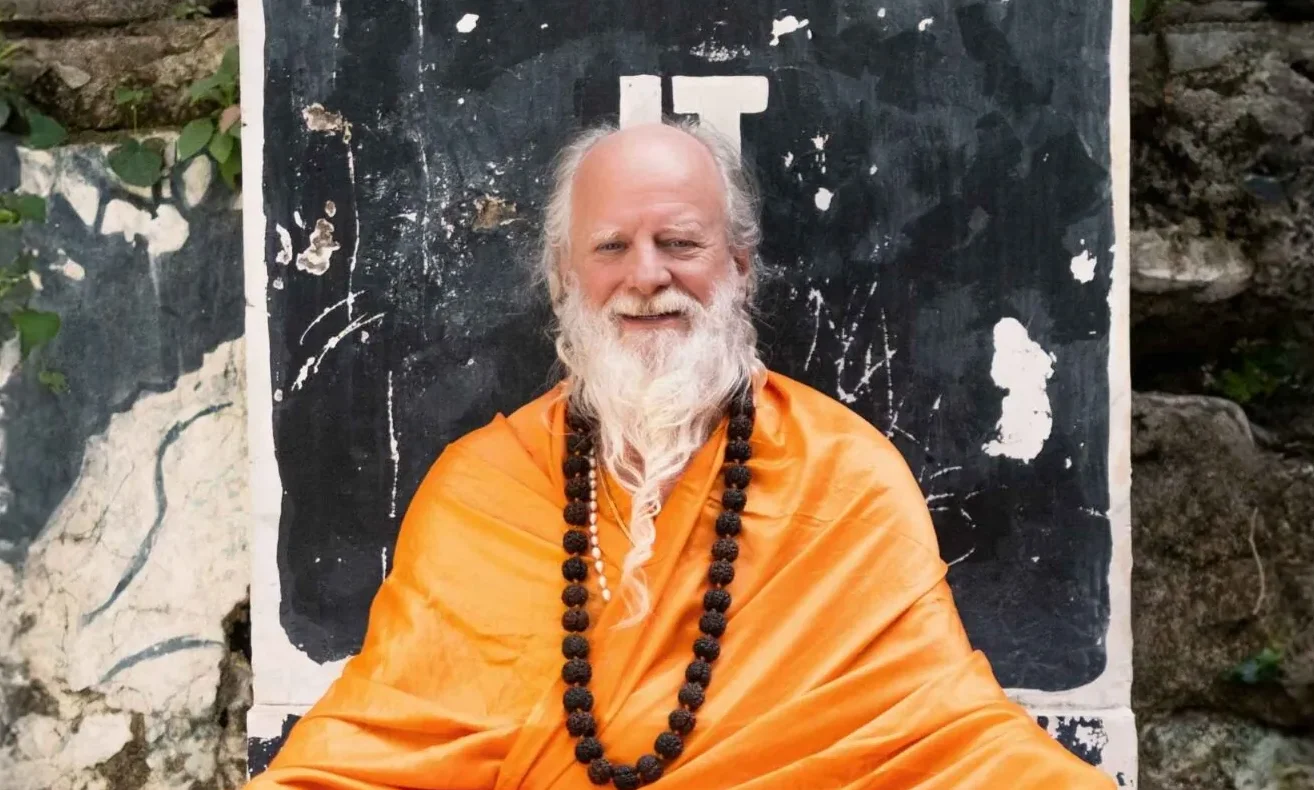
“Dhanur Veda is the Veda of awakening the full potential, awakening full potential of individuals and awakening the full potential of society.”
Thom Knoles
What creates diplomacy, and why does it seem so absent when societies need it most?
Thom explores Dhanur Veda, the Vedic body of knowledge concerned with governance, diplomacy, defense, and the awakening of collective potential.
He explains why the Vedic approach is diagnostic rather than prescriptive, and why lasting change begins not with controlling behavior, but with raising consciousness.
Listen to or watch this episode for a deeper look at how individual dharma shapes leadership, community, and society.
You can also watch this episode on YouTube here: https://youtu.be/Z96m3YmxyfA
Episode Highlights
01.
Four Vedas and Their Branches
(00:45)
02.
The Bow as Consciousness
(03:07)
03.
Governance Begins With Dharma
(04:47)
04.
Diplomacy Follows Receptivity
(07:23)
05.
Defense, Not War
(09:27)
06.
From Family to Society
(10:52)
07.
Sanskrit Flow and the Sandhi Rule
(13:12)
08.
Q – Has this been tried before?
(14:47)
09.
A – Diagnostic, Not Prescriptive
(15:01)
10.
The Vedas Measure Alignment
(19:40)
11.
Q – Is this true of architecture as well?
(21:10)
12.
A – Shaping Space Shapes Consciousness
(21:14)
13.
Ayurveda Works the Same Way
(26:10)
14.
Q – What restores diplomatic skill?
(28:34)
15.
A – Begin With Your Own Example
(29:04)
16.
Leadership Mirrors the Collective
(30:45)
17.
Confusion Breeds Corruption
(33:57)
18.
Change Society by Example
(37:03)
Jai Guru Deva
Transcript
Dhanur Veda: The Forgotten Art of Diplomacy
[00:45] Four Vedas and Their Branches
Thank you for tuning into my podcast, the Vedic Worldview. I’m Thom Knoles.
Today I’d like to introduce to you a subject of one of the branches of the Vedic knowledge. Veda is one, but it has four major divisions. The first of these is Rig Veda, R-I-G, Rig Veda. The second of them is Sama Veda. The third one is Yajur Veda. The fourth one is Atharva Veda.
Each one of these four Vedas has a subordinate Veda. Rig Veda‘s subordinate Veda, the Upa Veda as it’s called, of Rig Veda is Ayurveda. The Upa Veda of Sama Veda is called Gandharva Veda. The Upa Veda, the subordinate Veda of Yajur Veda, is a branch of knowledge called Dhanur Veda. And the Upa Veda of Atharva Veda is known as Sthapatya Veda.
Ayurveda is the science of health and relevant longevity. And Gandharva Veda is all of the arts of music and dancing. And Dhanur Veda, which is the Upa Veda of Yajur Veda, is the science and art of governance and diplomacy. And if those things fail, then warfare. The last of these is Sthapatya Veda, which is the Veda of architecture, or the shaping of space.
[03:07] The Bow as Consciousness
Dhanur Veda, the word Dhanu, it means a bow, the instrument of archery, and Veda. And so it’s not all about archery. This is an analogy for a straight, flat stick, meaning the supersymmetric Unified Field.
When you splash down onto the Unified Field and experience it in meditation, in Vedic Meditation, you are curving the bow. You’re breaking the symmetry of the flat line. If you become enlightened, then you are stringing the curved bow. That means tying a string here and bringing it to here, which holds the Totality in one consciousness. This is an analogy for Cosmic Consciousness, a fully strung bow, which has massive potential in it.
And then when you take the bow and you press the limb of the bow out and draw back on the bowstring with an arrow in place, an arrow is a thought, and you bring that arrow back and bring the string to here, and then let the string slide off your fingers effortlessly, and you have a flat trajectory straight toward the target. The powerful nature of thought in Cosmic Consciousness.
So Dhanur Veda is the Veda of awakening the full potential, awakening full potential of individuals and awakening the full potential of society.
[04:47] Governance Begins With Dharma
And so then, in any kind of civilized life and living as a collective, there needs to be some agreement about governance. Governance is the very first of the matters which Dhanur Veda takes into account.
And in Dhanur Veda, there is the prescription for an ideal society. Ideal individuals who are free from accumulated stress, whose lives are not in orbit around overloads of experience of their past, but who have been liberated from the scarring effect of these overloads, who’ve released their stress and are living a life in their fullest potential.
People who are able spontaneously to cognize their dharma, d-h-a-r-m-a, dharma. In Sanskrit, it means whatever it is that is your personal role for the moment in the evolution of everything. Are you living what is your highest and best in every given moment? Are you able to be adaptive so that you can change roles, if a change of role is what’s required of you, minute by minute by minute?
And so living dharma and having your dharma refreshed on a regular basis, this is all the vision of Dhanur Veda. Ideal individuals make up an ideal collective where everyone is playing their role in a way that fits in to the interests of the whole.
And so this is the minimal governance is required in order for Dhanur Veda, the ideal society mentality of Dhanur Veda, to be attained to. It all comes back to individuals having minimal reliance upon governing forces in order to live their lives successfully. Individuals are living their lives successfully, requiring very minimal intervention by any kind of governing force.
And so this is one way of looking at Dhanur Veda.
[07:23] Diplomacy Follows Receptivity
Dhanur Veda also deals with other societies beside your own, how to interact with, engage with, successfully, adaptively, the needs of other civilizations, other collectives that are outside the collective of the Dhanur Vedic ideal society. And so this is the realm of diplomacy.
Being able to play something of a parental role, not patronizing, but parental in the sense of having capacity, resources, the capacity to meet worthy inquiry, just as we do in individual life.
If there is worthy inquiry being made on our body of knowledge, then rather than giving advice unsought, which is considered to be a violation of the laws of Nature, in the Vedic worldview, giving advice unsought always leads to very peculiar interactive dynamics between whomsoever is giving the advice and whomsoever is supposed to be the recipient of it.
And so, in the Vedic concept, we look for either implicit or explicit inquiry, and then we meet that level of conscious receptivity on its own level, not more, not less than the conscious receptivity. And it puts responsibility on the giver of the wise and trusted counsel to be able to identify the conscious receptivity of the recipient.
Take that into a collective scale, and we have, first of all, attention on one’s own collective, rather than asking others to clean up their backyard. Be sure your own society is in great shape, and if it is, then making oneself available as a wise and trusted counseling community to other communities to the extent that they have conscious receptivity, to the extent that they ask.
[09:27] Defense, Not War
And then Dhanur Veda also then ultimately deals with, what if there’s an attack, what if there is aggression from the outside, how to deal with that. And it does have a section of it that deals with warfare.
And its opening philosophy is that if there is a war, then the purpose of military is to bring an end to the conflict as quickly as possible with absolute minimal loss of life on either side. And so Dhanur Veda deals then with matters of defense. It does not deal with matters of offense. There’s no department of war in Dhanur Veda. There’s only a department of defense.
So Dhanur Veda is a very interesting body of knowledge, and ultimately it has its innocent expression, even without studying it, just in your own daily life.
[10:52] From Family to Society
In your own daily life, you are a community of cells, 70 trillion cells are representing, you represent, your consciousness represents 70 trillion cells, the interests of your body and your well-being. And then you have your family, that’s your little society, you know, the people by whom you are surrounded who are concerned with your daily life.
And then the way in which you as an individual interact with those by whom you’re surrounded, and also the way in which you as a collective of family or community, your chosen family, whether they’re your consanguine family or they’re your chosen family, how you as a family have an ethos that interacts with the world around you, a sense, a very good solid sense of who you are and what you are.
That means some description of a sense of your collective talents, you as an individual, and then those by whom you surround yourself, with whom you surround yourself. And then what is your ethos? That is to say, what do you stand for? And then what opportunities do you see? And finally, what is your action plan? What are you known for doing about opportunities that you see?
You are a community of people with a certain degree of capability, and that capability needs to be made relevant socially. So social relevance is one of the biggest questions of Dhanur Veda: What is the relevance of one’s existence?
So all of these questions get examined and then answered in the process of taking the Dhanur Vedic look at community, family, and then ultimately, countries and their interaction with other countries all over the world. And this treasure trove, this body of knowledge, all comes under the heading of Dhanur Veda.
[13:12] Sanskrit Flow and the Sandhi Rule
It’s spelled D-H-A-N-U-R, Dhanur, and then Veda. Just a little bit of a Sanskrit lesson here. There are some rules of flow in Sanskrit. They’re called Sandhi rules, S-A-N-D-H-I.
A Sandhi rule is akin to the way in English we can’t say “a apple” or “an clock.” We would say “a clock” and “an apple.” So there are certain ways that you can put endings on words that flow into the next word properly to create grammatic correctness.
These are Sandhi rules, and the Sandhi rules in Sanskrit require us to take the word Dhanush, which is the word for the instrument of archery, a bow, and to turn it into Dhanur, because there’s a V coming, and the V is Veda. So we can’t say Dhanush Veda. In order for it to be a proper grammatic flow, it has to be Dhanur Veda.
Same with Ayurveda. Ayurveda is Ayush Veda, but Sh and V, V can’t follow Sh. It has to be turned into a U-R sound. Ayurveda is the Veda of Ayush. Dhanur Veda is the Veda of Dhanush. So there it is, a little bit of Sanskrit for you, and a description of what Dhanur Veda is all about.
Jai Guru Deva.
[14:47] Q – Has this been tried before?
“I’m wondering, has there been a large-scale attempt to incorporate this governance into a localized community that we’re aware of?”
[15:01] A – Diagnostic, Not Prescriptive
Well, large-scale and localized are kind of at odds with each other. I would say there certainly has not been large-scale any time in recorded history. Perhaps there have been times, because Dhanur Veda is more a description of something that’s already happened, rather than simply a kind of design concept that could be put into place.
It must be a description of a time, there must have been Vedic societies that reflected this, and that was described in Ayurveda. Certainly at no time in the last 5,000 years has there been any society that has operated believably along Dhanur Vedic principles.
However, it is something that’s there. Now, this is a really interesting concept you bring up, because this comes under the heading of what we call Smriti in Sanskrit. Smriti is spelled S-M-R-I-T-I. Smriti means a description of a pivotal event, which if you discover that that description fits you, it becomes diagnostic.
What do I mean by that? Rather than hoping for beautiful skin, if one finds oneself having beautiful skin, you would look up the Smriti to do with beautiful skin, and it would say that beautiful skin is a consequence of a good diet, of good rest and sleep, good meditation, and so on. “So I must be doing the right thing, because the Smriti about beautiful skin says that I have it.”
So you look at the end product and you see from that that you’re on the right track, rather than “do this, do this, do this, do this” in order to get something. So the Veda has this very peculiar way of saying to you, if you simply practice your meditation technique twice a day, your meditation technique twice a day takes your awareness into the home of all the laws of Nature. That’s the least excited state in your own consciousness.
When you’re living life in attunement with all the laws of Nature, in your least excited state, and your thoughts are coming from there, then you will discover proper levels of exercise just on the fine level of feeling, proper levels of rest and sleep just on the fine level of feeling, what should be taken and eaten and what should not be taken and eaten, just on the fine level of feeling. Without having to make a plan in advance, one ends up having what turns out to be, in retrospect, a Vedic lifestyle.
So then Dhanur Veda, rather than being prescriptive, is more diagnostic. To what extent is a society living the Dhanur Vedic ideal? Well, when you apply the Dhanur Vedic ideal to it, it’s a measuring device. But there’s a lot missing here. So rather than trying to do the things that are described in Dhanur Veda, you get the whole society meditating. You get them practicing their meditation twice a day, and then you can tell the extent to which that’s working by the way that spontaneously they arrive in that Dhanur Vedic way of behavior.
[19:40] The Vedas Measure Alignment
So rather than being prescriptive, which could also then be a bit condemnatory, Dhanur Veda is diagnostic. It’s a diagnostic tool that you can apply to a society.
When you find that a society is not living according to the Dhanur Vedic ideal, you don’t try to adjust the behaviors. You get everyone meditating, or a larger percentage of people meditating, and then you measure it again, maybe after six months or a year, and you see to what extent the diagnoses of Dhanur Veda are applicable in the case of an individual community.
This is true all the way through the Vedas. Vedas are non-prescriptive. In other words, they’re not offering unsought advice. They provide you with an ideal against which you can measure how well you’re doing physiologically, mentally, sociologically, and environmentally.
And then if you find you fall short, the answer is not to tinker with the superstructure, but get down into the basis and get those individual minds transcending and experiencing oneness with the home of all the laws of Nature. So that rather than taking an intellectually delineated approach, “don’t do this and do do that, and don’t do that and do do this,” and so on and so forth, just transcend all of that, align yourself with the laws of Nature, and then you’ll see spontaneous change occurring, which will meet a higher percentage exam. When we do the exam, the Vedic exam, we can see a more ideal life is being lived.
There’s a very unusual way in which all the Vedic knowledge applies itself to individuals and to society. It’s non-prescriptive. It is diagnostic.
[21:10] Q – Is this true of architecture as well?
“Is this true of architecture as well?”
[21:14] A – Shaping Space Shapes Consciousness
Yes, so architecture comes under the heading of Sthapatya Veda. And in Sthapatya Veda, there are ideals of the shaping of space that are talked about. And the way that architecture is discussed is that space, or Akasha, Akasha is the name for space in Sanskrit, Akasha is one with consciousness.
So when you shape space, you’re shaping consciousness. And so then what is the consciousness state that’s created by a particular design where you’re really designing boundaries? I like to use the example of just over here, Grand Canyon.
When you look at Grand Canyon, it’s vast, it’s stunning, it is awe-inspiring, and you just can’t believe what you’re seeing. Now, I’ll take people to the rim of Grand Canyon, let them have a look at that, and they always, if they’ve never seen it before, or even if they have, they gasp when they’re looking at it, standing on the rim of this canyon.
Just to give you an idea of concept, one mile deep, so 1.6 kilometers straight down, and 25 miles from rim to rim, so many kilometers, nearly 40 kilometers from rim to rim, and then 240 miles from left to right. So the vastness of it, and there’s a big river down there, which you can see, the Colorado River at the bottom of Grand Canyon is about 100 meters, about 100 yards across. But when you’re looking at it from the rim, it looks like a tiny little thread. So you get an idea of the size of everything.
Then I’ll ask my friends or students, “Let’s just do a little exercise. We’re sitting on the rim, we’re going to lie back on our back and look up at the sky.” And on a beautiful clear day, there’s the vast blue Arizona sky above you. And I’ll say to them, “You’re right now, instead of looking at the canyon, you’re looking at something that is a million times bigger than Grand Canyon. And you can see this from your backyard. Why are you not lying on your back in your backyard just saying, ‘wow, wow’? I’ll tell you why. It’s not the space. It’s the walls.”
It’s the walls that make Grand Canyon grand. And so it’s the shaping of the space, the shaping of it. When you shape the space, you’re taking unboundedness and you’re putting boundaries on it. So Sthapatya Veda, Architecture Veda, begins its process of talking exactly like this. Space is consciousness. It’s one with consciousness. This is a fundamental tenet of the Vedic worldview.
When you shape space, you’re shaping consciousness. You’re creating a being. It’s a personification of space. By taking unbounded consciousness potential and putting boundaries on it, you’re shaping it. So you’re creating an entity when you create space, when you shape space. And architecture is all about what kind of entities are you creating, and what characteristics do they have. For what purpose are you creating like that?
So then in Sthapatya Veda, it says, when this particular purpose is conceived of, this is the space. This is the space shaping to which you’ll find yourself conforming. But it’s non-prescriptive. It doesn’t say, “instead of doing that, do this.” It says, if you find yourself doing something other than this, rather than trying to change your behavior, what you do is learn to transcend.
Because where does this concept come from? Well, it comes from the rishis who cognized Sthapatya Veda. How did they get to have that consciousness where they could conceive of this? They didn’t do it by prescription. They did it by allowing their consciousness to unify with the underlying field, which has all the laws of Nature embedded in it. And the reason is that if you go by prescription, you get rigidity.
[26:10] Ayurveda Works the Same Way
So let’s use Ayurveda as an example in this. In Ayurveda, there are all of these different suggestions about food combinations, about time of day where you would eat, times of day when you would sleep, and so on and so on and so on.
If you meet a great rishi who, when the vaidya feels the pulse of a rishi, they’ll say, “fantastic.” But if you actually follow the behavior of the rishi, they may not be living according to the Ayurvedic rulebook. Because the rulebook of Ayurveda is really non-prescriptive. It tells you that if your consciousness is attuned with the laws of Nature, these are the ways in general that you’ll find yourself behaving, rather than if you behave in these ways, your consciousness will unify with the field. That doesn’t work.
Unify with the field, in other words, if you don’t meditate, you can’t practice Ayurveda. How do you know the extent to which you’re unifying with the field? Well, one of the ways is to take the diagnostic of Ayurveda and to discover that I’m spontaneously behaving these ways, rather than, “I should behave these ways and then I’ll get unification with the field.” It doesn’t work that way.
So unification with the field is primary and then the behaviors are secondary. And Ayurveda is more of a diagnostic than it is a prescription. Now, for most people who don’t meditate, the Ayurvedic doctors will say, “don’t mix salt with milk,” and so on and so on and so on and so on like that, all these little things. And people have no choice, because they don’t meditate, except to treat it prescriptively.
But Ayurveda is not actually a prescription, it’s a diagnosis. And this is true of everything that’s Vedic, absolutely everything. It provides you with a diagnosis of the extent to which you’re attuned with the Unified Field, rather than a prescription as to how to get attuned with it. We can apply this right across the whole of Veda.
[28:34] Q – What restores diplomatic skill?
“It seems that nowadays, a lot of leaders, not just political but also business and other realms, have forgotten or perhaps never knew the art of diplomacy, resolving to Twitter or X to make their views known, for example. They seem to be engaged in a battle of one-upmanship rather than trying to resolve differences. As well as practicing Vedic Meditation, what else can they learn from Dhanur Veda to restore their diplomatic skills?”
[29:04] A – Begin With Your Own Example
What we need to learn from Dhanur Veda is how to restore our own diplomatic skills. We don’t look to others and say, “those people are doing this and they should be doing that.” So the Vedic worldview, the Vedic approach to things is non-prescriptive. It is more a diagnostic.
When we see leaders, and by the way, even in the absence of Twitter, leaders since time immemorial have all been behaving like this, the exact way that my questioner described. There are very few leaders who actually lead because leaders, so-called, are actually followers.
What are they followers of? They’re followers of what the collective will tolerate. They have their finger on the pulse of what the collective will tolerate. And whatever the collective seems to be able to tolerate, that will be their behavior.
[30:45] Leadership Mirrors the Collective
What is it that determines what the collective tolerates? It is the individuals of that collective. And so individuals of a collective have a certain consciousness state. And that consciousness state radiates into the environment around them what is acceptable and what’s not acceptable. It all comes from individuals.
And so, when we have, let’s say, supposing we had a small town of 10,000 people, and in that town of 10,000, they were all highly enlightened people, who would lead those highly enlightened people who have zero ambiguity about what is acceptable and what isn’t? Well, it would take only a highly illuminated leader to represent a collective of 10,000 people who are enlightened, who are unambiguous about what it is that’s acceptable and what is not.
All right, let’s take a neighboring community, let’s put them a thousand kilometers away just to make sure that there’s no cross pollution. And it’s also got 10,000 people in it. But that 10,000 people, the individuals, are ambiguous about what is acceptable in life and what is not acceptable in life. The atmosphere is an atmosphere of ambiguity about what’s acceptable and what isn’t. The atmosphere is an atmosphere of confusion about what’s acceptable and what isn’t. Individuals within families give mixed messages to each other about what’s acceptable and what isn’t. And those families are giving messages to other families about what’s acceptable and what isn’t.
Now you put a leader in charge of that, and that leader putting his or her finger on that pulse is going to say, “I’m going to see what I can get away with here.” Because this collective is very ambiguous about what’s acceptable and what isn’t. There’s no common agreement about anything.
[33:57] Confusion Breeds Corruption
So when there’s no common agreement about anything, what we end up with is a leader who is able basically to serve his or her own particular agenda while attempting to convince the people that he or she is acting in their best interest. And this is what we call corruption. There’s no other word for it.
And so where is corruption absent in the world today? Nowhere. It’s not absent in local city councils. It’s not absent in groups of families who meet together for a common purpose, let’s say ice skating. They all are in the ice skating community. There’s corruption in there too.
It’s in city councils, it’s in counties, it’s in states, it’s in federal, and it’s in all of the nations together united in one place supposedly. And what is the corruption? The corruption means that it’s anybody’s guess what’s acceptable to a collective because the collective itself is made up of individuals who are confused about what’s acceptable and what isn’t.
So, so long as we have confused individuals, we’re going to have corrupt leadership. And the leadership is not really leadership. A leader is really only an expression, an innocent mirror of the collective that they supposedly represent.
So whenever we see a leader whose behavior we don’t agree with, we have to go straight back here again. And we have to be sure that we’re a solid citizen. By being a solid citizen, I mean that we are ourselves personally attuned with all the laws of Nature. We are ourselves completely attuned with our dharma, our personal role in the evolution of everything. And that we have that infinite stability and infinite adaptability to be dharmic, to be leading a life where minute by minute we are attuned with the laws of Nature.
[37:03] Change Society by Example
And so, once I’m okay, then I can start seeing to what extent I can radiate and be an exemplar to others who might come to me and say, “How do I get to be more like you?” And you say, “I’m so glad you asked. I thought you’d never ask. I practice meditation. If you’d like to learn it, I’m happy to introduce you to the local teacher of it. Or if I’m a teacher of it myself, I’ll teach you. How’s three o’clock tomorrow?”
To be an exemplar. And so what’s the solution to unideal societies? It is not prescriptive. You can go out and shout at leaders all the time and say, “do better, do better, do better.” People have been doing that since time immemorial. People have been shouting at leaders for thousands upon thousands of years. And what we get is a reflection of whatever the average deserving power of that collective is.
And that’s a hard pill to swallow if you are a relatively integrated member of society, to look at the leadership and say, “that’s a reflection of the average deserving power of your community.” People don’t want to hear that. They want to shout at those leaders and say, “do better, do better, be this way, don’t be that way,” and all of that. But those leaders are only leaders because they’ve been created by, they are opportunistic, and they’ve been created by the lack of high consciousness of the collective.
When the collective gets more high conscious, more highly conscious, the leadership naturally is forced to change. So we can’t just decry the leadership. We have to look at ourselves. We have to look at our family, our family ethos. We have to look at our familial interactions with other families. We have to start looking at society. But the very first place to look is how ideal are you? How ideal are you?
If you really are ideal, you’ll be an inspiration to others, and you’ll be able to change society by being an exemplar and providing wise and trusted counsel to those who are around you. Don’t wait for the leaders to do it. That’s my advice. Never wait for leaders or for governments to create an ideal society. They do not know how to do it. Only individuals can do that.
Jai Guru Deva.
