
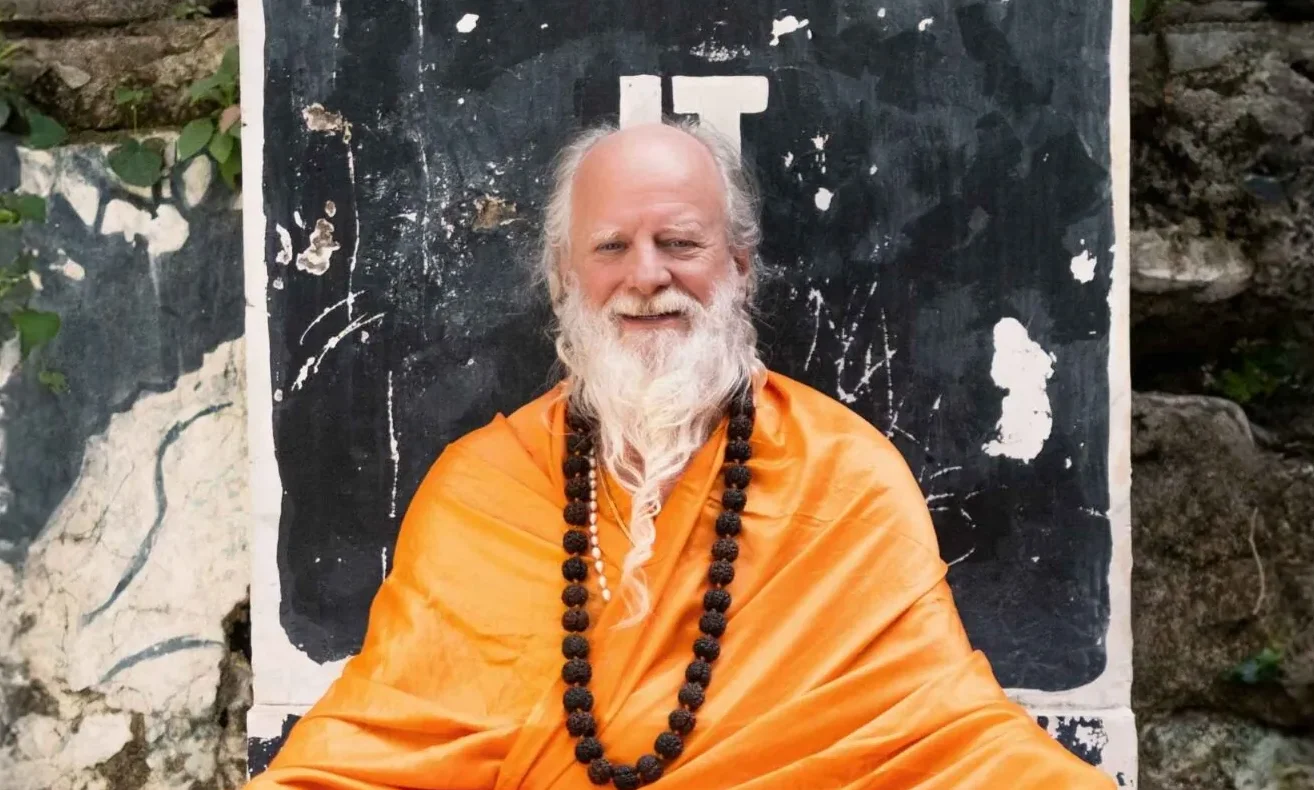
“Our number one concern, is the preservation of the purity of that body of knowledge, the purity of Vedic Meditation, and all of the implications that come from Vedic Meditation, because with purity there’s effectiveness. The moment it gets changed by anybody, it loses its effectiveness.”
Thom Knoles
What keeps a body of knowledge alive across thousands of years without losing its purity?
In this first part of a two-part series, Thom traces the Guru Parampara, the lineage of the Shankaracharya tradition, from Maharishi Mahesh Yogi and Guru Deva back through Vyasa, Shankara, and the ancient masters who carried Vedic knowledge forward.
Along the way, he explores why preserving the purity of the teaching matters just as much as sharing it.
This series also serves as a fitting prelude to upcoming Guru Purnima celebrations for 2026. You can find out more about Guru Purnima events near you by following this link: https://thomknoles.com/guru-purnima-2026/
Listen to or watch this episode to explore the tradition, the terminology, and the living provenance behind Vedic Meditation.
You can also watch this episode on YouTube here: https://youtu.be/gXEu2bE4n7c
Episode Highlights
01.
How This Knowledge Arrived Here
(00:45)
02.
Reading the Lineage in Stone
(04:02)
03.
Maharishi Mahesh Yogi and Guru Deva
(05:56)
04.
From Gaudapadacharya to Vyasa
(08:39)
05.
The Meaning of 1008
(10:57)
06.
The Lineage Before Vyasa
(13:00)
07.
What Guru Parampara Means
(16:08)
08.
Becoming an Initiator
(18:47)
09.
Why Thom Wears a Silk Dhoti
(20:51)
10.
The Meaning of Jai Guru Deva
(23:55)
11.
Why Guru Purnima Matters
(27:36)
12.
The Ceremony of Gratitude
(29:46)
Jai Guru Deva
Transcript
Maharishi Mahesh Yogi and the Masters of the Tradition, Part 1
[00:45] How This Knowledge Arrived Here
Jai Guru Deva. Thank you for joining my podcast, The Vedic Worldview. I’m Thom Knoles. Lots of questions are asked, naturally, by meditators about the lineage of the knowledge, to use an art world term, the provenance, how this knowledge got to be here today, where did it come from, and the kind of who’s who of all the masters of the tradition.
And some of you may have seen a beautiful picture of a depiction of the bright stars of the galaxy of teachers, who, over the last many thousands of years, mostly in India, have been responsible for bringing the knowledge from one generation to the next. One of the ways we can start this is from the current day going back, and then we’ll make a jump and go from as far back as we know, or can surmise, and meet in the middle somewhere.
So our tradition, the tradition that I represent, and by the way, the raiment that I’m wearing today is a type of silk that is the badge of rank of a Mahamandaleshwar. Mahamandaleshwar is a senior-most spiritual master of an ancient tradition, an honor that was bestowed on me in January of 2025. Our tradition is known as the Shankaracharya tradition. Shankaracharya is two words melded together, which is a classical Sanskrit way of doing things.
Shankara was the name of one of the brightest stars of the galaxy of teachers, sometimes known as Adi Guru Shankara. Adi, spelled A-D-I, Guru, Shankara, S-H-A-N-K-A-R-A, Shankara. Western historians, who are infamously poor at getting these dates right, will sometimes attribute his life to sometime in the early hundreds of years of the Christian era.
[04:02] Reading the Lineage in Stone
In India, if we go into the academies of learning, which are known as a math, M-A-T-H, it’s pronounced as maat. A math is an academy of learning, and there are four of them: one in the far north in the Himalayas, one in the far south on the southern tip of India, Rameshwaram, one on the far east coast, Bhubaneswar, and one on the far west coast, Dwarka.
These four are established by Shankara himself, and you can go there and read carved inscriptions of who were the masters, who in what year gave the knowledge to whom. A long, long wall of inscriptions of masters going back. We can say it starts getting a little speculative more than 3000 years ago, but according to that set of inscriptions in the math, particularly in Badrinath in the far north, Jyotir Math in the Himalayas, we can see that Shankara lived and taught, ending about 2584 years ago this year, 2584 years, which was shortly after the time of the famous Buddha.
Buddha‘s time was probably, arguably, within 300 years prior to that. So Buddha had his time of teaching, all of which, by the way, was in India. Shankara came after him. So our tradition, the Shankaracharya tradition, from your perspective, starts with me. I am a Mahamandaleshwar of the Shankaracharya tradition, meaning I have been given the responsibility to teach the highest level of this knowledge and to create a small civilization of teachers who can pass this knowledge down to future generations after I’m no longer locatable. That’s probably the best way to put that event.
[05:56] Maharishi Mahesh Yogi and Guru Deva
I learned this from my master, whose name was Maharishi Mahesh Yogi, Maharishi Mahesh Yogi. Maharishi was not a Mahamandaleshwar or a member of the Shankaracharya tradition with saffron robes. He was the student of Swami Brahmananda Saraswati, and himself never wanted to take the role which I’ve agreed to take, but he didn’t want to take that role of being officially in the lineage.
So Maharishi’s master, who we refer to as Guru Deva, Guru means a remover of darkness, and Deva means something like divine. So, a divine shedder of light, a divine remover of darkness. There are thousands of people whose title is Guru Deva in India. This one is Guru Deva, Swami Brahmananda Saraswati, the Shankaracharya, the king of the yogis. This is the preeminent master of all the masters of India. So my Maharishi, my teacher, was trained by him.
Guru Deva had a successor that he nominated. In fact, he nominated three successors before he dropped his body, and those three successors, the last of those three, is still extant on the Earth. His name is Swami Vasudevananda Saraswati. Although he is old enough now that he’s taken a vow of silence until he passes, and so that position is somewhat liminal at the moment.
Guru Deva learned all of this knowledge from his master, whose name was Swami Krishnanda Saraswati, and then the tradition goes back from there all the way to Adi Guru Shankara. Doesn’t stop there, but goes back to Adi Guru Shankara, who lived, as I said, whose body dropped 2584 years ago, in the area of Kedarnath in North India.
[08:39] From Gaudapadacharya to Vyasa
Shankara learned from his master, whose name was Govinda. Swami Govinda learned from his master, whose name was Gaudapadacharya, Gaudapadacharya, and these people are all depicted in the beautiful lineage painting of the bright stars of the galaxy.
Gaudapadacharya was a contemporary of Lord Buddha. In fact, they met briefly at the very beginning of Buddha‘s wanderings. Before he became Buddha, before he became enlightened, he met briefly with Gaudapadacharya. Gaudapadacharya learned from his own master, whose name was Shukadeva. Shukadeva learned from his master, who was his father. Shukadeva‘s father was named Vyasa.
Vyasa is a title, more than it is a name. So there is a Vyasa of every epoch. The Vyasa of an epoch is the one who takes a body of knowledge and sequentially delineates it, so that it’s conceptually delineated and able to be understood in a logical format. We refer to him by his title, Vyasa. He was the cognizer of a wealth of knowledge of Indian literature. Vyasa is attributed with having written the 18 Puranas, meaning 18 books of that thickness, on the subjects of all the beings and their exploits and pastimes, from the very earthy level all the way into the celestial world, and their interrelationships, the mythos of India.
He’s also known for having authored the Brahma Sutras, also known as the Vedanta Sutras, the treatise on the highest consciousness state, Brahman Consciousness. Vyasa is my namesake. My title in India is Śrī Aṣṭottara Śata Sahasra. That means Śrī with a 1008.
[10:57] The Meaning of 1008
Those of you who don’t know about this, 1 has a sound attributed to it, just as does every number. 0 has a sound attributed to it. 8 has a sound attributed to it. So 108 or 1008. 1 is related to the sound ah. 0 is related to the sound ooo. And 8 is related to the sound, mmm. Aum, Om. So when we say 108 or 1008, we’re really saying Om. Om is the pranava, the primordial sound at the first layer of creation, out of which all other sounds emerge.
So all mantras have their origin in Om, in pranava. We call it pranava. Om is the sound that it makes. It’s a continuous sound. Śrī Aṣṭottara Śata Sahasra, that means 1008. Mahamandaleshwar, that means my title as the senior-most level of spiritual teacher in India. Maharishi, great seer. Vyasanand, Vyasanand, the bliss of Vyasa. So we’re talking about Vyasa now as one of the masters of the tradition, and I got my name from my master, named after him, Vyasa, Vyasanand.
Vyasanand Giri. A giri is a mountain that stands alone, not part of a mountain range, a mountain that stands alone. Giri Maharaj. Maharaj means, Maha is great, and Raj means a king. So in India, I’m considered to be one of the kings of the yogis. But I got my title and name from my master, and my master named me after Vyasa.
[13:00] The Lineage Before Vyasa
So we’ll go back to Vyasa, the great writer. He wrote the Bhagavad Gita. He wrote the larger text out of which the Bhagavad Gita comes, the Mahabharata, and he learned all this knowledge from his father, who was his master. His master was named Parashara. Parashara was the father of Vyasa, who began training him when Vyasa was, 14 years after the birth of Vyasa, he began training him.
Parashara learned from his father, who was his guru, whose name was Shakti. Shakti learned from his father, his guru, whose name was Vasistha, and Vasistha is one of the “mind-born sons” of the creation operator, personified creation operator, known as Brahma. Brahma, the creator, harks back to the very first primordial individuation, which is known as Narayana, Narayana.
So Narayana informs Brahma, the creator, who passes the knowledge to his mind-born son Vasistha, and now you see we’re in the kind of mists of mythos because we’re going back so many thousands of years, where things are a little unclear because this knowledge is passed from one generation verbally in its oral tradition to the next. Vasistha gives it to his son Shakti, who gives it to his son Parashara, who gives it to his son Vyasa, who gives it to his son Shukadeva. Shukadeva gives it to a disciple, Gaudapadacharya. Gaudapadacharya gives it to Govinda.
Govinda gives it to Shankara, the famous Shankara, whose name, after him, the name of our tradition became the Shankaracharya tradition, but it includes, even the predecessors of Shankara are considered to be members of the Shankaracharya tradition. That’s how great Shankara was.
Shankara, and then Shankara had four major disciples, and each of those had disciples. And there’s a lineage of masters from, say approximately 2640 years ago, up to the current day, the entire lineage of that engraved in stone, with new engravings being made every few years, of who the masters of the tradition were going back to time immemorial.
[16:08] What Guru Parampara Means
So this is what we call the, in Sanskrit we call this the Guru Parampara. Guru means guru, a shedder of light or remover of darkness. Parampara means that which comes out of the transcendent and then becomes manifest. It refers to a lineage. A parampara is a lineage. Guru Parampara, going back to time immemorial, this turns out to be my provenance. That is to say, how it is that I got here, and how it is that I became the modern day, I’m expected to be the fountainhead of the knowledge for the Shankaracharya tradition, Vedic body of knowledge, an unbroken line of teachers, all the way from many thousands of years ago to the current day.
And this is what we consider to be our number one, our meaning me and my colleagues, our number one concern, is the preservation of the purity of that body of knowledge. The purity of Vedic Meditation, and all of the implications that come from Vedic Meditation, because with purity there’s effectiveness, and the moment it begins to change or get changed by anybody, it loses its effectiveness. Our number one thing is maintaining the purity of the teaching.
Our second priority is teaching it to whomsoever has sufficient curiosity, and the willingness to follow a few simple instructions, which surprisingly would not include everybody on Earth. Sufficient curiosity, worthy inquiry, and the willingness to follow a few simple instructions. That’s all we require for someone to learn this knowledge.
But our first priority is the maintenance of it, the maintenance of the purity of it. Even if we never again taught one new person Vedic Meditation or this body of knowledge, but we did maintain the knowledge for the next generation, we would have done our job. It’s only our secondary job to disseminate the knowledge. Maintaining its purity is foundational. Otherwise, we’re disseminating something that’s ineffective, and better that that just fades off anyway. So this gives us some kind of a snapshot.
[18:47] Becoming an Initiator
Now, when you train to become a teacher of Vedic Meditation, we call that position an Initiator. Initiator is somebody who can initiate others into the practice of Vedic Meditation, and then, of course, answer questions about the implications of the experiences that arise from twice daily practice of Vedic Meditation. When you complete all the prerequisites leading up to the training course, and then the 12 weeks training course in the Himalayas, and then, if successfully you pass that and all of the exams that are in it, then you become an Initiator, and you are then ordained by me to be an exponent of the Shankaracharya tradition.
And you then have entitlement to listen to a much longer treatise of mine entitled The Legends of the Masters. The Legends of the Masters was a recording that I made that took me 20 hours to make. I began talking about the different masters one by one, who they were, what was the mythos of them, what is it that is historic that we know about them, and all the details of their lives, as they grew up from being very young, and grew into their mastery, and all of that. It’s a 20 hours listening fest. I don’t recommend you listen to it all in one sitting. Maybe break it up into three or four sittings, although I recorded it in one sitting.
[20:51] Why Thom Wears a Silk Dhoti
There is that, and today I’m presenting myself on the vodcast of YouTube, and when you hear me speaking just in the podcast, you don’t know what I’m dressed in. I could be wearing pajamas, right? But now that we have gone to vodcasting and to YouTube, I decided today for the podcast vodcast to appear in my traditional, this is called a dhoti. There are two halves to it. There’s the bottom. It’s both of the same size.
It’s a long sheet of pure handwoven silk, made from a kind of silk that doesn’t kill the silkworms. Some of you who are vegans will be very happy about that. And the two strips are dyed in the dye made from saffron, so saffron that you might use for culinary purposes. Those little strands, hundreds of thousands of those strands are put into a pot, which is boiled with water from the Ganges River, and when it’s thick and lusty, then in goes the what would otherwise be ivory-colored silk, and it soaks in there, and then is brought out and bleached in the sun, and that whole routine of making it colorfast. And after about a year of preparation, it’s given to me.
In India, you’re not entitled to wear this, or this color, unless you are a Mahamandaleshwar. There are other variations on orange that are available to be worn by anybody who chooses to, but this is not a fashion statement. It’s a badge of rank, and it gives me, that gives observers who are in the know, information about me that I was ordained as a master of this tradition.
So I thought I would let my viewers see this, even though, as I’m recording, I’m sitting here in Arizona, and mind you, I don’t typically go out wearing this garment for my morning wanderings or anything. I wear usual Western clothes, but since we’re in an environment where no one is going to raise an eyebrow about seeing me look like this.
We have that adage from the Vedic tradition: “Wise do not bewilder ignorant.” So it’s not really an injunction. It’s a statement about who’s wise and who is not wise. Wise people don’t bewilder ignorant people. If you’re not bewildering ignorant people, you’re wise, and so you’ll see more of this.
[23:55] The Meaning of Jai Guru Deva
One of the ways in which we honor our tradition is through a standard phrase that is a salutation. It’s a blessing. It’s an opening statement. It’s a closing statement, and it’s the statement Jai Guru Deva. And you’ve heard me say it at the very beginning of every podcast episode.
Let’s break it down for a moment. When we spell it in Roman characters, Roman characters are the characters that are used for writing English, they come from Latin, from Rome. Jai is spelled J-A-I, but in fact, it’s a longer word which we would probably spell J-A-Y-A, Jaya. Jaya means glory to or victory to or hail. In fact, etymologically, Jai is the word in Sanskrit from which we get our English word hail. It comes from Jai.
So Jai and then Guru. Guru means the remover of darkness, the shedder of light. That function which causes us to learn how the laws of Nature work, whatever that is, whether it’s an embodied person, whether it was an event, whether it was something pleasant or something unpleasant. If you learned, and if from that, light was shed on how the laws of Nature function, then that thing is performing the guru function. Mostly, it refers to humans, but it’s not restricted or isolated to humans.
So Jai Guru Deva, D-E-V-A. There’s a peculiar thing that happens with the Sanskrit language: a final A on the end of a word, if it’s a soft A, it is elided. To elide something is an English grammatical term that says that you swallow that sound. So Deva, the A is swallowed and it becomes Jai Guru Dev(a). In fact, there’s another elided A on the word Jaya, which is Jaya, Jaya. Jaya, Jaya becomes Jai Guru Deva. Jai Guru Deva. Jai Guru Deva means glory to all of that that has taught all of us. Glory to all of that that has taught all of us, Jai Guru Deva.
And it has become a traditional salutation, now has spread widely into the West. Meditators tend to whisper Jai Guru Deva when they want to bring it close to a group meditation, or they may greet each other with Jai Guru Deva, or they may say goodbye to each other with Jai Guru Deva, in the form of a blessing. So when you hear that, it’s like a verbal version of a secret handshake. It indicates that you are a knower of a particular tradition of knowledge.
[27:36] Why Guru Purnima Matters
Once a year, in July, the moon becomes full. On very, very rare occasions, the moon is full at the very beginning of July and also at the very end of July. That’s very rare. Generally speaking, there’s one full moon in July, and that one full moon that happens in July has been selected by our tradition, conventionally, to be the celebration evening of all of those who are beneficiaries of Vedic knowledge, and that night is referred to as Guru Purnima.
Purnima, in Sanskrit, it means fullness, so it refers in this case to the full moon, Guru Purnima, the night, the full moon night, in which celebration of one’s great good fortune, well-deserved self-created good fortune, I might add, no luck. We don’t really buy into the luck concept in the Vedic worldview. There’s no randomity. Well-deserved self-created good fortune. Celebrating one’s and our colleagues’ and friends’ well-deserved self-created good fortune on the night of Guru Purnima.
It also happens to be, and it actually originated this way, to be the traditional birthday celebration of the rishi Vyasa, Vyasa whose name is appended to my own name. We would call him my namesake, Vyasa, one of the great masters and authors of the Vedic tradition, who reputedly lived somewhere in the area of 5000 years ago in India. So sometimes in India it’s referred to as Vyasa Purnima. In the West we tend to call it Guru Purnima.
[29:46] The Ceremony of Gratitude
So we celebrate that, and on that night, someone who is a qualified Initiator, an instructor in Vedic Meditation, who’s been trained to do so, will perform a ceremony of gratitude, naming all the masters of the tradition, going back to time immemorial, and making what are traditional offerings during a 4, 5, 6, 7-minute ceremony for all the meditators to see. Those who’ve already been initiated into Vedic Meditation will find this familiar, because that’s the traditional ceremony. It’s referred to as Guru Puja, P-U-J-A. Puja is Sanskrit for ceremony or celebration.
Guru Puja was seen and witnessed by all who learned from a qualified teacher of Vedic Meditation on the day that they learned their technique, their mantra, and the way of using the mantra. On that day, they witnessed a ceremony, the Guru Puja ceremony.
So, on Guru Purnima, in July once a year, we have a gathering of people, as many as we can get, and one of the things we do is perform Guru Puja for everyone to be able to see on that full moon night. And also, traditionally, the teachers are supposed to procure little sweets that get handed out, so everybody’s able to enjoy some sweet flavor at the end of the night. And for those who abstain from sweets, we can find something sour for you, or something yucky that you can eat and celebrate with other people who like yucky things. We’re not forcing you to eat sugar.
And so Guru Purnima, and we very often, whenever we have access to one, will have a modern-day print of the painting that depicts the bright stars of the galaxy of the tradition and our lineage, with Guru Deva sitting at the bottom of a lineage of teachers, and that’s often used in the Guru Purnima.
But it’s also used when we, it can be used as an option when we initiate people into Vedic Meditation.
Jai Guru Deva.
