
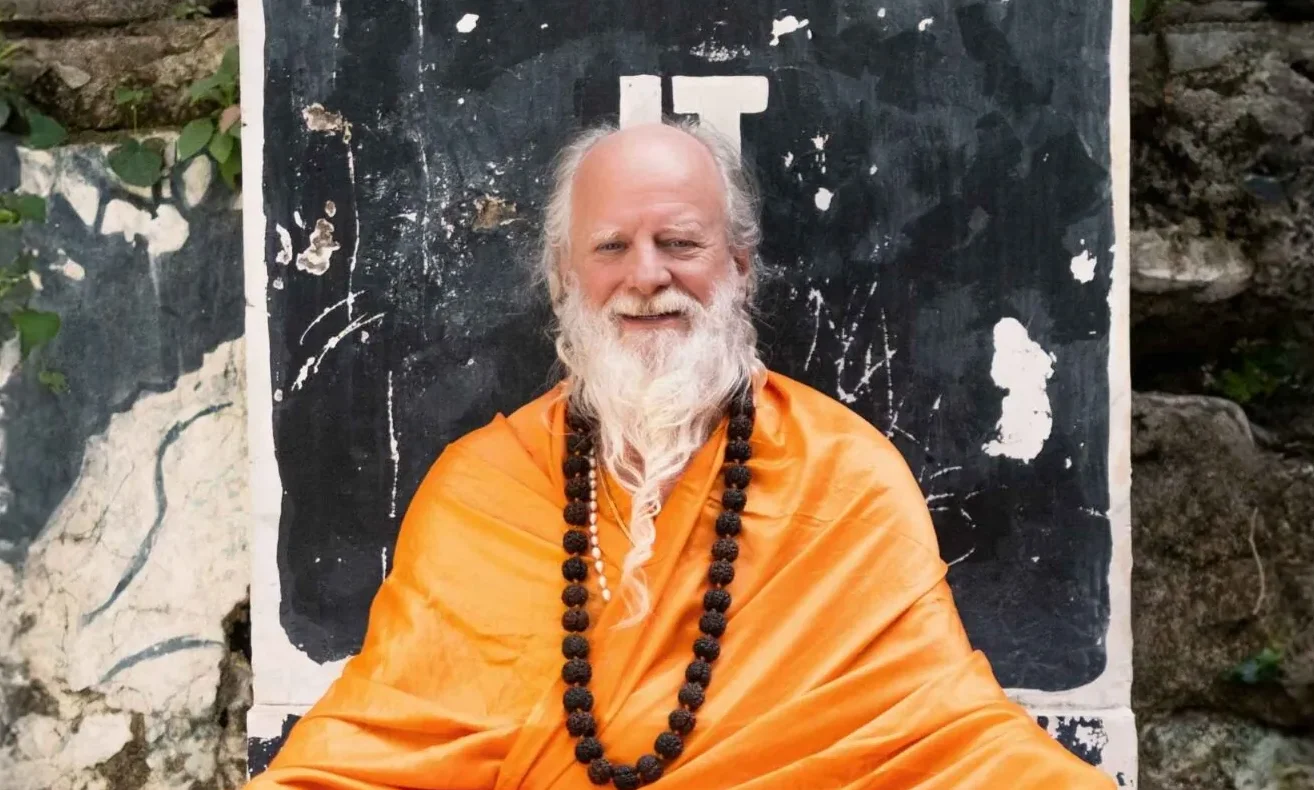
“Literalism is the baseline out of which fundamentalism comes, the latter being that which destroys all the connotative value of a body of teaching.”
Thom Knoles
Why would a naked yogi be received as a blessing, and why would a great master decline a title others might revere?
In this second part of the two-part Masters of the Tradition series (watch or listen to Part 1 here), Thom answers questions about Shukadeva, Maharishi Mahesh Yogi, the place of women in the tradition, and the meaning behind Guru Deva‘s throne and parasol.
Along the way, he opens a wider view of the Shankaracharya tradition, its stages of life, its hidden maternal lineage, and the cultural world from which these symbols emerge.
Listen to or watch this episode to explore the stories, symbolism, and living context behind the tradition.
You can also watch this episode on YouTube here: https://youtu.be/WbMjm5VzTLM
Episode Highlights
01.
Q – Who is the blue-skinned master with no robes?
(00:45)
02.
A – Shukadeva and the Demigods
(00:56)
03.
Unity Consciousness and Fearlessness
(05:00)
04.
A Naked Yogi as Blessing
(09:19)
05.
Q – Why did Maharishi Mahesh Yogi not become a Mahamandaleshwar?
(11:52)
06.
A – The Four Stages of Life
(11:56)
07.
Maharishi as a Forest Dweller
(16:07)
08.
Accepting the Mahamandaleshwar Title
(18:47)
09.
Q – What role do women hold here?
(19:53)
10.
A – Paralakshmi’s Injunction
(20:03)
11.
Saraswati and the Hidden Lineage
(24:14)
12.
Q – What is Guru Deva’s throne?
(26:20)
13.
A – The Throne of Jyotir Math
(26:34)
14.
A Badge of Rank
(31:24)
Jai Guru Deva
Transcript
The Masters of the Shankaracharya Tradition Part 2
[00:45] Q – Who is the blue-skinned master with no robes?
All of the great masters seem to be wearing robes except one who seems to be without robe and with blue skin. Who is that?
[00:56] A – Shukadeva and the Demigods
That is Shukadeva. Shukadeva was the son of Vyasa. And now we have to make sure that our listeners are up to speed on my insistence that we don’t take things literally.
Literalism is the baseline out of which fundamentalism comes, the latter being that which destroys all the connotative value of a body of teaching.
So we’re not fundamentalists or literalists. We are connotative. We love to enjoy the connotations of a thing. We love to enjoy the mythos, the legendary retelling of it, because in that depth understanding, we create relatability for ourselves. Rather than causing somebody else to be an icon, we’re finding that iconic behavior in our own self. It’s the whole purpose of mythos.
Having made that disclaimer, it’s important then to say that Shukadeva, legendarily, was so innocent that it never occurred to him to hide his body from other humans. In modern terms, we would say he was a nudist. He never wore any clothes and was never known to wear any clothes.
Why the bluish skin? Well, like his father Vyasa, who is also depicted in the Holy Tradition painting as having bluish skin, the two of them were considered to be demigods. By demigod, this is a term of art that means one of the parents was a celestial being, and the other of the two parents was a fleshy human being. So born of half-Deva.
Deva is the word in Sanskrit that gave us our English word divine. Deva means a shining one. What is a shining one? It is a being whose body is radiant with light, but is mostly made up of the elements of space and air and fire, but doesn’t have any earth element or any water element in it.
These are Devas, and Devas are considered to be, in the legendary telling of it, those beings who are in fact the laws of Nature. For example, in the Greek we have fire, and we have a god who is also fire. In the Roman we have fire, and we have a god who presides over fire, but is not the actual fire.
In the Vedic, which is where the Greek got their concept of divine beings who match the laws of Nature, the Deva is the element. For example, in the Vedic view, Agni is the name of a being and is also the name of fire. Agni. Agni is fire. Agni is not presiding over fire.
So anyway, these deific beings, legendarily, sometimes would procreate with humans and create that which in the term of art of mythology was referred to as a demigod. Vyasa was one of those, the father of Shukadeva, although he wore clothes, and Shukadeva, his son, never saw the point of it.
[05:00] Unity Consciousness and Fearlessness
It is also said that Shukadeva‘s event horizon of Unity Consciousness was so rich and great and powerful that anybody who managed to see him would be inside of his proximity effect when he would arrive, and they too couldn’t see any difference between themselves and him.
So they also felt no astonishment or shame or anything else in seeing him naked.
It’s very interesting, even today in India, great spiritual masters will wander around completely naked from time to time. I have to say right away, I’m not one of them, but I know some of them, have met some of them, and I consort with some of them.
A Baba, that means somebody, a Baba means father, but it’s an honorific title that’s given to certain kinds of forest yogis.
I walked from Rishikesh all the way to Badrinath over a six-week period once, just wearing flip-flops, me wearing my silks, him wearing absolutely nothing. But he smeared ash on his body, ash from crematoria, and this white ash that was the leftover remains from the cremated bodies of people’s loved ones.
He would go and ask for alms, it’s a traditional thing in India, smear the white ash all over his body. And when people would say to him, “Why do you do that?” he would get some of the ash, sprinkle it in the air a little bit, and say, “You see, I’m going to become this very soon. I’m just trying to get used to it.”
And it’s a kind of a, it’s a paean to fearlessness that they cover themselves in ash.
In India, once upon a time, I was in a very well-to-do, in the city of New Delhi, well-to-do neighborhood where a lot of embassies maintain their residences and ambassadors live in this, a place called Golf Links.
And I was invited to that British tradition of high tea, which the Indians inherited and advanced somewhat, one afternoon. And the entire high tea was populated by women. And these were women of high regard in India. I know there was one federal minister of education there. There were many women who were movers and shakers in Indian society, and all of them were elegantly dressed.
And it has to be said that, in general, Indian people dress conservatively. There’s very little flashiness of décolleté or whatever. They tend to cover themselves quite amply. And that belies an idea that Westerners might have that they are somewhat prudish. In fact, they’re anything but, as I’ll illustrate in this story.
[09:19] A Naked Yogi as Blessing
At a certain point, the woman who was looking after the tea in the kitchen and who was serving, I was the only male in the room, these 15 women and me, serving us with Darjeeling tea, came running out and whispered something to her mistress, the woman who employed her, who went into the kitchen and then came out and announced to everybody that we all had to come into the kitchen and see.
There was a view from the kitchen window of the backyard. Sitting in the backyard under a tree was a stark naked man, a yogi covered in ash, who had taken up residence sitting in full lotus position at the base of this great tree in the back lawn of this woman’s ambassadorial home.
And she said, “We’ve all been blessed. We’ve all been blessed. Now,” she said, “some of you may not be aware, but there are certain protocols. We can approach and request to take his blessing. We may offer him food, but only leftovers, so we’ll have to get the kitchen to prepare a little extra so that we have leftovers. He won’t eat anything but leftovers.
He’s only going to stay here a maximum of three nights, could leave any time, but they never stay anywhere more than three nights.”
And she said, “All right, ladies, let’s all prepare ourselves, and we’ll go out, and all of you have to eat something from your plate, but leave something over so that we can create a plate of leftovers, and you can follow me out.” She goes, “Today, the greatest blessing has come to this home, the greatest blessing.”
And she placed the thing in front of him and he acknowledged her. And then one at a time, they came and touched his feet and he patted them on the head. And then everybody filed away and left him to his seclusion and silence.
But it occurred to me that had that happened in, say, Chicago or in Sydney, Australia, or in any other Western country on Earth, the first line of action would be to call the police.
In India, a naked man appearing in your backyard and covered in crematorium ash and sitting under a tree is considered a blessing. In any other country, it’s considered to be a home invasion by an undesirable, and the person would be carted away and incarcerated. Nothing like that happens in India.
Just to give us some kind of a sense of just how different the Vedic culture of India is to our cultures. And next time you have an opportunity, either with me or on your own, to get to that subcontinent and to explore India, you’re exploring the most marvelous, filled with marvels, country on Earth.
You can find marvels in any country. In India, you can find a hundred times as many marvels as you can in any other country. Things that you won’t see or hear of anywhere else.
[11:52] Q – Why did Maharishi Mahesh Yogi not become a Mahamandaleshwar?
Why did Maharishi (Mahesh Yogi) choose not to become a Mahamandaleshwar?
[11:56] A – The Four Stages of Life
To become a Mahamandaleshwar, one has to be approached by a council of masters, which is referred to as the Akhara, A-K-H-A-R-A, Akhara. And one has to be seen as someone who is willing to meet all the duties of that Akhara, including, but certainly not limited to, the duty of assuring whomsoever is qualified to be the next Shankaracharya, who is selected from that Akhara.
So the Akhara is 13 women and men who are all Mahamandaleshwars. And every time a Shankaracharya, a king, or indeed it could be a queen of the yogis, drops his or her body, then a convocation occurs, a gathering of the members of the Akhara.
Maharishi felt that his biases about who was capable of succeeding his master, he had very strong thoughts about that. And also the fact that he was born in a caste that was designed to serve and not necessarily to teach. And he wore, for that reason, an ivory-colored dhoti. And that ivory-colored dhoti marked him as someone who was not eligible to be a Mahamandaleshwar. Indeed, he was also not eligible to be a swami. He had never truly renounced and taken up sannyasa.
So there are four stages of life. The first of them is called brahmacharya. Brahmacharya means one is a student of a master. The second stage of spiritual development may be, and it’s a choice, may be a grihasta. So grihasta, G-R-I-H-A-S-T-A, grihasta is the state. And a grihasti is somebody who is participating in it, is a civilization builder.
So that implies someone who either is a procreator, a father or mother, or a caregiver to families, someone who is in gainful employment, someone who holds property of any kind. It may not mean land, but it can mean anything, anything, property at all. A grihasti is practicing grihasta.
The next phase is referred to as vanaprastha, V-A-N-A, all one word, P-R-A-S-T-H-A, vanaprastha. Vana means a forest, or it may mean wood. Prastha means to inhabit, someone who is a forest dweller.
And the final of these four, these are referred to as ashrams. Even though an ashram is a place where people gather to learn knowledge, these are ashrams, these are stages of life. The last of them to be considered is sannyasa. Sannyasa is S-A-N-N-Y-A-S with an elided A on the end. Sannyasa becomes sannyas(a).
[16:07] Maharishi as a Forest Dweller
Maharishi was a brahmachari, meaning he had been a student of a master. That phase of his life came to a close. He chose never to participate in grihasta, so he was not a civilization builder. He wore a silk robe for the whole of his life after being a brahmachari, the same type of silk robe that he wore when he was serving Guru Deva.
He considered himself to be a vanaprastha, and that means a forest dweller, meaning that he moved from one place to the next and had no fixed address. And a vanaprasthi also is someone who is training protégés and creating protégés for the next generation.
Maharishi never took sannyasa, that is complete renunciation of all possessions, which would have put him into a saffron-colored robe, dhoti, and would have made him eligible to be called upon to be a Mahamandaleshwar. So he had participated in two of the four ashrams, brahmachari and vanaprastha. He was never a grihasti, and he was never a sannyasi.
In my case, I’m also a vanaprasthi. I am not a swami. So people sometimes in India will see me in my orange outfit and refer to me as swamiji. Ji means dear. Swami. Swamiji. I’ll always answer because I know that they just don’t know I’m not a swami.
All the other members of my akhara are swamis. There are 13 of us, women and men, and we all wear the same saffron color that we’re entitled to wear.
[18:47] Accepting the Mahamandaleshwar Title
All of them except for me, the other 12 are all swamis. They’ve all taken sannyasa. I’ve never taken sannyasa. I’m a forest dweller. I’m a vanaprastha. And I live in a forest. Right now, I’m living in the largest contiguous pine forest in North America. Ten million acres of the Coconino National Forest is my home.
And I was called to be a Mahamandaleshwar, and I could have said, “No thank you,” but I didn’t. It seemed incumbent upon me to accept the title. I’m a Maharishi. They’re all swamis. So, for example, one of my very close friends there is Sri Sri 1008 Acharya Mahamandaleshwar Swami Kailashanand Giri Maharaj. He is a swami. I’m not a swami.
I am Sri 1008 Mahamandaleshwar Maharishi Vyasanand Giri Maharaj. I’m the only one that’s not a swami. I’ve never taken sannyasa. Sannyasa means renunciation of all worldly pleasures, a life of celibacy, and no retention of possessions or a family name. I’m still Thom Knoles, by the way. Thom Knoles. Family name.
[19:53] Q – What role do women hold here?
I’m wondering, there’s all men in the Holy Tradition. I’m wondering what part women play in the tradition.
[20:03] A – Paralakshmi’s Injunction
All of those men have mothers, and many of them had wives, but there is a phenomenon that vibrates through our tradition known as Paralakshmi‘s injunction.
Who’s Paralakshmi? Some of you may have heard the name Lakshmi before. Para means transcendental, and so she’s depicted, and remember this is a consciousness play, not literalism. She’s depicted as, from the navel, not seeing the navel, but from slightly above the navel down, she is transcendental. She’s the vast unbounded field of unmanifest Creative Intelligence. From here up, she has what we would call a normal form, like that of a human.
People sometimes say to me, “Why do we always anthropomorphize deities?” Her answer would be, “No, no, we’re not anthropomorphized by you, we deamorphize you.” In other words, humans look the way they look because they look the way they look. And so, we are a projection of them.
Mahalakshmi, Paralakshmi, is the embodied form of Mother Divine, and she, with her hands, causes the birth of Narayana. Narayana, who is the first master depicted of the tradition, who’s lying on his side, reposed, and out of whom all the rest of the knowledge comes in our consciousness play.
Mahalakshmi says, her injunction, the women are not to be mentioned overtly, overtly. Implicitly, yes, but not overtly. Why? Because of masculine brutality towards women.
To prevent women masters from being targets of brutal consciousness from the masculine side of creation, the women feel as though the men can be in the credit role, and the women don’t need to be because it’s implicit.
[24:14] Saraswati and the Hidden Lineage
Now, this is the Saraswati order. Lakshmi has a younger sister by the name of Saraswati, also a deity, another aspect of Mother Divine.
Lakshmi is known to be the, she is the deity who is the fountainhead of all abundance, abundance of every kind. Abundance of Creative Intelligence, abundance of adaptation energy, abundance of stability, abundance of material goods, materialism, abundance of every kind. Also abundance of caution, and abundance of any kind of abundance, it comes from Lakshmi. She’s abundant. She’s the prolific one.
Her younger sister, younger meaning who came into manifestation later, later could be one ten thousand billionth of a second, but later, after Lakshmi came Saraswati. Saraswati is the goddess of, in our consciousness play, Mother Divine in the form that conveys to the world knowledge, learning, music, culture, language, and dance. That’s a lot.
And so, Saraswati then was given the title of the matron of our tradition. Our tradition is known as Shankaracharya, after the famous Adi Guru Shankara from 2,584 years ago. But he also had the name Saraswati tacked on to the end of his name. So, my master’s master’s name was Swami Brahmananda Saraswati. Saraswati is the name of the feminine who is the matron of our tradition.
And so, this is well known that we come from a maternal matrilineal tradition. The feminine doesn’t wish to have its specifics identified out of the concern for the history of humanity, in which certain low-conscious males may consider it proper to defile or brutalize women.
Mother Divine is also mentioned and embedded throughout our tradition. So, for example, we say, Bhavam Bhavani sahitam namami. This is reference to Mother Divine, it’s there, it’s all through there, but it’s transcendent. And it’s for that reason.
There’s one more thing Lakshmi reckons, Paralakshmi reckons, that the women are secure enough, they don’t need to be named in the credit roll, and the men are a little insecure. And so, it helps them to feel good that they are depicted and named in that way. [Laughter]
[26:20] Q – What is Guru Deva’s throne?
I’m wondering about Guru Deva at the base of the Holy Tradition and the significance of what seems like a throne he’s sitting on and umbrella over him.
[26:34] A – The Throne of Jyotir Math
In our Holy Tradition depiction, and also in isolated pictures of Guru Deva, for example, here he’s sitting on that self-same throne, though this photograph doesn’t allow you to see the entire throne on which he sits. This is the throne of the Shankaracharya of Jyotir Math. It has a very interesting history. So, I’m going to describe it for those who are listening on audio only.
It’s a seat, a chair. It’s wide enough that somebody could sit with their legs up in cross-legged position and their knees would not be constricted by the sides of the chair. The arms of the chair are represented by regular chair arms, but at the heads of the arms, on each of the arms is a carved head of a lion.
And then the chair is covered with a silk, a kind of reddish colored silk seat, on top of which is a deerskin on which Guru Deva directly sits. Behind him is the silk cushion of the back of the chair. The throne, as we’re now going to call it, rises up behind him and is heavily ornamented and has carving on it.
The chair itself sits on curved legs that any furniture maker would refer to those as Queen Anne legs. The Queen Anne legs are the legs of a chair or furnishing that have a curve in them before they come to the ground. Instead of regular chair feet, we see the actual paws and claws of a lion. So we have the four legs of the chair and lion’s feet at the end of Queen Anne legs.
That itself is sitting upon a tiger skin. That tiger skin happens to be the skin that Guru Deva flayed himself from his pet tiger that died a natural death of old age.
So there were two tigers that followed Guru Deva. We’re not going to say they were pets because he didn’t feed them, nor did he give them water. They simply followed him around, and it was a male and a female, and they would go off hunting and lick themselves clean and then come back and sleep alongside him in his cave.
He was frequently seen by people wandering in the forests during the time of the British Raj. Elephant-riding tiger hunters would see Guru Deva walking on a narrow pathway on a cliff face 500 feet above the valley floor with a tiger on each side of him. He had that reputation. One of those tigers, when it passed, Guru Deva saved the skin of it by his own hand.
At the base of the picture is a small what we would call a kind of coffee table or a footstool, like an ottoman sort of thing, also with Queen Anne legs, also with lion’s paws for feet. On that is sitting his two wooden sandals with toe pegs. He wore wooden sandals with a toe peg to hold those sandals onto his feet, no other straps or fasteners.
Then the sandals of Guru Deva adorned with flowers and garlands and so on. There’s a parasol above him which is elaborately embroidered with depictions of deities with the symbol for Pranava, Om, with the picture of Durga riding on a tiger.
[31:24] A Badge of Rank
There are other things on that embroidery because I happen to know because that exact parasol sits above the seat of the current successor to Guru Deva, Swami Kailashanand Giri. That exact, we would call it an umbrella, but it’s a parasol really. And it’s designed to keep the hot Indian sun off of him. But it also, that parasol, with its rich embroidery and signs and symbols, is itself a badge of rank.
During the time between 2,584 years ago to present, that particular seat has been extant. It is carved from one solid block of sandalwood and it is gilded. It has had a thick coating of gold placed all around the timber of it. It’s got a very unique smell to it. I’ve smelled it many times.
During the time of British Raj, because it was illegal for there to be anyone named anything like king or queen, because there was only one king or one queen and that was whoever sat at Buckingham Palace, and all other claims to that were considered to be sedition, you couldn’t have a Shankaracharya. So Shankaracharyas are the kings or queens of the yogis. I wouldn’t have been able to be called Maharaj, which is the last two syllables or three syllables of my spiritual name. It would be considered sedition in British India.
Also, the British were known for taking things from countries. Crown jewels, archaeological artifacts, and things like that, ended up in the Tower of London and the British Museum. They didn’t want this seat to go there, and so it was expertly hidden in a cave somewhere in the Himalayas for 300 years.
And it was only brought out for Guru Deva to sit upon after it was cleaned up and dusted off and everything, and perhaps the cushion fibers, you know, reconstructed and whatever, to make it worthy of him sitting on in 1939.
The British had occupation of India for 247 years, that ended in 1947. And in 1939, Indians felt confident enough that the British were on their way out, that they could restore the throne and declare someone to be the Shankaracharya. It was a kind of act of defiance while the British Raj were still in possession of India. It was from 1939 till 1947. It was quite a long time. 1947 was when the British officially walked out of the country.
And in 1939, Guru Deva was declared to be the Shankaracharya, the king of the yogis, and the throne was brought back out. So that’s something of the history of the throne of Shankaracharya. And that throne still sits there today, the seat that the Shankaracharya of Jyotir Math sits upon.
