
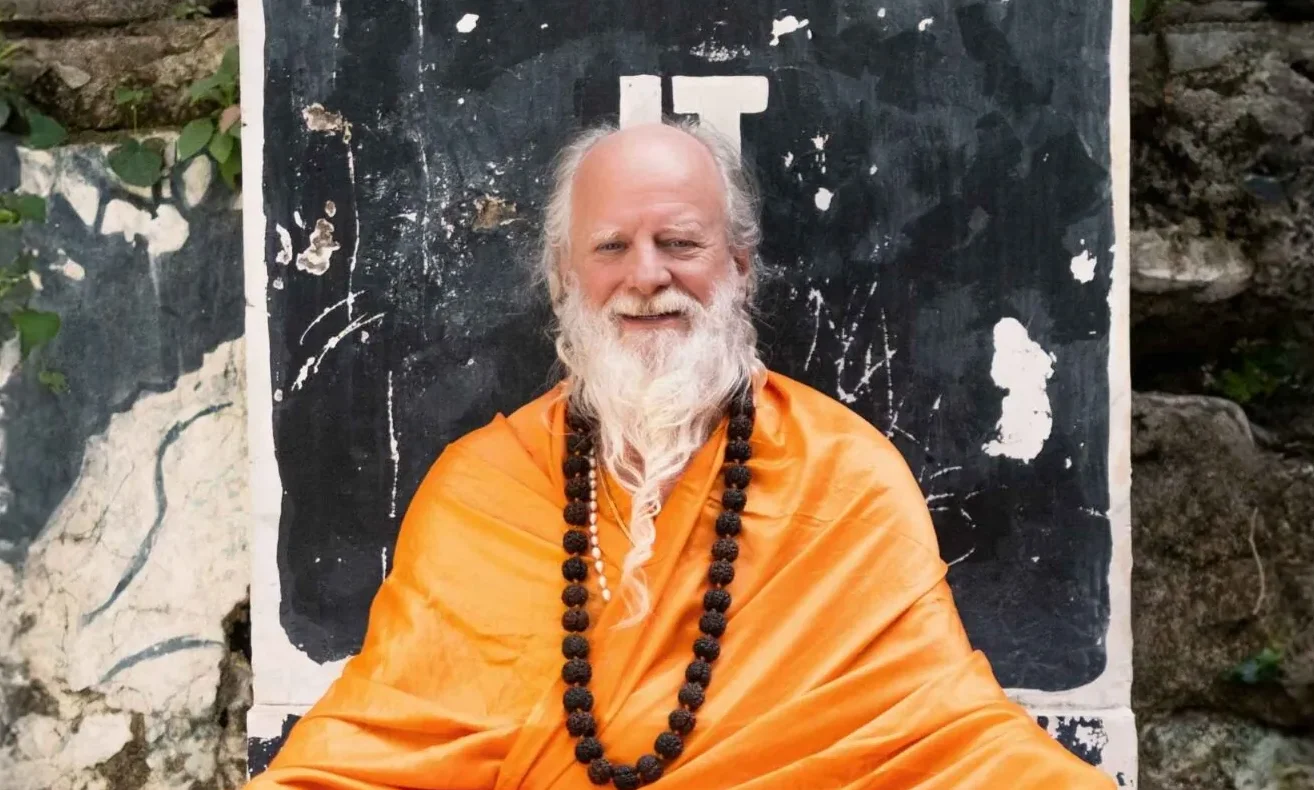
“There is no evolution without disruption.”
Thom Knoles
There’s never any shortage of characters on the world stage who demonstrate what appear to be anti-evolutionary behaviors, but what if the very forces that seem to obstruct life are part of what drives its evolution?
In this follow-up episode on Ravana, the essential villain (you can find the first episode here), Thom responds to listener questions about adversity, the severity of rishis when creating consequences, the relevance of mythos for householders, the symbolic meaning of Ravana’s 10 heads, and how to honestly evaluate our own Ravana-like actions.
Along the way, he offers a Vedic view of resistance, showing how disruption, challenge, and even apparent destruction can serve the larger movement of growth and awakening.
Listen or watch to explore how this perspective can change the way you meet the pressures of everyday life.
You can also watch this episode on YouTube here: https://youtu.be/axXqhBRfyos
Episode Highlights
01.
Questions From Part One
(00:45)
02.
Q – Is adversity needed for growth?
(01:11)
03.
A – Evolution Requires Disruption
(01:25)
04.
Near Extinction Drives Adaptation
(04:34)
05.
Why Adversity Creates Rigor
(06:57)
06.
Destroyers Get Destroyed
(10:37)
07.
Q – Why are rishis so severe?
(11:27)
08.
A – Resistance Can Look Extreme
(11:44)
09.
Michelangelo And The Marble
(15:25)
10.
Q – How is mythos relevant to householders?
(18:53)
11.
A – Householder Life Meets Ravana
(19:15)
12.
Elevational Theater In Life
(21:45)
13.
Great Stories Reveal The Pattern
(24:20)
14.
Pattern Recognition Makes Us Human
(25:21)
15.
Humanity And Self-Destruction
(27:48)
16.
Q – What do Ravana’s 10 heads mean?
(29:08)
17.
A – Formidability Through Many Forms
(29:17)
18.
Ten Heads And Twenty Arms
(31:52)
19.
A Different Form For Each Observer
(33:26)
20.
Q – What’s the best way for a new meditator to engage with mythos?
(34:27)
21.
A – Enjoy The Story First
(34:32)
22.
Learn The Deeper Meaning In Satsang
(38:06)
23.
Q – How should we think about ourselves if we have served the Ravana function?
(41:02)
24.
A – Evolution Includes A Lesser Past
(41:15)
25.
Growth Comes From A Smaller Self
(43:53)
Jai Guru Deva
Transcript
Ravana: The Essential Villain, Part 2
[00:45] Questions From Part One
Jai Guru Deva. Welcome to The Vedic Worldview. This is part two of a two-part series, Ravana, The Essential Villain. This episode includes questions arising from the previous episode. If you haven’t listened to that episode yet, we recommend doing so first. You’ll find a link to that in the show notes, or the description below.
[01:11] Q – Is adversity needed for growth?
You talked of obstacles like a rock creating a beautiful waterfall. I’ve often thought about adversity creating the conditions for growth. Is that similar? Can you talk on that?
[01:25] A – Evolution Requires Disruption
Yes, there was a paper published within the last 10 years by an enormous group of scientists out of London in a peer-reviewed journal, in which the entire subject was that there is no evolution without disruption. So we often think of evolution as a steady flow, that there’s a constant flow in a particular direction of greater adaptive forms, greater adaptive functions.
The way that evolution works is that something with a less complete, a less replete repertoire of capabilities grows to have greater capabilities with reference to meeting demands, and so on, more successfully. So, you take a biofilm, and a biofilm can be destroyed by a human stepping on it, whereas another human can’t be destroyed by a human stepping on it. Or a fox can’t be destroyed by a human stepping on it, or a rattlesnake can’t be destroyed by a human stepping on it.
So then from biofilm to human, let’s say, if that was the track of progress that we were looking at, in order for there to be large spurts of evolution without resistance, first of all, there’s a continuous resistance causes adaptive forms and adaptive functions to appear. There’s a basic idea in science that all forms, all existing forms, and all function are in fact responses to a demand for adaptation. They are adaptive forms, they’re adaptive functions.
And so then, for there to be adaptation, there has to be pressure against survival, and then something that you develop, a form that you develop. So five fingers, toes, and why do we have anything that we have, let’s say, on the human body? It’s because that adaptation, that’s an adaptation, it’s a form that’s an adaptation to a function, came into being over reproductive generations through there being somebody who had a little bit more of this…
We could say accidentally that they had a little bit more of a particular capability. Maybe instead of having five fingers they had a little bump on their paw, and those offspring of that particular generation survived to reproductive age better than other people who didn’t have the bump, and eventually these forms all appear, and so on, as responses to the demand for evolution.
[04:34] Near Extinction Drives Adaptation
Then occasionally there are… so there’s a continuous resistance to the adaptive capability, and that causes, stimulates, adaptive forms and functions. But once in a while there are near extinction events that occur that are massive, massively challenging to whether or not a particular member of a species or an entire species can adapt well enough to be able to get past the near extinction event.
So, think of millions of years ago, tens of millions of years ago, an asteroid hits the Earth at the Yucatan Peninsula, and it wipes out more than 90% of all species on Earth. 5,000 foot tsunami traveled completely around the world, and all the large dinosaurs were killed, in short. The dinosaurs that did survive became the birds that we see today. They were the ones that managed to survive the asteroid hit, and so we look at the birds today, and we go, “Pretty things, so delightful and so amazing, so regal eagle and a beautiful little sparrow and hummingbird,” and all that. We’re looking at dinosaurs.
What were the humans back then? Well, we were likely little four-legged furry creatures that were running around under the feet of the giant dinosaurs. Those were our ancestors, and the likelihood of us evolving into this if the asteroid hadn’t hit and wiped out the previous dominant species is virtually zero. We probably wouldn’t have got past another few million years, but that near extinction event that caused big dinosaurs to vanish and allowed little critters like our ancestors to flourish unimpeded, relatively unimpeded, caused our forms and functions to come into being, and we became upright neuro-centric anthropods with iPhones.
[06:57] Why Adversity Creates Rigor
So, what is the cause of evolution? Well, there is a fundamental force that what, we would call in astrobiology the bio-friendliness of the universe. It seems to be assembling itself to become greater and more sophisticated living things, but that fundamental force requires resistance and occasionally massive challenges to it in aid of really developing itself into things which, like us, can sit around making funny noises with these voice boxes, which you know once upon time, just made honking noises or squeaking noises or something.
And we’ve developed language and communing and written language, and we’ve developed the World Wide Web, and we’ve invented a thing called artificial intelligence that the only thing that it knows is whatever it’s read on the World Wide Web, it doesn’t know anything else that can assist us in doing menial tasks and things.
How did all that happen? Well, it happened because of the combination of two forces, an underlying assembly force that was assembling atoms and molecules into living things, essentially, but as resisted by a continuous erosion of that assembly force. Those two things combined cause sophisticated forms and functions to come into being.
So this is a very fascinating concept, when we look at the world, and we say, “Well, could we have a world with zero adversity?” If we did, then it would be essential for us to become extinct, because we wouldn’t be performing the function that assembly, what’s called assembly theory, is out to perform, which is rigorous adaptive forms, rigorous adaptive functions.
So, without adversity, there’s no rigor. So, any athlete would relate to this. When you train to be an athlete, there must be resistance. So, if you could effortlessly be sprung with springs up and over the high jump bar, you’re not going to become a great high jumper, you know? If you go to lift the weights, but they’re really just inflatable plastic, and they look like heavy weights, but they’re actually not, there’s no resistance. So without resistance, you’re not going to build muscle forms. And so muscles are adaptations to adaptive forms that serve a function based on resistance coming. Resistance to you moving causes you to be stronger.
That’s in a microcosm version of this concept. Yeah.
So when we look around, we go, “Oh, the world, oh, too bad it has all these resistances in it. Too bad it has all of these villains in it. Too bad it has all of this stuff,” and all that. Actually, what all of this is, it’s opportunity to adaptively become the heroic version.
[10:37] Destroyers Get Destroyed
Now, why wouldn’t you just want to be a villain? Well, because there’s a fundamental law of Nature, too, which is: destroyers get destroyed. So those things that take up the role of resistors, they have a temporary period of eager hoarding, but they’re, the overall assembly theory of ever greater sophistication and participation of a whole rather than just a fragmental part, ends up defeating them. So if you have a choice between being a resistor and a destruction operator or an heroic adapter, be the latter.
[11:27] Q – Why are rishis so severe?
The Vedic myths often feature rishis placing curses on others that seem out of proportion with the mistake that inspired the curse. Why is that? And why aren’t the rishis more compassionate about the failings of others?
[11:44] A – Resistance Can Look Extreme
This reminds me of an argument made by teenagers to parents continuously everywhere in the world: “Your rules and your groundings and your restrictions on me are far out of proportion to the errors that I’ve committed. Why can’t you be more compassionate?”
The interesting thing is, a few moments ago, in a different context, we were talking about how evolution is aided by resistance, it was necessary for there to be the asteroid at the Yucatan Peninsula event, some whatever it was, 60 million or so years ago, had to be an extreme extension extinction event in aid of the growth of the human.
So had there been no asteroid collision that wiped out more than 90% of the entire species population of the Earth, humans wouldn’t exist today, and all scientists agree with this. This is not even faintly controversial. It was a bit extreme, wasn’t it? Giant asteroid whacking the Earth is still, apparently the Earth is still vibrating and wobbling from that one hit, in its gravitational orbit, it wobbles slightly. In its spin, it wobbles a little.
We can tell that by looking at the North Star, the pole star, and it doesn’t exactly sit in one place. When you look at it, it seems to be going around in the tiny circle, and that’s because the Earth is still shaking a little bit from being whacked by that giant thing. Well, one of the things is us.
So in the Vedic mythos it’s perhaps simply reflective, the rishis pronouncing implications and making curses is perhaps reflective of reality. Reality, you know, we kind of say, “Oh, if only.. you know, it’s bad enough that the markets are down, and I’ve got to get creative and figure out a way to make the earnings that I require to feed my family and make some progress in life. Does there have to be bad weather as well? Does there have to be an argument with my spouse as well?”
Well, evidently. We’re always looking for fewer things to which we have to adapt. “Could we just have a break, please, and have fewer fronts of adaptation where I have to muster my creative intelligence to be adaptive in the face of what appears to be a near extinction event?” The curse of a Rishi. And really, what I think the mythos is doing is reflecting the way that Nature’s intelligence operates. It operates in what we consider to be extremes, but which, in fact, are sculpting.
[15:25] Michelangelo And The Marble
I would like to remind those who ever studied art about the great Michelangelo. He was a builder of propensity. He would look at a marble block. He chose his marble very carefully to have certain veins and lines in it, and he would look at a marble block.
Let’s say, for example, we’ll just take the marble block that he purchased and had put in place, out of which he was going to sculpt his version of the Hebrew King David, David. So he sizes up the block, and then he waits and waits and waits and he sizes it up and he waits. And he might make a few initial marks on it with charcoal, and then, at a certain point, having delayed for what appeared to be a very long time, having built the propensity, he unleashes a ferocious attack on the marble with hammers.
In some cases, they weighed more than 10 pounds apiece, whacking into the marble, knocking chunks of marble off that were the size of men’s heads, and roughing it out. Roughing out the statue of David was a thing that took him a relatively short time, and he was ferocious in roughing it, and then he began the fine sculpting. And for those of you who have ever seen it up close, you’ll note that it, evidently it’s intentional that some of the natural, darker veins of marble that go through the lighter backdrop of marble reflect exactly the placing of the veins on the calf of David. A thing which modern sculptors look at, and they think, “How did he know that? How did he make that leg match the marble veins?” He was Michelangelo.
So a disproportionate attack on a completely unshaped block of marble, which eventually he carved it into and sculpted it into this magnificent sculpture, which most art historians agree is one of the finest examples of three-dimensional sculpture that exists on the Earth. And filled with not just, it wasn’t just an okay representation of a man, it has emotion in it. The face of that particular sculpture causes you to emote, and Michelangelo knew that very, very, very well.
So, extreme coming up against non-adaptive form causes adaptive form to come into being, and this is the way Nature works. So, rishis simply reflect that, and as I said, every teenager complains the same way about the rishis and the curses about their parents, “A bit extreme, isn’t it?”
[18:53] Q – How is mythos relevant to householders?
How is it relevant to a householder? These mythos stories. So the Ramayana and these demons, and the householder that’s getting to work, taking care of the family, doing their business. How do some of these stories relate?
[19:15] A – Householder Life Meets Ravana
Each of us has to meet our Ravanas. So somebody wants to go off into the forest and have a nice picnic… in ancient times, in the mythological times of Rama and Ravana, and all they’re really doing is having a picnic, and they also decide that they’re going to set up an altar to Nature’s intelligence and perform some kind of singing ceremony.
And then suddenly out of the forest comes some of Ravana’s goons. He had many, many followers who wanted to emulate him, and they come and terrorize everybody, eat all the food, and urinate all over the sacred ritual, and people go running from there, and there may even be death and destruction as well.
So here we are, driving our kids to school, and we get a notification that our insurance company has pulled our insurance just before a major meteorological event, like a hurricane, is coming. We do our best to bolster up the house and get everything ready, but the roof comes off, and now there’s no insurance. We approach our employer seeking some kind of relief, and perhaps now could be the early time for that promotion that we’ve been talking about for 10 years, but the employer says, “No, look, we’ve had to make an opposite decision and let you go.” And then one of the kids falls sick, and there’s a medical bill, and so on, and so on. You see what I mean., this is householder life.
So householder life does meet its Ravanas, and it needs to have its Ramas. It needs to have the sudden incarnating, and the incarnating is supposed to be in you, the awakening of your full Creative Intelligence, so you move from being somebody who is able to be described and defined merely by circumstances, to being able to be defined and described by your amazing creative response to circumstances.
[21:45] Elevational Theater In Life
So then we read these stories, and we read about adversity, and what we always read about is that in the fullness of time, in the legendary telling, there’s always elevational theater. So elevational theater, moving my hand for me from right to left, so that you can see it from left to right, there is a plateau described, and the plateau is the steady state, the status quo. In the status quo, there’s some people, and there’s Nature, and there’s interactions between people and Nature, and everything is operating along quite well. Let’s call that an initiating point in a story. It could be any kind of point.
Then there is a major challenge that forces a break of the status quo and a fall. So then we have a fall from status quo, a loss of all the previous glories and ease and comforts of the previous state. Then we have transformative use of Creative Intelligence to cause and awaken a fulsome injection of Creative Intelligence, so that the fall turns into a rise, which is way over here and completely separate to the previous status quo.
A rise from the former condition, a rise from the pit, and a rise that goes above the former condition, rising up to a higher state, and then it curves out into a new plateau. Now we have a new plateau that we can describe, where there are relatively few adaptive challenges, but wait for it, there’s another one coming. And then here comes the hit, then there’s the fall, then there’s the rise, then there’s the new plateau. So now we have three plateaus. This plateau fell, rose, got to a new state, better, better than the previous. Now a fall, now a rise.
I refer to this as elevational theater, because if we do a Fourier curve on this, you might remember this Fourier curves, you take a zigzag line like that, and you average it out into an arc. The average arc is upward, upward, upward, upward, even though to get upward you’re along this way down up, along this way down up, along this way down up, but the overall is ever increasing sophistication.
[24:20] Great Stories Reveal The Pattern
And so then when we read these legendary retellings of, in this particular case, Vedic stories, or we could go for Homer, the Iliad, and the Odyssey. We could go for any great literature. If you read along for long enough, the writers are going to show you that there is elevational theater possible.
Some writers will start their story down inside the pit. Other writers will start their story in a status quo from which is a fall and a rise. They may stop the story at the rise, they may start the story at the rise and the elevation, and then a drop into the pit, but if you think about it, there’s no end or beginning to any story. It is arbitrary where we start a story and where we end a story, but if we have a broad enough vision, we can see a pattern.
[25:21] Pattern Recognition Makes Us Human
Pattern recognition is the gift that gives us humanity. Our capacity that we have that other species don’t have in as great a capability is pattern recognition. We can see patterns. So, and I’ve used this example many times, so forgive me, but it’s a good one, because it happened once.
If the Bengal tiger, who is a species under extinction pressure in India, is looking at the last reproducing member of the chital deer family, and there may be other members of the family, but this is the last reproducing member of that family. The favorite food of the Bengal tiger is the chital deer, and if that tiger were to pounce on that chital deer, it would eliminate the reproduction of that entire species on which all tigers depend.
We ask the rhetorical question, is the tiger going to pause and think, “Hmm. Maybe I better let these deer reproduce.” A human could do that. Could. A tiger can’t do that. Driven purely by instinct, the tiger is going to pounce, cause the extinction of the chital deer, and then thereby contribute to its own species extinction. Pattern recognition is very poor, relative to humans, very poor in the animal kingdom.
So when we see animals approaching extinction, we are invited to feel terribly guilty about being the cause of it through habitat destruction, and a lot of that is true, but those animals don’t know how to save themselves. Humans do know how to save them from extinction. And this is the whole point of awakening ourselves to minimizing the number of extinctions that are occurring due to human intervention. The whole point of it is we can recognize patterns, and these animals are not going to be able to do it.
[27:48] Humanity And Self-Destruction
Now, it’s also an interesting sidebar, just to say that I always wonder when I see those posters that show the most threatened animal on the edge of extinction, and animals that are less threatened than that, less threatened than that, but all still quite threatened, that humans don’t appear on that chart anywhere. Because there would be an argument to be made that humans are probably the most threatened species on Earth.
If we make the mistake of initiating nuclear conflict, then the Earth will get along quite well without us. In less than 10,000 years, the Earth will recover, and a different species than us will make its way in the evolutionary time. And give it another three or four million years, cockroaches will have iPhones. So we have an opportunity to continue being the dominant species on the Earth, but only if we play the role of the avatar rather than playing the role of the destructor.
[29:08] Q – What do Ravana’s 10 heads mean?
Could you speak about the significance of the 10 heads of Ravana?
[29:17] A – Formidability Through Many Forms
There’s a tremendous amount of detail about this, and not in Valmiki’s Ramayana, but in the Ramacharitamanasa. So, thousands of years after Valmiki wrote his Ramayana, Ramayana being the epic story of what was supposed to have been 10,000 years ago, and we’re not going to be too controversial about the historicity of that, there was another great master by the name of Tulsidas.
And Tulsidas wrote in a language that was not Sanskrit, but it was a Sanskritic language, it was a proto-Hindi language, a treatise known as the Ramacharitamanasa, which is accepted as a new cognition and expanded cognition of the Ramayana. And in the Ramacharitamanasa it explains in great detail why Ravana created for himself 10 heads when he chose to be in his classic form.
Now we have to say that Ravana mythologically was a shape shifter, and so he could have any number of heads he wished to have at any given moment, completely changing his form at will, and there are many instances of him doing this.
On one occasion, he had a singular head and appeared to be a monastic, wandering mendicant seeking alms, so that he could fool a particular woman into stepping outside of a safety circle, so that he could snatch her up and kidnap her. So he had the capacity absolutely to shift shapes.
[31:52] Ten Heads And Twenty Arms
Ultimately, the answer is, why not have 10 times as many of everything? “Everybody else only has one head. I’m going to have 10 times that number of heads.” You can imagine a churlish, competitive teenager who has capability and who has privilege, saying to an average teenager, “You have one car. I’ve got 10 cars, man. For every car you have, I’ve got 10.”
For every head that you have, I’ve got 10. He didn’t only have 10 heads, he had 20 arms. “So I have 10 times as many arms as you have, 20 arms.” And what this is supposed to be is the all-seeing eyes. You can have one head looking forward, one head looking backward, one head looking to the right, one to the left, one to the northwest, one to the northeast, one to the, and so on and so forth. Every one of the cardinal directions and every in-between direction, including up and including down, all at the same time. But you’re not going to be able to sneak up on this guy.
And in case he ran out of hands… we do that when we’re trying to answer our iPhone with soap suds on our fingers or French fry grease on our fingers, we kind of wish we had more hands. He did have more hands. He had greater capability. So, whenever we see a god or a demon or anything like that with a larger number of these adaptive forms and functions, what the story is saying to us is they had massive capability. Massive capability is displayed as having a larger number of things where the average person only has one or two of those things, and is to get across the idea of formidability, and so he made himself formidable through that.
[33:26] A Different Form For Each Observer
And that was in his most classic shape, but in some of the tellings of Ramacharitamanasa, Ravana is described as somebody watching him, and even while he sat on his throne, he could be a different form for every observer in the room. So that somebody would be observing him, and he would have a singular head and two arms, and look in a particular way. Somebody else would be observing him, and he’d look like he had the 20 arms and the 10 heads. In other words, he could adapt his form to suit the effect that he wished to have on any given observer.
10 is just a number like most people have one little head bobbing around, he had 10 heads bobbing around, so see if you can beat that. You can’t. How about 1000 heads? He could arrange that too.
[34:27] Q – What’s the best way for a new meditator to engage with mythos?
What’s the best way for a new meditator to engage with mythos?
[34:32] A – Enjoy The Story First
Well, with Vedic mythos, what I would recommend, first of all, these ancient texts have survived the challenges of being relevant for 1000s of years. They’re still around, and they’re around for a reason, and the reason is it’s a cracking good tale.
But when you read, when you read The Odyssey, all about Odysseus, who the Romans called Ulysses, it’s a cracking good tale. When you read the Iliad, then you read the face that launched a thousand ships, Helen of Troy, who was stolen and taken to Troy, and then the descent upon Troy of the thousand ships that came to rescue her and go to war with the city state of Troy. It’s an amazing… they make epic movies out of these things.
And Ramayana and Mahabharata, and all the puranic literature, if you pick it up, particularly, and I… here’s a plug for my contemporary Ramesh Menon, Ramesh R-A-M-E-S-H, Ramesh, last name Menon, M-E-N-O-N, Ramesh Menon, who is a contemporary of mine and a prolific and expert translator.
And he doesn’t make the mistake that some of the Victorian translators made of, you know the Ramayana is in poetic verse in Sanskrit, the language of Sanskrit. And so many of the Victorian translators into English made what I consider to be a travesty of a mistake, which is to try then to translate it and cause the English to rhyme the same way that the Sanskrit rhymed, and it ends up tearing and straining the capacity to to convey meaning.
The only reason why the Sanskrit was in rhyming verse in all of these ancient texts was that it made it easier to memorize it. It’s easier to memorize something that rhymes. If you make the alphabet rhyme, a b c d e f g h i j k l m n o p, easy to remember that. So in aid of memorizing it in Sanskrit, it was turned into rhyming verse, but the real core of it is the meaning and the sequence of events that are conveyed, and Ramesh Menon is a genius at getting across that core without falling into the trap of imitative rhyming.
[38:06] Learn The Deeper Meaning In Satsang
And so these are cracking good tales, I mean they stand side by side with any modern novelist’s story writing or any modern storyteller’s writing. Anyone who picks up the Mahabharata, for example, and starts reading it is going to be hooked within the first three pages. You know, you can’t wait to turn the page and see what’s happening next, and you become engaged with the characters.
So that aside, how to arrive at the deeper meaning of it. Well, then you come to my Satsang and ask me detailed questions about it. Satsang is a members-only, for Vedic meditators, club of people that meet once a month and can ask me anything, and I’m more than open to answering questions about Vedic mythos. And also listen to my podcast, because in this podcast, in very many instances, I’m answering questions with regard to Vedic mythos.
And the other one is to read the translation and commentary of by Maharishi Mahesh Yogi, my master, on his translation of the Bhagavad Gita, the central chapters of the Mahabharata, where he gives you something of a Rosetta stone whereby you can interpret the deeper meaning of what is being spoken by the protagonists of the story, in an amazing scene where they are on a battlefield. The guru and the disciple are on a battlefield in the no-man’s land with a war about to start, where on one side there are the forces of destruction and on the other side are the forces of maintenance and creation, and then how to interpret the advice given by the guru to the student. If you read that it gives you certain parameters that you can then apply to other Vedic literature. It’s not that hard, actually.
I’d also recommend anyone who wants to dive into this to, as I said earlier, to read Joseph Campbell. And Joseph Campbell’s commentary, though it is inclusive of Vedic, is not limited to Vedic, and he gives you the tools by which properly to analyze and contemplate the deeper and richer meanings of the world’s mythology, the whole world’s mythology. Particularly his book, entitled The Hero with a Thousand Faces, meaning that there’s a hero motif. Where there’s a hero motif, there’s a villain motif. And then the thousand faces means a thousand different cultures who came up with similar hero and villain motifs, and embedded those into their storytelling.
So, basically, the answer is enjoy the story and then dive into detail with me.
[41:02] Q – How should we think about ourselves if we have served the Ravana function?
How should we think about ourselves if we look upon our own past and see that we have served the Ravana function in the story?
[41:15] A – Evolution Includes A Lesser Past
If this is a very much, as you phrased it, a past tense contemplation, then we can look at it and say evolution is real. “From a less sophisticated, less comprehensive thinking person, I’ve become a highly sophisticated, very inclusive, and intellectually rigorous person.” So, evolution is real. Evolution is not, “I was always perfect. Over a million lifetimes, I was perfect. I was perfect for one lifetime, and I was perfect for the next lifetime, and I was perfect in the next lifetime.”
You never evolved is the answer to that. Evolution demands a very interesting thing, and in the particulars of an individual, evolution demands that you were less sophisticated earlier than you are now. If you were not less sophisticated earlier than you are now, then you haven’t evolved.
And so Ravana also evolved. At the very last moments of his life, when he was brought down by the great arrow that went to his chest from Rama’s mighty bow, crashed to the earth, and all of the enemies of Ravana, who had assisted in the war against him and all of his millions of followers, their triumph and their eagerness gathered around him, wanting to tear him to pieces. He was still breathing, having crashed to the earth.
The brother of Rama, Lakshman, held them all back and said, “Wait, wait, he’s actually somebody who’s learned a lot in his life. Let’s hear what he has to teach us.” And he, in his last breaths, he gave Ravana the opportunity to explain what he learned and to give wise and trusted counsel, just before dying. He gave very good counsel, which is basically the counsel I just gave a few moments ago. If you have a choice between being a destruction operator and being a hero, be a hero, and if you’re having thoughts about being a destruction operator, postpone that. It was pretty much a summary of his counsel, and then he, you know, his life, he breathed his last.
[43:53] Growth Comes From A Smaller Self
So the peculiarities of evolution are that evolution is not evolution unless there’s progression from a lesser state. And so we look at that, we go, “Well, there’s progression from a lesser state. If I find myself currently in a lesser state, then assembly theory says everything’s assembling itself in your consciousness to convert you into being in a more heroic state,” lean into that. More is always better, but more implies less was the reality of before.
If less was not the reality of before… I mean, think about, you know, just all of us as babies, we couldn’t feed ourselves, we pooped all over ourselves. We urinated all over ourselves in the environment. We cried and made a lot of noise when we were uncomfortable. We couldn’t explain ourselves. We couldn’t explain what was bothering us, and we required 24 hour a day diligent care. What a mess.
And then the forces of evolution caused whomsoever were our caregivers, plus a bit of inherent nature of our own, caused us to grow into ever greater self-sufficiency. But there was a time once when you were an absolute slob, pooping and crapping and urinating and vomiting and crying and screaming and yelling and requiring 24 hours a day care.
So from that, at the very least, we’ve evolved into people who can make arrangements to be okay on a given day, and we have a degree of self-sufficiency, and it will continue to grow. So, the degree of our self-sufficiency is only ever going to continue growing from that which we had when we were a neonate, a newborn baby, and you know, we just have to allow that expansion to continue, just as it always has been.
So to look from an expanded lens back historically at ourselves and in a lesser state, and then to make a comparison to that, “Compared with today, I was really a jerk before. Had a drag on civilization.” It’s a little bit unfair, because that was the time when there were pressures on us that caused the adaptive forms and functions to sprout out of us and bring us into the status that we are today.
And there will be a day, way in the future, where you look back at however good you think you are now and realize that this could have been improved upon as well, and did get improved upon. It always will. This is the way things work. Everything gets better.
