
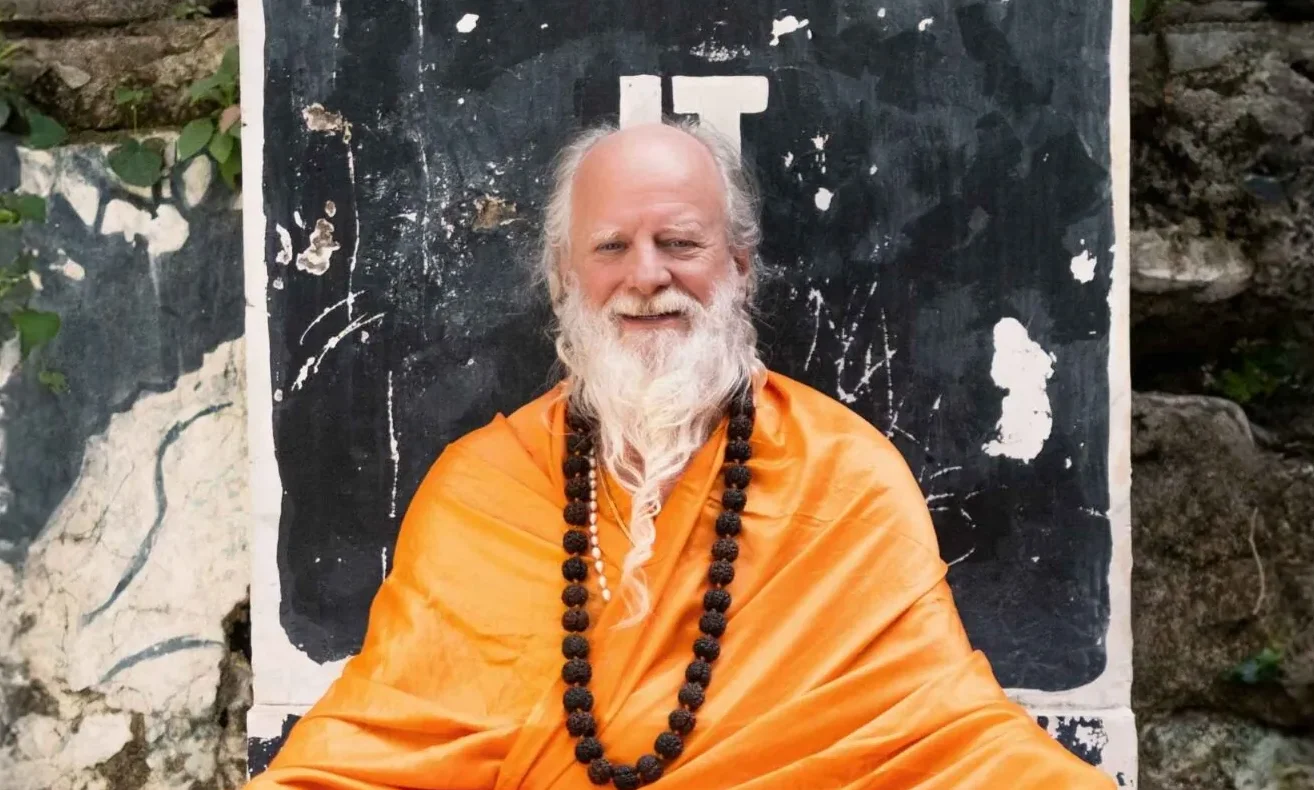
“In order to have a hero, an Avatar, you have to have a villain.”
Thom Knoles
What if the villain is not outside evolution, but part of what gives it shape?
In this first episode of a two-part exploration, Thom uses the characters of Ravana and Rama, from the epic Ramayana, to unpack Vedic mythos, dharma, and the surprising role of the antagonist in the unfoldment of consciousness.
Along the way, he reframes mythology not as fantasy or fallacy, but as a way profound knowledge becomes relatable and alive.
Listen or watch to explore why, in the Vedic worldview, even destructive forces may have a place in the larger movement of evolution.
The second episode of this series is available for you to watch or listen here.
You can also watch this episode on YouTube here: https://youtu.be/3sGz4FP6LTw
Episode Highlights
01.
What Mythos Really Means
(01:58)
02.
Valmiki and the Ramayana
(05:32)
03.
Conditions for an Avatar
(07:54)
04.
Ravana Enters the Story
(10:18)
05.
Ravana’s Origin in Vaikuntha
(13:06)
06.
What Is a Rakshasa?
(16:52)
07.
Dharma and the Flow of Life
(19:12)
08.
Villainy Gives Shape to Heroes
(23:31)
09.
Nothing Is Anti-Evolutionary
(24:59)
Jai Guru Deva
Transcript
Ravana: The Essential Villain Part 1
[00:45] What Mythos Really Means
Thank you for listening to my podcast, The Vedic Worldview. I’m Thom Knoles. In this episode, I’m going to talk about some elements of Vedic mythos. What is mythos?
Those of you who are unfamiliar, I highly recommend you reading any, and in fact I would prefer all, books by an old friend of mine, Joseph Campbell. Professor Joseph Campbell was professor of mythology and literature, mythological literature, at the female university, Sarah Lawrence University on the East Coast of the United States, and held that tenure for decades. He is a writer who also understood and practiced Vedic Meditation, and was someone who had a close relationship with our body of knowledge, and whom I met on several occasions.
So, according to Joseph Campbell, mythos needs to be understood as to its etymological origins. It is related etymologically to the word matris, or matrix. Forget about the movie. Interesting movie, but nothing to do with an actual matrix.
A matrix is best thought of as the narrow neck of an hourglass. Something through which, a birth canal, through which there is flow from whatever has the majority of that which is held, through a narrow neck, into that which needs that which was in the former area. And the idea of matrix is matris, which means mother, and it refers to that birth canal, that narrow neck, say, for example, in an hourglass.
How does knowledge make its way from totality of knowledge through a matrix that relativizes it, makes it relatable, and into the vacuum where knowledge is so much needed? And this is done through the legendary retelling of classical motifs, of sequential elaborations of storyline, that are found, universally found, all over the world in all cultures, even in cultures which attempt to be relatively modern.
So, for example, atheistic cultures also have mythos. And so mythos means the way in which broader knowledge makes its way through a narrow neck into lesser knowledge, where knowledge is more greatly needed, and that birth canal, the matrix, is referred to as mythology, to use the English word.
Mythos does not mean fallacy. So we rank, all those of us who are educated in this subject, when we hear people refer to “urban myths,” it’s not an urban myth that there are alligators in the sewers of New York. It’s an urban fallacy. And so the conflation of the word myth with the word fallacy is, to me, a great travesty of our modern, the modern destruction of the English language. Myth is not fallacious.
Therefore, let’s look at myth as mythos, as legendary retelling of classical, what we would have to call archetypes of human consciousness. And the use of that word would have pleased very much Carl Jung, who, the great psychotherapist, psychoanalyst of the last century, who had for a time been a protégé of Sigmund Freud, but then became a great psychiatrist in his own right, and who created Jungian psychology, all based upon Vedic motifs.
Most people don’t know that Carl Jung was an avid scholar of Vedic knowledge, and most of his concepts, including that of there being standard archetypes embedded in human consciousness, and the ways in which these different archetypes interact, commune, and integrate with each other, was a Vedic concept. So here we are. How do the Indians, the ancient Indians, do it?
[05:32] Valmiki and the Ramayana
Well, one of the great books of knowledge from the more ancient era was written by a Rishi, a seer, great knower of reality, by the name of Valmiki, and Valmiki is attributed as the author of a text called the Ramayana. Ramayana, Ramayana. Westerners very often say “Rama-yanna,” but that’s gross mispronunciation of the name. It’s not “Rama-yanna,” it’s Ramayana.
Rama is the Avatar of the maintenance operator. This is, again, a mythological construct to give us relatability, so that we have something to which to relate. The Vishnu, Vishnu maintenance operator consciousness personified. Vishnu gives birth many times as an Avatar, 10 times in fact, and one of the Avatars, one of the full embodiment expressions of Vishnu, is the form of Rama.
[07:54] Conditions for an Avatar
What is it that causes an Avatar, a divine form, to come to the Earth? Well, first thing that’s needed, things have to be really bad and look really gloomy.
There has to be tyranny, there has to be autocracy, there has to be depletion of resources, there has to be the suffering of the many, and there has to be, as it looks, apocalyptic times ahead. First condition for an Avatar to arrive. Interesting, yes?
Second condition for an Avatar to arrive, a sufficient critical mass of masterful consciousnesses on the Earth who are in the highest possible consciousness state, and who can desire such a being to appear on the Earth to bring about redemption, to bring about a restoration of greatness, and to destroy the destructive power of the destroyers on Earth. Someone who eliminates fear-based administration.
So let’s set the scene. Supposedly 10,000 years ago, and by the way, we’re not going to get hung up on the historicity of this. This is mythological timing, mythological history.
10,000 years ago, there was a kingdom. In that kingdom, there was a king and a queen, and she and he had trouble creating children. So they called upon a great Rishi from the forest to come and perform a special fire ceremony, out of which a beautiful deity came and presented the queen with a kalash, that is to say, a container of nectar, which, if she… and she had two sister queens, that is to say, there were three queens to the one king, if they shared this liquid, that each of them would give birth to a magnificent child, and those magnificent children would be magnificent in exact proportion to how much of the liquid the queen drank.
One of the queens drank the largest portion of it, and she gave birth to Rama, and two of the other queens gave birth to, one of them two, and the other a singular son, who, each of whom had glorious qualities, but weren’t quite as glorious as Rama. Why did Rama get born? Rama was the Avatar of Vishnu, the great maintenance operator. Well, because way off in the kingdom of Sri Lanka there was a demon.
[10:18] Ravana Enters the Story
What’s a demon? Well, we’ll get into that. Someone who has become a master of certain laws of Nature, giving that person the capacity to rule over some natural laws, but who does so by cutting across the interests of others. And so the shared interests of the rest of humanity not being regarded as a critical form and function of life. So the hoarding of power, the hoarding of resources, the hoarding of capability.
And this being who lived on the island of Sri Lanka was known as Ravana, Ravana. Ravana was a magnificent creature. He was born a in a very high-caste family and learned all kinds of yogic powers. These are called siddhis, or extraordinary human capabilities.
One of those was to become a shape shifter. In his most magnificent form, Ravana had 10 heads and 20 arms sprouting from his shoulders, each one of the arms holding a weapon. Weapons for cleaving, weapons for smashing things, weapons for bows and arrows, and divine weapons that went like modern day missiles and whatnot. And he could make himself look handsome and beautiful by his shape-shifting powers, or he could make himself look terrifying, or he could make himself look like a regular person, and he could do so instantaneously and at will.
Nobody in the kingdom where Rama was born knew about Ravana. He was over there in Sri Lanka, gaining power, and he decided to come across from Sri Lanka into India and begin trying to subsume all of that glory of India, the wealth of India, and the rest of it. And so then Ravana appears on the scene and begins creating havoc in one particular section of India, and in so doing he fulfills the first of the criteria. There has to be tyranny, there has to be autocracy, there has to be a hoarding of resources, there has to be suffering by many, there has to be apocalyptic times coming.
And there were great rishis who lived on the Earth, one of them was the master of our tradition, Vasishta. So Vasishta was a great Rishi of our tradition, who also lived at the time of Ravana and Rama. And so now we have the scene set. The Avatar has appeared. Rama is born, he’s a little child, not capable of very much just yet, but showing a lot of promise.
[13:06] Ravana’s Origin in Vaikuntha
Who were these people we’ve already spoken about? Who Rama was. Who was Ravana? Well, Ravana, we have to go back to Vaikuntha. Vaikuntha is the heavenly layer, the loka, which means location, where we get our English word location, comes from the Sanskrit word loka, L-O-K-A. The loka, the layer of celestial creation, the abode of the embodiment of maintenance operation.
That force that maintains whatever it is that continues to be evolutionary is maintained by someone, and that maintainer is named as Vishnu. Vishnu‘s abode, there is ostensibly an enormous palace, and when you appear in Vaikuntha, there’s a gate, of course, there’s a gate to the palace. Standing at the gate are two deities, and these two deities are brothers, and they have to check your ID, and so on, before you can come and see Vishnu.
And one day, there are these Kumaris, who are great Rishis, the four, I think there were four of them, Kumaris who appeared and said, “We wish to see Vishnu, please,” and the gatekeepers said, “Whom shall we say is calling?”
And the four Rishis said, “You know very well who is calling, and because of your impudence, we’re going to now pronounce an imprecation.” What’s an imprecation? It’s an old Victorian word that means a curse. “We’re going to pronounce a curse. The two of you have to now go to the Earth and live lives as demons.”
“Oh no, please don’t do that to us. We don’t wish to do it.” And then he goes, “Well, all right. Well, you’re asking very nicely for some mercy, for us to show some clemency. So we’ll show you the clemency in the following way. You can have a choice. You can either go to the Earth for eight births as regular humans who live lives as meditators and end up gaining enlightenment, and then you come back here.”
“Or you can go to the Earth for three births, and you know, living three births, but you have to live as demons. And if you live as demons, all right, how can we have clemency about that? Let’s think… that you’ll be really bad, bad enough, and critically bad that you will cause Vishnu, your lord, to come to Earth as Avatar. And the first of those Avatars will be named, one of the Avatars, Narasimha. The second of the Avatars will be Rama, and the third of the Avatars will be Krishna. These are the last of the three Avatars of Vishnu.”
So they go, “All right, we’re going to choose, we’re not going to choose the human lives in the eight lifetimes. We’re going to choose, because it’s a shorter time, we’ll choose three lives as demons.” And so these brother gatekeepers instantly vanish out of Vaikuntha and are born onto the Earth in the form of these beings who end up becoming the great demons, and it’s their job to be the worst kind of villains.
If they don’t achieve that, they’re not bad enough, they’re not going to satisfy the criteria for an avatar of Vishnu to arrive. So Ravana comes to the Earth. He has a brother by the name of Kumbhakarna, and Kumbhakarna is an equally great rakshasa.
[16:52] What Is a Rakshasa?
What is a rakshasa? The word raksha means a friend. Rakshasa means a friend who betrays you. Rakshasa is the equivalent in English of someone who just can’t help it. It’s just so bad. They kind of like the fact that they’re really good at being bad. They just can’t help it. They’re just bad, you know, just born that way.
They’re kind of greedy, and they know they’re greedy, and they know there’s not a good thing, but something in them just can’t, just can’t stop themselves from being greedy. And they kind of, it’s like having itches to scratch all the time, they just got to get more and more greedy. And they also have very clever ways of getting power, and you know, it was super powerful, very very powerful. And they can kind of turn a blind eye to other people’s suffering, whose suffering they themselves cause and bring about, and you know, these, these are rakshasas.
Rakshasas can be embodied partially in a human, or they can be completely like celestial beings. In Sanskrit, they’re referred to as Asura. Asura means a means not, sura means angel or a divine creature. They are angels who are fallen angels. They’re considered to have divine characteristics, but they use their divinity to contrast with forces of good.
All right. So, here’s a basic Vedic concept. In order to have a hero, an Avatar, you have to have a villain. No villain, no hero, no Ravana, no Rama. No rakshasa, no great hero to undo the rakshasa. Why do we love our heroes? Because our heroes have the capacity to destroy the destructive power of the villain. No villain, no hero. You see how this is going?
[19:12] Dharma and the Flow of Life
Dharma. Dharma means the process of universal evolution. Individuals also have dharma, your personal role in the evolution of everything. Dharma means you are doing that which is your role for the moment. And nobody’s stuck in any role, by the way. You evolve in every role for the moment. Your role is to be that element that glorifies that which is more evolutionary than you.
So I like to use the analogy of the river. Here comes a mighty river, down out of the mountains, and so on. All rivers at their head waters, headwaters means the source of the river, have to pass through various kinds of mountain pastures, and occasionally they come to mountain ranges. They can’t go over them, they can’t go under them, they’ve got to go around them.
So winding river, and gravity is pulling that river down to sea level, the ocean way, way below, and thousands of miles away, and the river has to make its way there. The river winds and winds, and rivers that wind are beautiful. We love looking at winding rivers. Rivers that don’t wind are boring. That’s what you call a canal. Concrete canal, boring straight line, straight from the top of the mountain right into the ocean. Boring story. Nature doesn’t seem to like boring stories, evidently.
And so, what is it that causes the river to wind and wind, go in S bends, and everything, all the way down to the ocean, where it widens out and unifies with the ocean? Non-river. What’s non-river mean? The banks of the river are non-river. The rocks, the boulders, the mountains, the cliffs, the caves, all the rest of that stuff is the thing that gives shape to that which is flowing.
But hold on for a moment. My geologist friends tell me everything is flowing, absolutely everything. I was shown a cartoon made by a physicist of a glass of water. Inside of the glass, which is made from, as we know, carbon, sand, heated up and becomes transparent, you mold in a particular way, and it turns into a drinking glass. And in that drinking glass you pour some beautiful, perfect spring water, and you go to take your drink, and the beautiful flowing water comes out of the glass, which is non-flowing, and flows into your mouth and hydrates your body. Beautiful.
But in this cartoon that was created, an animation of what is actually the case: 1000 years, here’s the glass with the water in it. 1000 years, the water’s evaporated completely. The glass itself begins to change its shape in the animation. 10,000 years, it changes its shape even more. 20,000, 100,000, 1 million years, 2 million years. The glass is now melting into the table.
And then 10 million years, the glass that held your water has turned into, over a period of time, it became like a liquid, and now it’s spreading out over the entire tabletop. What is the lesson we’re learning here? The things that we think are non-flowing are actually flowing. The non-flowing things also are flowing, but they’re simply flowing more slowly than the flowing things.
So a river flowing through non-river, a river flowing through boulders and landscapes and whatnot, evidently, not flowing places are the things that cause the river to flow. A river can’t be a river without non-river on each side of it, but the non-river stuff is also flowing. It’s just flowing more slowly. You follow? Yes, you do.
[23:31] Villainy Gives Shape to Heroes
What is villainy? So, the villains of the world are those whose evolutionary capability is less than the evolutionary capability of the non-villains. And heroic amongst the non-villains are those non-villains, those heroes who move frictionlessly and freely through the villainy.
The villainy could just be ignorance, or could be active villainy, like an active dam wall that comes up in front of the river, and the river has to go this way, or over the top of it, create a waterfall. Fantastic feature, right? Can’t have a waterfall without an obstacle to the water.
So, in the Vedic view, everything is playing his role, and everything gets to play a role that is satisfactory in the end.
The two brothers, who were destined to become demons and had to be bad enough to bring an Avatar to the Earth, as soon as they had finished their three lifetimes as demons on the Earth, they immediately returned to the gates of heaven and said, “Well, that was a very interesting episode, wasn’t it? Three demonic lifetimes, and look, what we did. We brought Rama to the Earth, we brought Narasimha, another Avatar to the Earth, we brought Krishna to the Earth. It was us that did it,” and they’re there taking credit for it.
[24:59] Nothing Is Anti-Evolutionary
So the next time we decide that something is anti-evolutionary, we have to check ourselves and have a realization that there’s no such thing as anti-evolutionary. There is just that which is evolving currently, currently more quickly than that which is currently evolving less quickly than that, and one of those gives form and rise to the other.
Jai Guru Deva.
